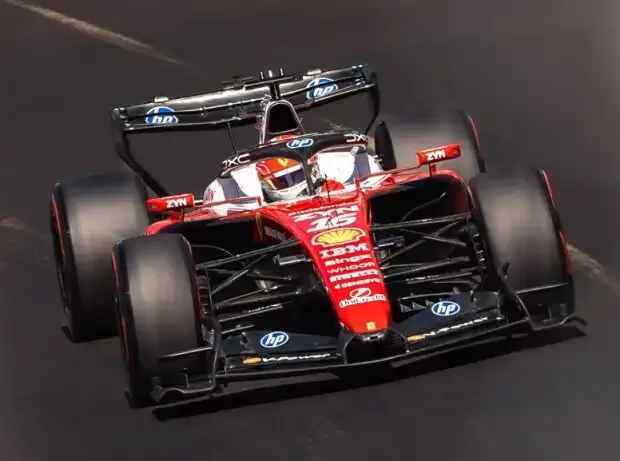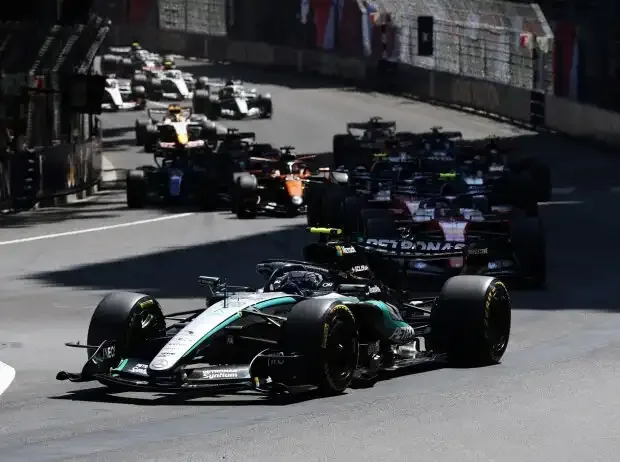





– The new Formula 1 regulations will be changed again starting next year. Just under half of the season was enough for teams, the FIA, and Formula 1 to realize that the current rules need revision.
Read more Mercedes: That sets better drivers apart from good ones
This means that starting next year, the 50:50 split between electric and thermal components, which was supposed to be the core of the new technical cycle, will be abandoned.
Important to note: The formula was not fundamentally wrong, but it lacked the means to sustain itself. Without MGU-H and with a battery whose capacity has essentially remained unchanged compared to the previous year, the FIA had to make compromises when setting the aero package.
It will be the same next year. After less than half the season, some teams have already exceeded the downforce values planned for the end of 2026, which is a sign of how much development can still increase.
Therefore, the FIA has approved some aerodynamic changes for next year to reduce downforce and thus relieve the power unit.
These interventions will be accompanied by measures on the power unit, which will take place in two phases with gradual changes to achieve a 60:40 distribution in favor of the combustion engine by 2028.
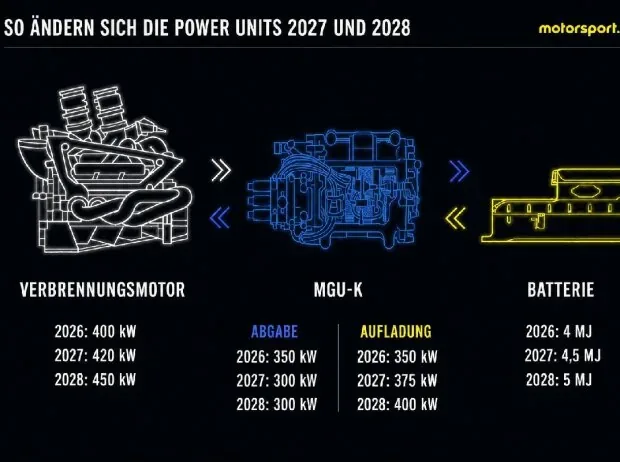
In 2027, the maximum power of the combustion engine will increase to around 420 kW, 20 kW more than today. In 2028, 450 kW is planned. This is made possible by increasing the fuel flow by 13 percent.
But these are not the only changes. The most important innovations concern the electric component. As is known, the power of the MGU-K will decrease from the current 350 kW to 300 kW.
This reduces peak load and distributes energy better over the straights and the lap. At the same time, the maximum recovery power will increase to 375 kW in 2027 and 400 kW in 2028.
With the new rules, battery capacity grows
This means that the electric motor can recover 50 kW more in 2028 than today. Why are these changes so important? Because they are related to further adjustments that the FIA and Formula 1 have not highlighted as clearly but will have a decisive influence on how energy is used over the lap, starting with battery capacity.
If there is currently one point that has not changed compared to the previous technical cycle, it is the battery capacity. Both in the 2025 regulations and those for 2026, the maximum energy storable in the battery pack at any time during a session is 4 MJ.
That does not mean that the batteries could not store more energy on paper. But 4 MJ is the maximum allowed by the FIA.
For the 2026 cars, Formula 1 intended to save weight. So more could have been done with the battery, but the risk would have been to increase weight – exactly the opposite of what is needed to reduce mass.
The batteries in Formula 1 and Formula E, for example, have very different characteristics, and not everything can be transferred from one category to the other because the usage is completely different.
Of course, this also means less stress on the units and less wear. After all, the FIA’s original intention was to allow only two power units per driver for the entire season before increasing to three to give teams a bit more flexibility.
Read more Davide Brivio on 2027: “Maybe the driver will become important again”
Even though the engines have physically changed, it is clear that 350 kW during discharge and charge creates a very high load.
More energy and lower peak loads mean more flexibility
From 2027, this scenario changes. If more energy is recovered, more space is needed to store it; otherwise, increasing the maximum recovery would make little sense. Already next year, battery capacity will increase by 0.5 MJ from 4 to 4.5 MJ. In 2028, it will rise further to 5 MJ.
It is not yet clear whether the FIA will keep the limits for maximum MJ per lap unchanged, as is currently the case, to avoid superclipping or to force teams to ‘lift and coast.’
In any case, a larger battery and an engine with a lower peak consumption value offer the possibility to distribute energy better over the straights and keep electric power active longer.
Photo gallery: The Formula 1 drivers 2027
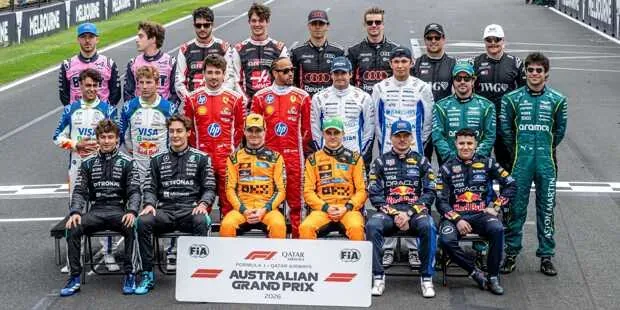
All this should make the engine’s behavior less sensitive to the throttle. With higher peak power, the way the throttle is used from track to track today has a significant impact on the power unit’s behavior. With the new specifications, this dependency is likely to decrease.
There are tracks where, with the current power units, it is more advantageous to approach the corner entry harder and delay opening the throttle, which feels almost unnatural for the drivers.
This uses more energy on the straights and wastes less when accelerating out. On other tracks, this effect is less pronounced.
Some limits change to avoid problems
It is clear that all this is intertwined with the aerodynamic development of the cars. Although the FIA will intervene next year, it is inevitable that teams will continue to increase downforce.
The more downforce there is, the fewer opportunities there are for energy recovery. Therefore, teams need a way to store more energy, which also results in the increase in battery capacity.
What is certain at the moment is that in some situations the charging limits will become more generous. During the installation lap, the allowed recovery value increases to 10 MJ so that a driver does not already reach the limit before the start and then has to start with reduced boost.
The same principle is applied behind the safety car, where this year cars without a ready turbo were seen at restarts because the charging limits were exceeded, and also in the outlap of qualifying, where the preparation phase is currently often characterized by complicated processes to manage battery and turbo before the drivers go out.
However, there is an important point. The FIA has not yet published the curves that define the use of the electric motor depending on speed.
- MotoGPBeirer on KTM future: “The 850 needs extremely strong riders”
- 24h NürburgringInside endurance dispute Nürburgring (1/3): Participants and their goals
- MotoGPMarc Marquez on courage and risk: “The craziest doesn’t win”
- Formula 1Steiner forecast: Will George Russell go to Audi in 2028?
Until this year, the regulations included formulas accessible to all that defined the power of the MGU-K depending on vehicle speed to limit energy consumption. These formulas will remain in place in the future, albeit modified, but will be integrated into a document currently only accessible to the teams.
Read more Norris makes it clear: Piastri duel made me a better driver