


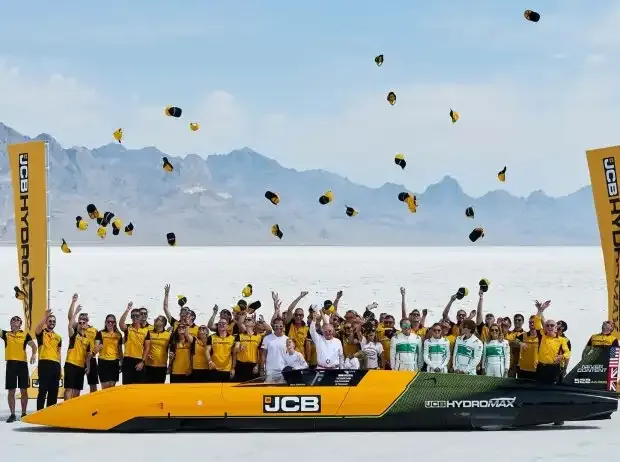
(Motorsport-Total.com/Motor1) – The hydrogen-powered JCB Hydromax has set a provisional world record for land vehicles on the Bonneville Salt Flats in Utah: The British streamliner reached an average of 406.320 mph (653.975 km/h) over the flying kilometer, catapulting hydrogen technology into a new speed dimension.
Read more Aerodynamics Pioneer: Abarth Alfa Romeo 1300 Berlinetta based on Giulietta

Unlike many current hydrogen vehicles, the nearly ten-meter-long Hydromax does not rely on fuel cells but on a hydrogen-powered internal combustion engine. At the wheel of the record vehicle was Wing Commander Andy Green OBE, who already has extensive experience with high-speed runs.
For the FIA-compliant record run, the Hydromax completed two runs in opposite directions within one hour. In the first run, the streamliner averaged 400.623 mph (644.899 km/h), in the second 412.135 mph (663.423 km/h). From both runs, the provisional FIA record of 406.320 mph (653.975 km/h) over the flying kilometer results.
At 406.320 mph (653.975 km/h), the JCB Hydromax significantly surpasses the previously FIA-recognized record for hydrogen-powered internal combustion engines. The previous best of 185.5 mph (298.5 km/h) was set by the BMW H2R back in 2004. The new Hydromax record falls under FIA category A, group XIV, class 7 (“World Flying Record Start Land Speed Record”) and remains provisional until official approval by the FIA.
Two hydrogen engines from construction machinery technology
Propulsion is provided by two series-based hydrogen internal combustion engines from JCB, delivering a combined 1,600 hp (1,193 kW). The units are built at the JCB engine plant in Foston, UK. Technically, according to JCB, they are based on the hydrogen engines the company originally developed for its own construction machinery.
With the record, the Hydromax also surpasses the JCB internal diesel best: The JCB Dieselmax reached 350.092 mph (563.420 km/h) in 2006 on the same salt flat with Andy Green at the wheel. Remarkably, according to JCB, the hydrogen internal combustion engine emits no CO2.
Record run of the JCB Hydromax
Hydromax also sets a new benchmark compared to hydrogen fuel cells. With its speed, it surpasses the previous record for fuel cell vehicles, which was around 303 mph (487.6 km/h). According to the company, JCB is currently the fastest hydrogen-powered vehicle overall.
Read more Would Lewis Hamilton’s planned one-stop strategy have worked?
Reactions from official sources
JCB CEO Anthony Bamford sees the record as a direct continuation of the Dieselmax project. Twenty years ago, JCB demonstrated at Bonneville what British engineering could achieve with a diesel engine. Now this has been achieved again with hydrogen-powered engines.
Pilot Andy Green is also impressed. The record holder, who holds the land speed world record at 763.035 mph (1,228.0 km/h) and is the only person so far to have broken the sound barrier on land, called the run a privilege. Bonneville is the “spiritual home” of the land speed record – and Hydromax has now inscribed itself into this history. Green described the vehicle itself as “stable, strong, and fast.”
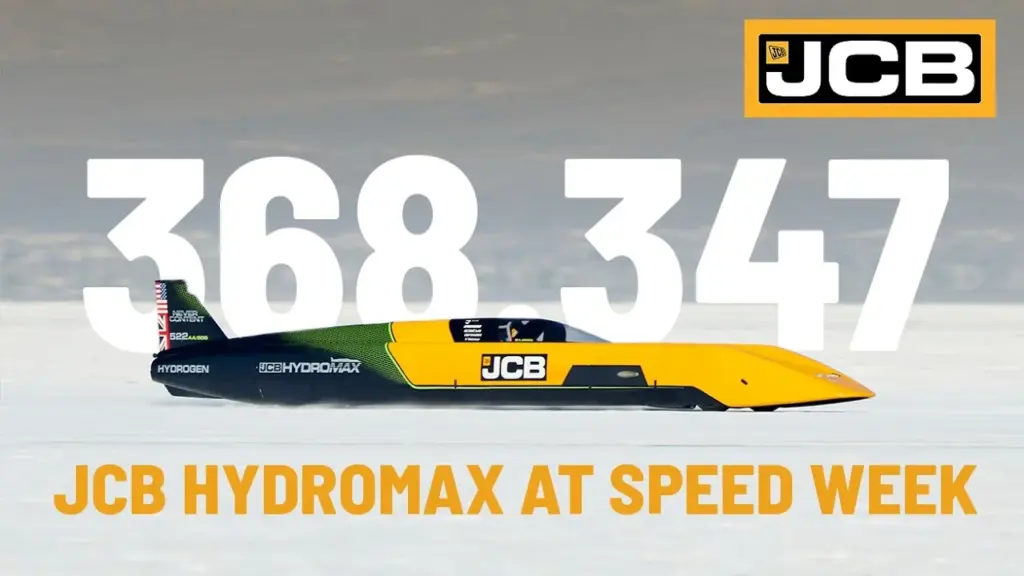
The record attempt was preceded by a successful appearance at the Bonneville Speed Week of the Southern California Timing Association. In the class Blown Gas Streamliner AA/BGS 500-plus cubic inch, Hydromax achieved an average of 368.347 mph (592.7 km/h) there, setting a new SCTA record.
Motor1 says: The run by Hydromax shows that hydrogen combustion can be used for extreme performance demands. What was once a research project is thus becoming a serious path for series-based engines – and a practical data point for OEMs, fleet operators, and vehicle manufacturers when weighing hydrogen, batteries, and fuel cells.
More records from the automotive world
The slowest car ever at the Nürburgring
Lynk & Co 08 with new range world record for plug-in hybrid
Read more Appeal against Monaco result: This is why McLaren is lodging a protest