






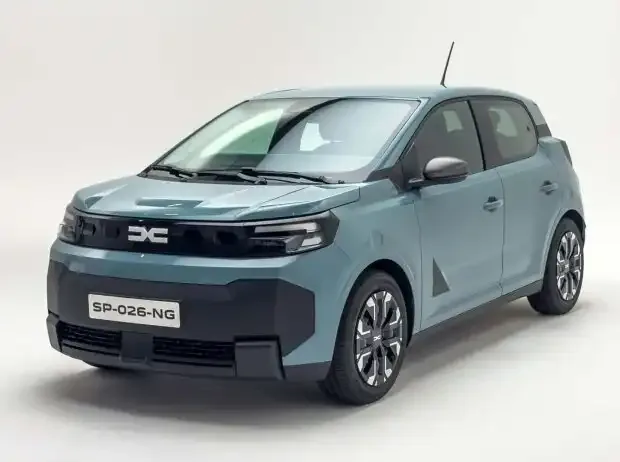
(Motorsport-Total.com/Motor1) – Only the name remains from the previous Dacia Spring. The second generation grows significantly, gets a completely new technical base, and will be built in Europe in the future. It offers 60 kW power, up to 250 kilometers of range, and surprisingly spacious interior. Nevertheless, the new Spring is expected to cost less than 18,000 euros in Germany.
Read more New chapter for Brad Binder: KTM rider switches to BMW in WorldSBK
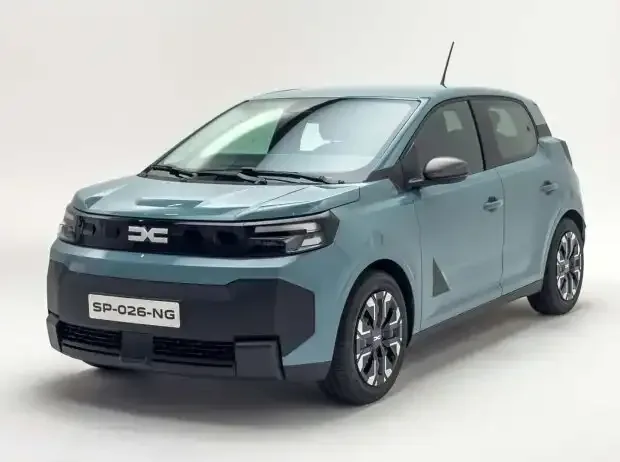
In 2021, Dacia was among the first manufacturers to bring a truly affordable electric car to Europe. Since then, the brand has sold more than 210,000 Springs in over 40 countries. Now, the previously extremely compact electric car becomes a significantly more mature small car. During a first seating test, we were able to take a detailed look at the new Spring.
Dimensions/Design
The new Spring measures 3.85 meters in length and 1.74 meters in width without mirrors. This makes it 15 centimeters longer and a full 18 centimeters wider than its predecessor. While Dacia remains in the A-segment, the Spring clearly moves away from the extremely narrow electric mini of the first generation.
Visually, this suits it well. The short, relatively high hood, more pronounced wheel arches, and the quite vertical front and rear ends give it significantly more presence. Large black areas connect the headlights and taillights, further emphasizing the increased width.
The light signature is based on the Dacia Link logo. Only the upper part is actively illuminated by LEDs, while the lower part, tilted at 45 degrees, reflects their light. The Dacia lettering on the rear is also directly integrated into the black panel. Both reduce the number of required components and thus costs.
Elsewhere, the design also fits the typical Dacia approach. Colored black plastic on the bumpers is intended to make small scratches and scuffs less visible. The glossy black panels at the front and rear have a laser structure to keep them looking neat longer in everyday use.
Photo gallery: Dacia Spring (2027): Seating test and all info about the new electric car
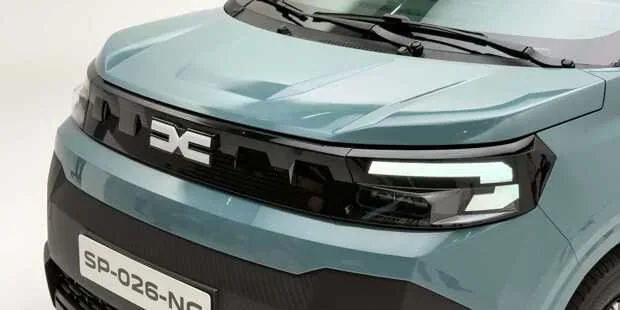
At first glance, the car also shows a certain similarity to the new Renault Twingo. Especially the rear doors and the side window line remind one of the corporate sibling. However, the Spring appears much more angular and straightforward. Those who find the Twingo too cute or playful will likely find it easier to warm up to the Dacia.
This is quite interesting because the relationship goes far beyond design. Spring and Twingo share essential technical foundations. For the second Spring generation, Dacia uses the Renault Group’s RGEV-Small platform for the first time.
This architecture belongs to the same new small car platform family that Renault also uses for the Twingo, Renault 5, and Renault 4. The relationship to the Twingo is especially close, as motor, battery, and several key performance data are almost identical.
Interior/Trunk/Infotainment
The additional 18 centimeters in width are immediately noticeable inside. During our first seating test, it was especially noticeable how comfortable the front seats are. The position is relatively high, and there is significantly more elbow room than in the previous Spring. The car feels much less narrow and cramped inside.
The adjustment options are also better. The driver’s seat can be adjusted longitudinally and in height, and the steering wheel can now also be adjusted in height and depth. This sounds like a given but noticeably contributes to a more mature seating position in the Spring.
Material-wise, Dacia remains consistent. Hard plastic dominates almost everywhere. Some colored accents and the design of the dashboard lighten the overall impression. The Spring does not even attempt to imitate a more expensive car with soft-touch surfaces.
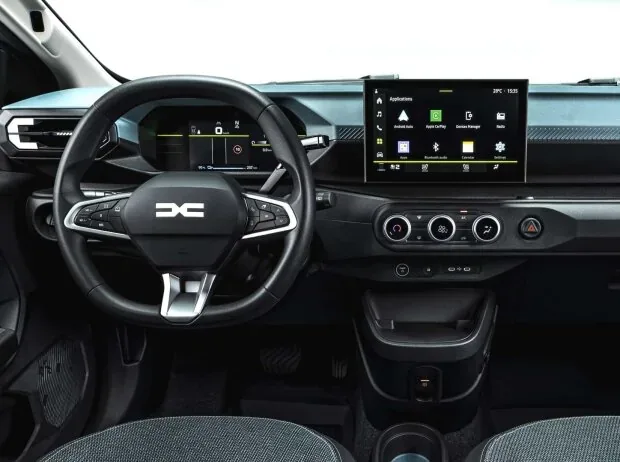
The result still appears solid and quite likeable at first encounter. You can see where savings were made without the interior feeling uninspired. The clearly structured dashboard is especially appealing, and the basic operation also makes a straightforward impression. There really isn’t that much to operate.
Standard equipment includes a digital 7-inch instrument cluster in front of the driver. In the Expression trim, the Media Control system together with the owner’s smartphone handles infotainment tasks. The phone is placed in a holder clearly visible on top of the center console.
The Journey trim gets Media Nav Live with a 10.1-inch touchscreen. Wireless Apple CarPlay and Android Auto are included, as well as connected navigation. Dacia specifies an eight-year service period. Connected services such as charging planning, pre-conditioning, and vehicle tracking are also included.
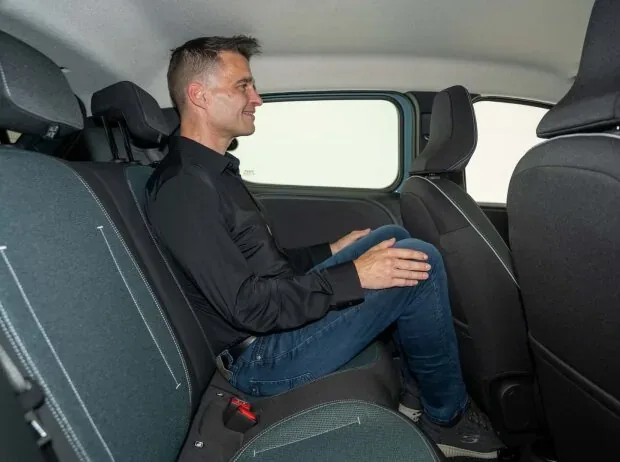
Even more surprising than the cockpit is the rear seat. Even behind my own driver’s seat setting, at 1.87 meters tall, I could still sit comfortably. For a car only 3.85 meters long, this is remarkable.
However, it is not really comfortable for adults back there. The rear bench sits relatively low, while the vehicle floor is raised by the battery. This causes the legs to be noticeably bent. For long holiday trips, this would not be my first choice, but for shorter distances, the rear seat works surprisingly well.
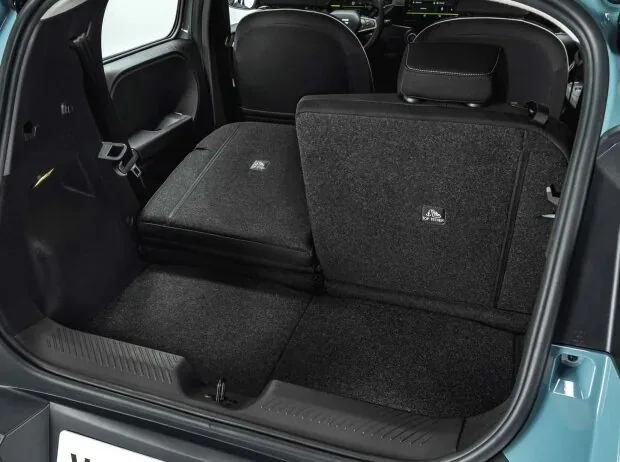
The Spring also gains significantly in trunk space. Dacia specifies 337 liters and calls it the largest luggage compartment in the electric A-segment. With the 50:50 split rear seat folded down, this increases to a maximum of 1,283 liters. According to the manufacturer, some models from the next higher segment offer less.
The two-part loading floor is well designed. The two elements can be removed separately to divide the trunk or store items underneath. This way, for example, you can access the charging cable without having to empty the entire trunk first.
Additionally, the Spring can again be equipped with a frunk. The storage space under the front hood holds 18 liters and is also suitable for cables or smaller items. Unlike the actual trunk, the frunk is not part of the standard equipment.
Inside, Dacia also distributes several YouClip attachment points. Accessories such as cup holders, bags, lamps, or cable holders can be hung there. Up to three mounts are standard, and additional points can be added via accessories.
Drive/Battery
Technically, the new Spring is a complete departure from its predecessor. Dacia explicitly states that nothing was carried over except the name. The basis is the Renault Group’s RGEV-Small platform, developed for small electric cars.
Particularly interesting is the closeness to the Renault Twingo E-Tech Electric. Both cars have an electric motor with 60 kW and an LFP battery with 27.5 kWh usable capacity. There are also extensive similarities in charging.
The Spring motor develops 175 Nm and accelerates the car from 0 to 100 km/h in 12.1 seconds. The top speed is 130 km/h. Thus, the Dacia is not a highway sprinter, but for the intended city and commuter use, the performance data are significantly more convincing than in the early Spring versions.
| Technical data | Dacia Spring |
| Drive | Front motor; 60 kW; 175 Nm |
| 0-100 km/h / Vmax | 12.1 s / 130 km/h |
| Battery | 27.5 kWh usable; LFP |
| WLTP consumption | 12.7 kWh/100 km |
| WLTP range | up to 250 km |
| max. AC charging power standard | 6.6 kW |
| max. AC charging power optional | 11 kW |
| max. DC charging power optional | 50 kW |
| Charging 15-80 % AC 6.6 kW | 2:55 h at 7-kW wallbox |
| Charging 15-80 % AC 11 kW | 1:55 h |
| Charging 15-80 % DC 50 kW | 28 min |
| Weight | from 1,212 kg |
| Length / Width | 3.85 / 1.74 m |
| Trunk | 337 to 1,283 liters |
| Frunk | 18 liters, optional |
Above all, the low weight helps. Dacia specifies a value from 1,212 kilograms. For an electric car, this is very light. Accordingly, consumption is also low. The combined WLTP cycle shows 12.7 kWh/100 km in the data sheet.
Read more Williams strategy: Why Albon and Sainz have no set-up secrets
The usable battery capacity is 27.5 kWh. Like Renault with the Twingo, Dacia uses lithium iron phosphate cells. The LFP chemistry omits nickel and cobalt, among other things, and fits well with the cost-oriented concept of the Spring.
With one charge, up to 250 kilometers according to WLTP should be possible. The value is not huge but fits quite precisely with what existing Spring drivers actually do with their cars. According to Dacia, they cover an average of only 34 kilometers per day.
According to the manufacturer, 93 percent of private Spring customers are first-time electric car owners. 79 percent switched from another brand to Dacia. On average, they drive four individual trips per day at an average speed of 34 km/h. 75 percent charge at home.
Dacia remains pragmatic with charging as well. The Spring comes standard with a 6.6-kW AC charger. Charging from 15 to 80 percent takes nine hours at a normal household socket. At a reinforced socket, the time drops to 5:40 hours, and at a 7-kW wallbox to 2:55 hours.
Optionally, there is a charging package with 11 kW AC and a 50-kW DC connection. At a three-phase wallbox, charging from 15 to 80 percent then takes 1:55 hours. At a fast charger, the Spring needs 28 minutes for the same charging range.
50 kW may not seem particularly impressive in 2026 at first glance. However, with a battery of only 27.5 kWh capacity, the number is relativized. More charging power would only save limited additional time for a car with this usage profile and such a small battery.
Another function of the optional Charge Pack is Vehicle-to-Load. This allows the Spring to use its traction battery as a power source for external devices. Dacia mentions e-bike batteries, flashlights, or a coffee machine as examples.
It is also interesting how technically close the Spring is to the new Twingo. Renault also offers its small car in Germany with 60 kW and a 27.5-kWh LFP battery. There, the WLTP range is up to 262 kilometers. The Twingo currently starts at 19,990 euros.
This results in a fairly clear division of tasks within the group. Renault deliberately makes the Twingo a more emotional and playful city car with more elaborate infotainment and additional interior ideas. Dacia reduces the same technical basics more towards space, simple operation, and the lowest possible price.
Renault also took new paths in development itself. According to Dacia, the Spring is the first model of the brand to benefit from new group-wide development processes. The development time is said to have dropped to less than two years. At the same time, development costs could be reduced.
The Spring will no longer be built in China but in the Slovenian Renault plant Novo Mesto. This means the car is produced in Europe for the first time. In this context, Dacia also points out that the Spring thus meets the requirements for funding programs where European production is relevant.
Prices/Equipment
The model range remains clear. There are only two trim levels called Expression and Journey. Both use the same 60-kW drive, the same 27.5-kWh battery, and the standard 6.6-kW AC charger.
The Expression includes, among other things, 15-inch Mura steel wheels with wheel covers, air conditioning, front electric windows, electrically adjustable exterior mirrors, automatic headlights, rear parking sensors, electric parking brake, the digital 7-inch instrument cluster, and Media Control with USB-C.
The height-adjustable driver’s seat, the 50:50 split rear seat, the modular trunk floor, and three YouClip attachment points are also standard.
Journey adds 16-inch Drava steel wheels with wheel covers, keyless entry, a rearview camera, and Media Nav Live with a 10.1-inch touchscreen. Navigation, connected services, two USB-C ports, and fabric and artificial leather upholstery are also included.
Official German prices are not yet available. Dacia has only announced for Germany that the entry price should remain below 18,000 euros. This means the new Spring will likely be somewhat more expensive than its predecessor, which last started at 16,900 euros.
Italy provides a guideline. There, the Spring Expression costs 17,900 euros, and Dacia charges 19,500 euros for the Journey. However, these amounts cannot be directly transferred to the German market.
| Version | Italy | Germany |
| Spring Expression | 17,900 euros | announced below 18,000 euros |
| Spring Journey | 19,500 euros | not yet known |
The comparison with the Twingo is particularly exciting. The Renault starts in Germany at 19,990 euros and also uses a 60-kW motor and a 27.5-kWh LFP battery. If the Spring actually stays just under 18,000 euros, there would be about 2,000 euros difference between the two technically closely related small cars.
Of course, Renault offers more in some areas for this surcharge. For example, even the base Twingo has a central 10-inch screen and individually sliding rear seats. For the Dacia, the focus is more on the most affordable access to electromobility.
With the generational change, the role of the Spring also changes. The previous car had a special position solely due to its tiny dimensions. The new one is still compact at 3.85 meters long but now a fairly grown small car.
This brings significantly more space and a more mature sense of room, while the Spring must compete more strongly with other affordable electric cars. Its strongest arguments remain the low price, low weight, and surprisingly good space utilization.
This combination could be particularly interesting for commercial users. Care services and other businesses with many short city trips rarely need huge batteries or particularly high charging power. A small battery, low consumption, four doors, lots of trunk space, and up to 250 kilometers of range fit quite well with such usage profiles.
Whether the Spring has improved as much in driving as in space and technology must be shown by a first test drive. The seating test already makes it clear that Dacia has moved far away from the original concept of the narrow electric mini. The Spring has become more mature and technically closer to its much more fashionable Renault sibling than ever before.
More from Dacia:
Dacia “Evader” as a prototype: Electric newcomer under 18,000 euros
Dacia Hipster Concept: New budget car with electric drive as a study
Read more Experts: World Championship train for George Russell to Monza probably gone