







(Motorsport-Total.com/Motor1) – With the first Audi A2, the audience was a bit alienated during its lifetime, but it can now undoubtedly be counted among the icons of the brand with the four rings. Almost 21 years after the end of the aluminum fuel-saving marvel, Audi is giving the idea of the distinguished, very technical compact car a new chance.
Read more This is what Max Verstappen thinks about the new Formula 1 track in Madrid
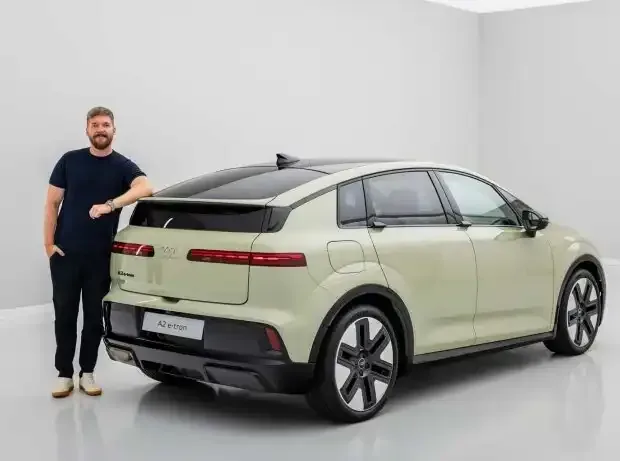
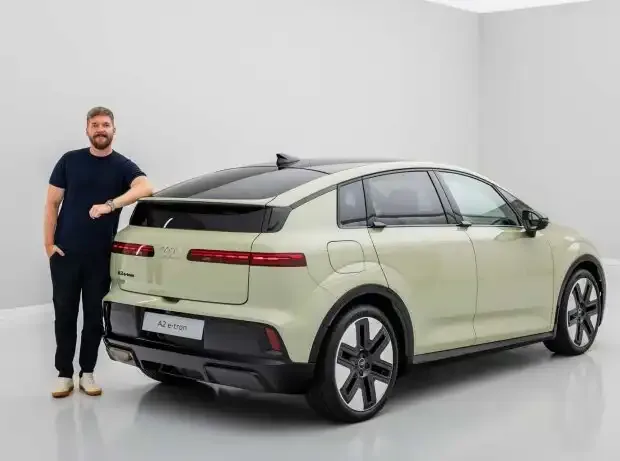
The name is known, but the concept behind it is new: The Neo-A2 with the e-tron addition will be launched at the end of 2026 as a fully electric compact car. The model will be built in Ingolstadt and is intended to form the entry into the electric Audi world in the future. During a first seating test in the photo studio, we were already able to take a close look at the vehicle and talk to those responsible about technology and development.
Dimensions/Design
With a length of 4.32 meters, the A2 e-tron moves in the classic compact segment. Although it shares much technically with the Volkswagen ID.3 Neo and the Cupra Born, this is not visible. However, it benefits from their rather generous wheelbase. At 2,764 mm, it corresponds to that of the larger Audi Q4 e-tron. Despite the significantly shorter body, this creates comparatively a lot of space in the interior. We will come to that shortly.
Audi also pursues a clear efficiency approach in aerodynamics. The A2 e-tron achieves a drag coefficient of 0.24 in the most economical configuration. Among other things, air curtains at the front of the vehicle, so-called gap reducers at the wheel arches, and an active cooling air intake were developed. The latter remains closed during normal driving and only opens when cooling is needed – for example, during charging, high power output, or high outside temperatures. The underbody is also completely flat.
According to Audi, the aerodynamic measures can reduce the WLTP consumption of the 140-kW model with the efficiency package by up to 0.9 kWh to 12.8 kWh/100 km. The package is actually only available for the 140-kW variant and includes the sleeker S-Line exterior package, the sports suspension, and special 19-inch aero wheels with lower rolling resistance tires. In general, the A2 is available on 18 to 20-inch wheels.
What must not be missing on an Audi? Right, light signatures. The new A2 has four in total, one of which is actively digital with a motion effect. At the rear, there is active turn signal lighting.
One more word about the door handles: As you can see, you see completely smooth doors and – like on the new BMW X5 – small handle satellites on top. They operate electrically and have a second level of protection in case the onboard electronics fail in the event of damage. At least the operation is easy. For those who need it…
Photo series: This is the Audi A2 e-tron (2027)
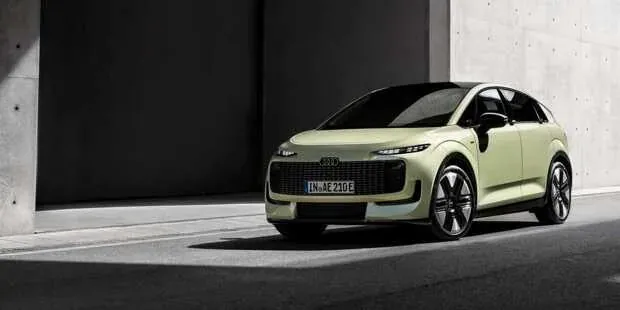
Also interesting for everyday use is the towing capacity: All power levels should be able to tow up to 1,600 kg. According to Audi, this explicitly applies to the entry-level model as well.
Our first impression regarding the appearance: The distinction from the group siblings as well as the homage to the original A2 have succeeded. Especially the rear with the angular, spoilered finish in the style of the predecessor and the stylish taillights (am I the only one who recognizes a hint of Honda Integra Type R here?) is appealing. Various design details and the finish appear exceptionally high-quality and distinguish the A2 e-tron from many (Chinese) competitors. Which is also urgently needed given the prices. More on that shortly.
Interior/Trunk/Infotainment
For infotainment, Audi relies on the now familiar panoramic display with 11.9-inch instruments and 12.8-inch infotainment. An optional augmented reality head-up display projects speed, navigation instructions, and media data into the field of view.
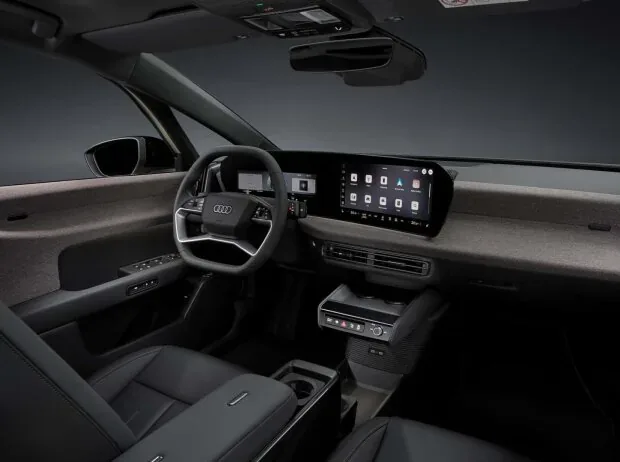
Climate control is operated via the central screen; at least sensible features have been integrated into the steering wheel, which impresses with decent buttons and rollers. And for those who like to talk to their car: AI models in the cloud complement natural voice interaction. That there is also a route planner with charging stops should no longer surprise anyone.
As one of the first car manufacturers, Audi brings the advantages of the Fidlock system into one of its vehicles. Fidlock combines strong magnets with a mechanical locking mechanism: Items such as cup holders, charging cable bags, or a tension strap for the trunk can thus be attached very easily and positioned flexibly. A useful innovation.
Three modular Fidlock adapters in the center console and a matching cup holder are part of the standard equipment. The center console also offers many storage compartments – open ones for a handbag or closed ones in a storage compartment under the center armrest.
Thanks to the standardized system, all compatible Fidlock products – for example from the bicycle or outdoor sector – can also be used in the vehicle. Optionally (for whatever reason), there are three more Fidlock points in the trunk: two in the left trunk side panel, one in the right trunk side panel. According to Audi, the system will be expanded over time.
Another interesting new topic is the optional Audi Connected Work. The system can be connected to a Microsoft 365 Business account and can, for example, summarize appointments for the day, read emails aloud, or bring a Teams call to the screen.
Wireless smartphone charging is standard. The gear selector lever moves to the steering column in the A2 e-tron, creating space for two charging trays that fix the phones magnetically and charge with up to 25 watts. PET bottles up to 1.25 liters fit in the front doors, and 1.5-liter bottles fit in the center console. Overall, Audi boasts storage space for up to four liters of beverages.
Regarding space, Ingolstadt deliberately does not position the A2 e-tron as a classic small car. Rather, it is described as a vehicle that should also work as a first car in a family (range and towing capacity are also mentioned here). Not without reason, as the first seating test shows. The feeling of space in the front feels mature; in the rear, I would even suggest a certain generosity, even when my person (1.85 meters) takes a seat behind the own driver’s seat setting. The headroom also has enough breathing space, even with the optional 1.6 sqm glass roof.
One compartment further back, it does not look worse – the trunk volume is 396 to 1,336 liters. Audi emphasizes usability: Three large suitcases can be accommodated with the loading floor lowered. They had some with them at the appointment – they fit. In addition, there is a frunk with a rather laughable 13 liters of volume – but enough for a charging cable or (small) dirty items.
As recently with the facelift of the Q4 e-tron and the new Q7, one also has the impression with the A2 e-tron that the Ingolstadt team has taken the sometimes sharp criticism of the interior quality to heart. The material quality here does not make a luxurious impression but is more than acceptable. The so-called “Soft Wrap,” i.e., the fabric cover that extends from the cockpit to the rear doors, is pleasing. In addition, very soft plastic is now used extensively – even in the lower areas of the inner door.
Drivetrains/Batteries
Technically, the A2 e-tron is based on a variant of the Volkswagen Group’s MEB 31 modular system, i.e., the platform that unsurprisingly is also used by the ID.3 Neo and the Cupra Born. When asked about what is going on with MEB and MEB Plus or the differences therein, product manager Herman Verbeek reacted almost sardonically.
Read more No rushed comebacks: Paradigm shift in MotoGP?
That is a term that has become established in the press but officially does not exist. There is the mentioned platform as variant 2 for Audi Q4 e-tron, VW ID.4, and others, and then there is variant 1, which the new A2 e-tron uses. The soon-to-be-released VW ID.Polo and Cupra Raval will use MEB 21, the smaller version of the modular system with front-wheel drive. Just to clarify that once and for all.
While the larger cars of the MEB 31 (Q4 e-tron, etc.) are also available with all-wheel drive, this is not planned for platform variant 1. In other words, there will be no A2 e-tron with electric Quattro drive. According to the developers, the all-wheel drive topic was extensively examined. However, the expected quantities for a corresponding variant in the compact segment would be too low to justify the additional development.
At launch, four power levels are planned: 125, 140, 170, and 240 kW, corresponding to 170, 190, 231, and 326 hp. All versions use a rear motor. The strongest variant is said to accelerate from 0 to 100 km/h in 5.7 seconds and reach up to 200 km/h. A derivative with even more power is in preparation. So expect an S2 e-tron, which could then possibly go towards 280 to 300 kW.
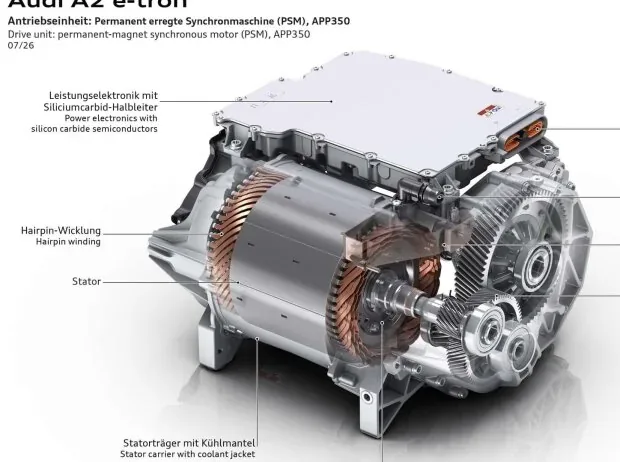
For propulsion, Audi relies on further developed variants of the well-known APP350 and APP550 machines. The power electronics work with silicon carbide semiconductors, which should minimize friction losses. There are four recuperation levels, one of which is supposed to enable one-pedal driving.
It gets a bit complicated with the batteries. There are three battery sizes with 52, 61, and 84 kWh. For the two smaller batteries, Audi uses lithium iron phosphate cells (LFP), promising a robust, aging-stable chemistry. They are constructed in cell-to-pack design. The nickel-manganese-cobalt battery (NMC) with 84 kWh is based on a module design and is reserved for the variants with 170 and 240 kW power.
The range increases depending on the combination of motor, battery, and equipment to up to 646 km according to WLTP. The mentioned 140-kW version with efficiency package achieves the lowest WLTP consumption at 12.8 kWh/100 km.
The fast charging also differs between the variants. According to Audi, the two more powerful models with 84-kWh battery can charge with up to 183 kW DC. About 29 minutes are stated for 10 to 80 percent. The 140-kW version manages up to 105 kW. The base version reaches up to 100 kW.
When asked about the somewhat modest maximum charging power of 100 or 105 kW in the weaker A2 versions, Audi counters that the LFP battery can absorb high charging power over a relatively wide state-of-charge range due to its cell chemistry.
To keep track, the following very clever table is recommended:
| Technical data | A2 e-tron 125 kW | A2 e-tron 140 kW | A2 e-tron 170 kW | A2 e-tron 240 kW |
| Drive | Rear motor; 125 kW; 350 Nm | Rear motor; 149 kW; 350 Nm | Rear motor; 170 kW 350 Nm | Rear motor; 240 kW; 545 Nm |
| 0-100 km/h / Vmax | 8.8 s / 160 km/h | 7.9 s / 160 km/h | 7.0 s / 160 km/h | 5.7 s / 200 km/h |
| Battery net/gross | 50 / 52 kWh | 58 / 61 kWh | 79 / 84 kWh | 79 / 84 kWh |
| WLTP consumption | 13.7 kWh | 12.8 kWh | 13.9 kWh | 14.2 kWh |
| WLTP range | 423 km | 515 km | 646 km | 630 km |
| max. charging power AC/DC | 11 / 100 kW | 11 / 105 kW | 11 / 183 kW | 11 / 183 kW |
| DC charging 10-80 % | 24 min | 26 min | 29 min | 29 min |
| Weight | 1,840 kg | 1,840 kg | 1,910 kg | 1,930 kg |
In addition, there is bidirectional charging. Vehicle-to-Load (V2L) allows external devices to be powered via a 230-volt socket in the trunk or an adapter at the charging port with up to 3.6 kW. The A2 e-tron can thus operate tools, an electric grill, or other devices.
Vehicle-to-Home (V2H) also makes the vehicle an energy storage for the house. However, a compatible DC wallbox is required for this. At launch, V2H is initially to be available in Germany, Austria, and Switzerland.
In terms of chassis tuning, Audi wants to create its own, more dynamic character despite the technical proximity to other MEB models. Steering and damper tuning were specifically adapted. A progressive steering system is available depending on the equipment. Thanks to the rear-wheel drive, the turning circle is just over 10 meters.
Prices/Equipment
The Audi A2 e-tron can be ordered from autumn 2026, with deliveries starting in December. The entry price in Germany is 38,200 euros. A comparable ID.3 Neo is available from 33,995 euros.
However, the standard equipment for the entry-level model is comparatively extensive. Among other things, the large curved display, navigation, rearview camera, Level 2 assistance functions, wireless smartphone charging, and bidirectional charging functions are standard. In addition, there are three equipment packages: Tech, Tech Plus, and Tech Pro. Annoying in this price segment: The heat pump costs extra.
The 61-kWh variant is available from 41,900 euros. In the version with 170 kW and an 84-kWh battery, the A2 e-tron costs 48,900 euros. The top model A2 e-tron 240 kW is available for 51,200 euros.
More from the Audi cosmos
Audi RS Q6 e-tron: Prototype with significant differences to the SQ6
Audi Q4 e-tron (2026) with new cockpit and new APP350 motor
In summary
Technically, the new Audi A2 e-tron is a polished and maximally efficient VW ID.3 Neo. It could be much worse. However, the designers have managed to give it a very own character and actually surprisingly much charisma. The first impression is promising, also regarding quality and thoughtfulness in the interior.
Let’s hope it will have a better fate than its predecessor and will not be truly appreciated only 15-20 years after production ends. Price-wise, it is certainly ambitious. We look forward to the first test drive.
Read more Rare Collector’s Opportunity: Ferrari 250 GT Cabriolet from 1958 before Million-Dollar Auction