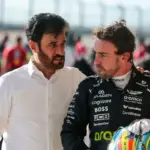



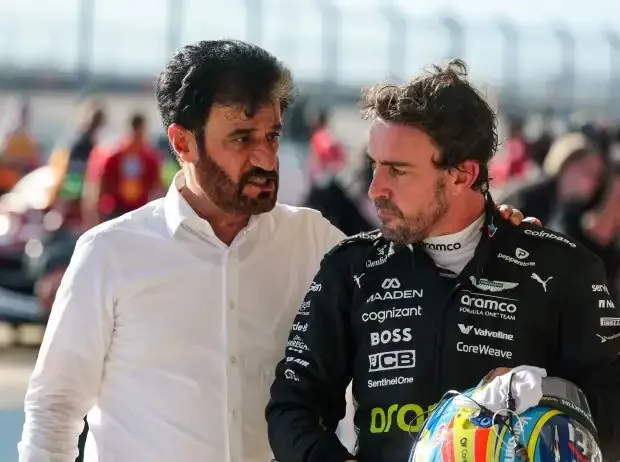
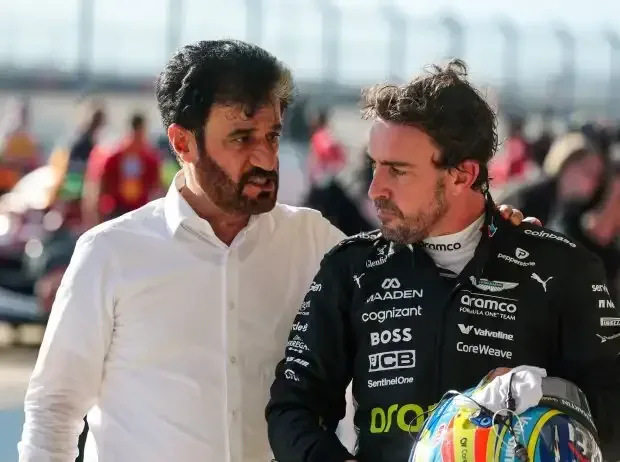
– In his attempt to remain competitive in Formula 1, two-time world champion Fernando Alonso is now receiving support from the highest level. Ahead of the Spanish Grand Prix in Madrid, both Alonso and Aston Martin team owner Lawrence Stroll held talks with FIA President Mohammed bin Sulayem about the current plight of the partnership between Aston Martin and Honda, which has had a catastrophic start with a non-competitive package.
Read more MotoGP Training Spielberg 2026: Pedro Acosta P1, Alex Marquez causes red flag
The timing of the team’s collapse could hardly be worse. Alonso, who has not hidden his disappointment with the new engine regulations, has just turned 45 and is desperately longing for another period of success in the final phase of his career – after having played only a supporting role for years.
The Spaniard has at least not yet publicly confirmed his plans for 2027. And FIA President bin Sulayem seems concerned about the prospect that Formula 1 could lose one of its still active world champions: “We absolutely cannot allow Fernando Alonso, a great champion, to quit just because of the circumstances,” he says. “That’s not how you should leave the stage. He must be successful and then leave whenever he wants – and not because he was forced to quit due to performance.”
“I will talk to him. I saw that he was very sad, and I said: ‘Fernando, I understand that. It is not acceptable that you come to your own country and now as a two-time world champion…'”
Bin Sulayem then hints that he wants to do everything in his power to help Alonso get a more competitive package: “We already did something in May, legally for the team regarding the engine, so that it can improve. And then I told him: ‘I will not tell you what we will do. Please tell me what you want, because you are the driver. Come to me and tell me what we should do to improve these results.'”
Sulayem’s statements fit a familiar pattern
Bin Sulayem’s statements caused alarm in some circles. After all, it would not be the first time that the president had difficulty limiting himself to his own area of responsibility.
During his term, bin Sulayem was accused of gradually weakening the control mechanisms within the FIA. And especially on topics related to Formula 1, he stood out at the beginning of his term by venturing into areas that either did not fall under his jurisdiction at all or were subject to certain regulatory structures requiring majority decisions.
However, this does not seem to be the case here. The president is well aware that any changes in the area of power units are regulated by the so-called “FIA F1 Power Unit Governance Agreement.” That he publicly expresses his concern about Alonso’s future is therefore apparently part of a larger discussion about the not quite mature ADUO system.
That bin Sulayem made these statements on a stage in Madrid was probably no coincidence either. The Emirati is no stranger to tailoring his message to his audience. Recently, he visited the American FIA Congress in Buenos Aires and promised his support for efforts to bring Formula 1 back to Argentina – even though this area is entirely controlled by Formula 1 management and not the FIA.
Now bin Sulayem has also scored an easy point in Spain. And that, even though cynics suspect Alonso has long since decided to continue in 2027 and is merely playing with the media and his fans.
Honda’s problems part of a larger ADUO debate
Behind all this lies a bigger problem: the FIA’s ADUO system – the abbreviation stands for “Additional Development and Upgrade Opportunities” – is by nature not perfect.
Originally, it was intended as assistance for newcomers Red Bull-Ford and Audi and was meant to prevent a repeat of Honda’s 2015 debacle: a manufacturer falls so far behind the competition that there is practically no prospect of catching up. This harms the entire Formula 1 and could ultimately even prompt the brand in question to withdraw from the series.
Ironically, it is now Honda itself that relies on this system again, while both Red Bull and Audi have made remarkable debuts as Formula 1 engine manufacturers.
But instead of merely helping those manufacturers who have completely lost touch, the system soon became a political issue. For every two percent deficit, a manufacturer receives additional development opportunities on a sliding scale – in the form of extra dyno time, more leeway under the budget cap, and tokens with which new power units can be introduced during the season.
Only the performance of the V6 combustion engine is taken into account, while the entire power unit may be further developed using homologation tokens. This theoretically means that manufacturers could deliberately hold back the performance of their V6 to keep their development tokens. At the same time, the manufacturer with the strongest combustion engine can be excluded from further development opportunities.
Read more Elfyn Evans before WRC finale: «I know how not to do it»
In practice, this is exactly what happened to Red Bull-Ford. There is great anger there about the FIA’s measurement methods and how they were apparently outmaneuvered by the competition. Even Red Bull CEO Oliver Mintzlaff has personally engaged in his team’s discussions with the FIA.
Mercedes, on the other hand, is generally considered to have the best overall package in the power unit but still qualifies for support through ADUO due to the FIA’s V6 measurements.
That only the V6 performance serves as the basis of the ADUO system was a demand of the manufacturers and was decided by the involved parties by majority. The FIA itself would have been willing to consider other factors.
But the noise and controversies surrounding the system now tie up FIA resources that could otherwise be used to further develop the regulations themselves and work on a return to V8 engines for the next regulatory cycle.
Therefore, the world motor sport federation is open to revising the system during the upcoming winter break within the existing regulatory structures. Additional measures to support Honda could be part of these discussions.
Does Honda even deserve more help?
A central question, however, is whether Honda should actually receive further opportunities for improvement – or whether the Japanese manufacturer has now been helped enough and it is up to them to solve the task.
As bin Sulayem points out, Honda already received additional support in May. This includes an additional financial leeway of a total of 19 million US dollars over the next two years: eleven million due to a deficit of more than ten percent and another eight million that Honda can advance against its own budget cap for future seasons. In addition, Honda was granted 230 dyno hours, after previously having 190.
However, if one recalls the original goal of ADUO – namely to prevent a manufacturer from falling hopelessly behind and possibly withdrawing from Formula 1 as a result – then bin Sulayem’s proposal to consider further aid for Honda meets with approval from several competitors.
Asked about bin Sulayem’s statements on Honda, Mercedes team boss Toto Wolff is open to a renewed review of the regulations: “I think ADUO was designed as a catch-up mechanism, and this opportunity was unlocked for Honda. And they need more,” he says.
“I think the conversation the president had with Alonso is perfectly fine. We want to have all these top manufacturers in the sport. We want them to be competitive and successful. Rules are rules and should serve the good of the sport. But sometimes they may need to be adjusted.”
How the other manufacturers currently stand on this is not yet fully clear. Red Bull, based on their own experiences this year, naturally also has an interest in adjusting the ADUO system: “As stakeholders of this sport, we usually find solutions when there is a situation that needs to be corrected or support is needed,” says Red Bull team boss Laurent Mekies.
“I am sure that at some point we will sit down and talk about the future of the ADUO regulations. We know some of the weaknesses, and I am sure there are still some other points we need to address.”
After all, ADUO is neither a cure-all nor a balance of performance. Honda still has to work its way back to competitiveness itself. That is an enormously complex and costly task. And there is a reason why Honda has only used one of its two ADUO tokens this year: most of the resources are instead flowing into a new power unit for 2027.
- MotoGPMotoGP live ticker Spielberg: Acosta dominates Friday practice
- MotoGPMotoGP Training Spielberg 2026: Pedro Acosta P1, Alex Marquez causes red flag
- Formula 1Why Kimi Antonelli deliberately slowed down before the VSC
- Formula 1Antonelli can take a special record from Vettel – his reaction surprises
Regardless of what will be agreed upon next winter, Aston Martin and Honda still have a long way to go back to the top. For Fernando Alonso, however, this path could be too long.
Read more F1 drivers in unfamiliar cars: The stories behind rare test photos