







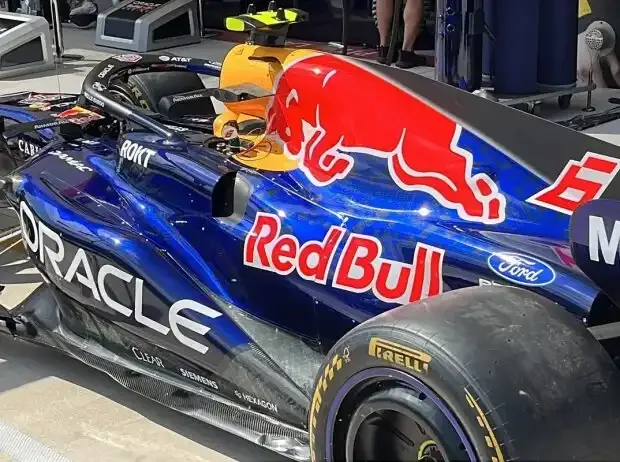
– Red Bull’s own interpretation of the “Macarena wing” probably attracted most of the attention in connection with the team’s extensive update package for the Miami Grand Prix last weekend.
Read more If there is no replacement: Espargaro absence exposes weakness
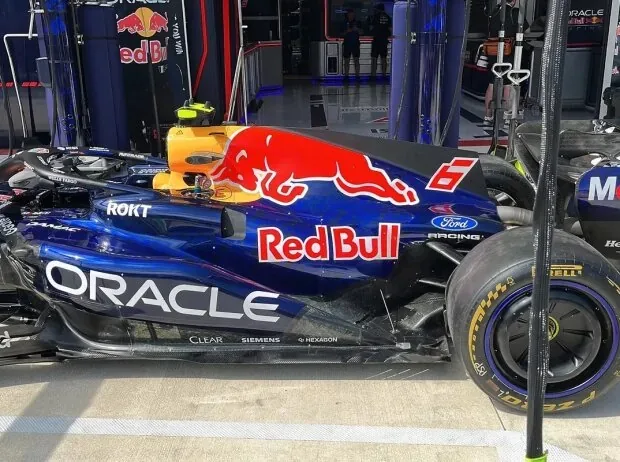
But the bodywork of the RB22 was also significantly revised, with the reintroduction of the “water slide” on the sidepod, which was used by several teams under the previous regulations.
To implement this, the outer edge of the sidepods sits exactly at the edge of the prescribed reference volumes that limit the bodywork, which widens the recessed channel on the top side.
This innovation works together with the team’s also new floor as well as an updated version of the inlets on the sidepods, which were already introduced in Japan.
F1 Technical Analysis: Explaining the Miami Updates
Internally, the flow around the radiators changes – especially since the previous sidepods were narrower and the radiators are now likely positioned further away from the vehicle center.
The trailing edge of the sidepods, which ends in a sharp point and merges with the floor, tapers only slightly towards the vehicle centerline to comply with the allowed dimensions.
Teams test different solutions
Red Bull’s updates have attracted attention from some teams. McLaren team principal Andrea Stella, for example, hinted that his team might consider a similar design.
“I think for those who are technically interested, we are in a very exciting phase,” explains Stella, adding: “It is a very interesting phase because if you look at the sidepod concept introduced by Red Bull, it is quite different from the concept pursued by, for example, Mercedes and Ferrari.”
“And the McLaren approach is different again,” says Stella, emphasizing: “I think there will eventually be stabilization, a convergence. But we still seem quite far from that.”
“Therefore, there will be a process where teams observe each other and test things. Certainly, every team will analyze the Red Bull concept and examine the advantages,” Stella announces.
Read more Esteban Ocon: Rollovers are the last big danger in Formula 1
“They were also quite clever and innovative in how they used certain leeways in the regulations to introduce such geometry. I therefore think that the overall design of the cars is still far from convergence.”
“That does not mean that some trends are not already emerging that everyone is moving towards. But the 2025 cars looked very similar after a few years under this regulation. I think we are still far from that,” says Stella.
More downforce and better balance?
Stella’s reference to “leeways in the regulations” seems to relate to the rear area of the water slide, which has an interesting geometry. Instead of falling under the “sidepod” section of the technical regulations, this area actually belongs to the bounding volumes of the engine cover (Article C3.8.2).
It specifically states there that the bodywork “must not have a convex radius of curvature of less than 75 millimeters” and “must not have a concave radius of curvature of less than 50 millimeters.”
Looking at how the convex outer bodywork converges at this rear tip, it appears smaller and then transitions into a flat-appearing edge inside the concave profile of the slide. Possibly, a clever interpretation of the wording has been found here.
F1: Miami Grand Prix (USA) 2026
In any case, the water slide sidepods have the clear advantage that the flow path over the top of the sidepods towards the floor is shortened. In this scenario, the air flowing over the floor loses less energy due to friction in the boundary layer of the bodywork.
Depending on the shape of the slide, it should also be possible to generate some rotational flow to keep the flow attached over the top of the diffuser.
- Formula 1Piastri in Red Bull’s sights: What’s behind it?
- MotoGPDriver upheaval at Yamaha: Quartararo expresses doubts about strategy
- MotoGP“Nothing is decided”: Brad Binder fights for MotoGP future
- 24h Nürburgring24h Nürburgring 2026: First tickets already completely sold out
Through stable flow, the pressure difference between the upper and lower sides can not only remain large (which generates downforce) but also be more constant, which improves balance in corners.