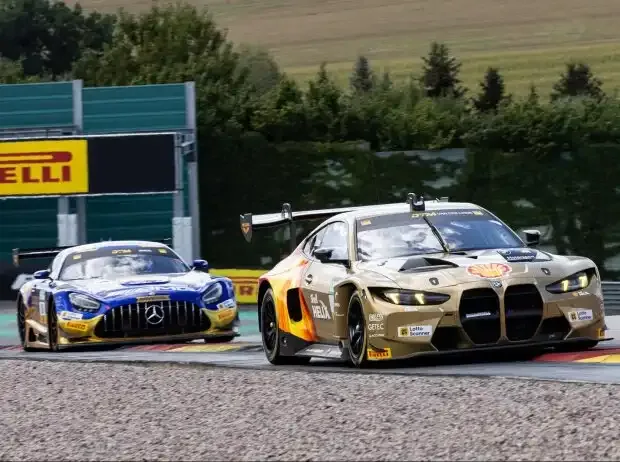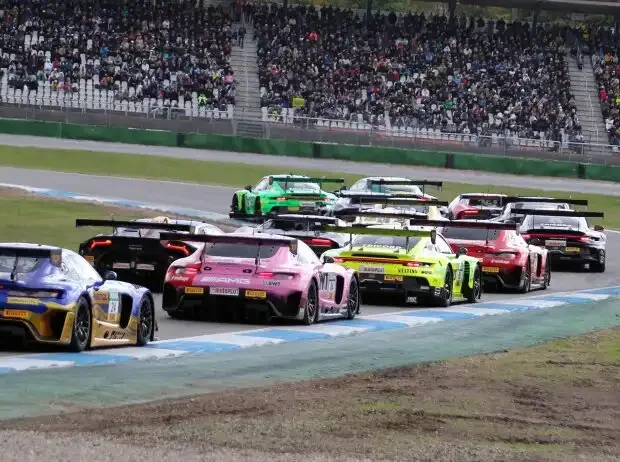








– Before the decisive DTM test on Monday and Tuesday of this week in Vallelunga, the pressure on Pirelli was enormous: because the first shot from the Italian tire manufacturer, which is supposed to supply an exclusive DTM tire with greater degradation and faster lap times in 2026, went quite wrong.
Read more “Seems to work”: What impresses Marc Surer about Audi
The teams complained during the Le Castellet test at the end of November about extreme “graining” with the experimental tires called “Option 1” and “Option 2” – especially on the Mercedes-AMG GT3, the new tires were said to have been “un-driveable” after just eight laps. So Pirelli decided on a further test with the DTM manufacturers, which was now intended to bring the turnaround.
For this, Pirelli brought two additional new experimental tires designated “Option 3” and “Option 4” to the track on the outskirts of Rome. This shot had to hit the mark now, because on March 24 and 25, all DTM teams will be equipped with the final Pirelli tire for the 2026 season at another test in Vallelunga, before the season opener takes place a month later.
Thiim misses test due to Iran war
As in Le Castellet, the test at the beginning of this week was also carried out by the manufacturers represented in the DTM, who commissioned their teams to use one car each. Only the Aston Martin team Comtoyou had to reschedule at short notice on Monday because Nicki Thiim was stuck at his residence in Dubai due to the restricted air traffic caused by the Iran war.
However, the Belgian team was able to recruit the Italy-based Aston Martin factory driver Mattia Drudi for the test at short notice. The manufacturers received precise instructions as to when and with which tires a qualifying or race simulation had to be carried out, how many laps had to be driven, and how much fuel had to be in the car. The Balance of Performance was also specified.
And there was a lot of driving: Finn Wiebelhaus was the leader in the HRT Ford on Monday with 157 laps, and on Tuesday Marco Wittmann in the Schubert BMW even reached 167 laps.
“That is already a significant step forward”
But has Pirelli turned the corner? The two new tire variants, which were now tried out for the first time, turned out to be more conservative than expected compared to the two Le Castellet variants that had caused criticism. “That is already a significant step forward,” says a team member who does not want to be named (SPONSORED LINK: Secure tickets for the 2026 DTM season now!).
But how do the two variants differ? With “Option 3”, the “peak” so important for qualifying and the degradation are significantly more pronounced than with “Option 4”, which in this respect is positioned between “Option 3” and the DHG tire that was used as a reference in Vallelunga.
Read more Jack Doohan: Never had a real chance at Alpine
“Regarding degradation, however, we are no longer talking about four or five seconds as in Le Castellet, but rather one or two seconds,” the team member confirms that the new variants are less extreme. The “graining” was also no longer as pronounced as in France, where the surface of the tires partially tore open. Instead, rubber abrasion off the racing line was an issue, which indicates that the tires are losing a lot of material.
New tire causes many open questions
Despite the positive impression, caution is advised: Vallelunga is a track that offers little grip – and the air temperature over the two days ranged between ten and 18 degrees. While it was overcast on Monday, the sun shone on Tuesday, heating the asphalt to around 25 degrees. But what does that mean for tracks like the Sachsenring, where the tire is under enormous load and it can be hot in September?
“I wouldn’t want to be in the shoes of those responsible so close to the start of the season, because no one can estimate whether it will work then,” warns a team member that the tires might be under too much stress during heat races.
And another aspect emerged during the test: the experimental tires are said to be more volatile than the DHG tire used previously. This means that at low temperatures, front-mid-engine cars like the Mercedes-AMG suffer more than before – and at higher temperatures, the mid-engine cars have difficulties. This would make the Balance of Performance even more difficult.
Pirelli now forced to make a quick decision
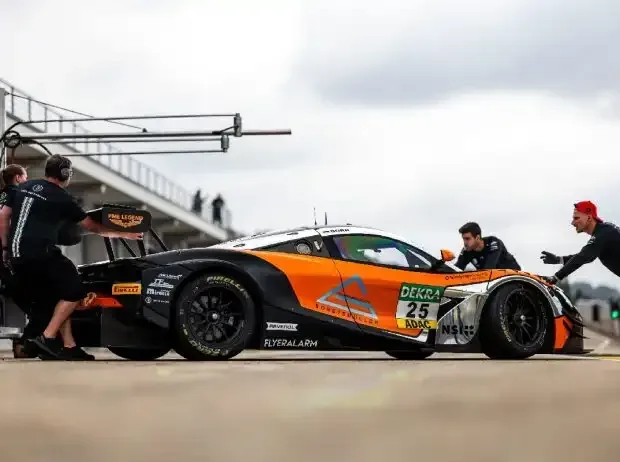
After the McLaren was conspicuously fast in southern France recently at low temperatures and seemed to cope very well with the heavily degrading tires, a similar picture emerged in Vallelunga.
Ben Dörr, who completed both test days because Sky expert Timo Glock is already in Australia for Formula 1, set the fastest time on Monday in 1:30.290. On Tuesday, Mercedes-AMG pilot Lucas Auer was fastest in a qualifying simulation in 1:30.326 – albeit at higher asphalt temperatures, which suit the car.
- Formula 1Curfew lifted: FIA reacts to chaos before F1 start
- Formula 1“Seems to work”: What impresses Marc Surer about Audi
- 24h NürburgringFalken will only start with one Porsche in 2026, but Dunlop is joining as a newcomer!
- Formula 1Why media reports are putting a strain on the Ferrari team
Now there is not much time for reflection: Pirelli is analyzing the data and manufacturer feedback and must then quickly decide what the final product will look like. It is heard that the deadline for this is said to be March 13, because then only about a week remains to produce the tire sets in time. For the two-day DTM test in Vallelunga, around 200 tire sets will be needed for the eleven teams.
Read more MotoGP CEO admits: “It will be difficult to race in Qatar”