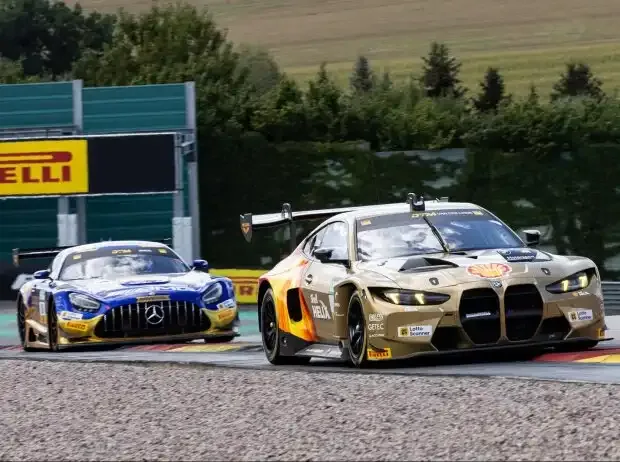


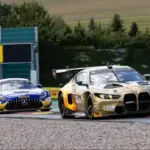
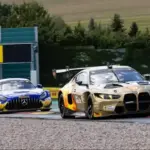
– Was the boost pressure of the BMW M4 GT3 Evo radically reduced this year? One might get this impression when looking at the Balance of Performance (BoP) in the DTM or at the 24h Nürburgring in 2026. But as Motorsport-Total.com has found out, the car was equipped with a new turbocharger in the winter, which explains the difference compared to previous years. But why was there a re-homologation with the FIA?
Read more Goyon confirms Honda talks: What’s next for Tech3?
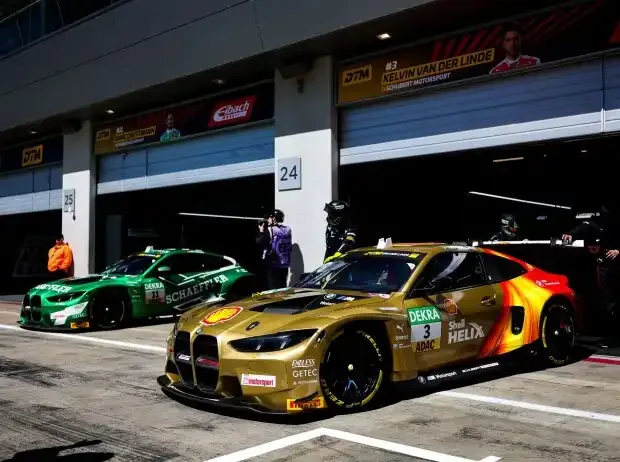
“The introduction was actually planned from 2025,” explains BMW motorsport director Andreas Roos in an interview with Motorsport-Total.com. “But because the development time was too long – and also because of the application – we then agreed with the FIA and the organizers that the introduction would only take place in 2026.”
More precisely, the premiere of the new turbocharger in the M4 GT3 Evo already took place at the end of November 2025 at the GT World Cup in Macau. The 12h of Bathurst in February 2026 were still run with the old turbocharger because the SRO Motorsports Group responsible for the BoP held its traditional BoP test only afterwards.
BMW motorsport director: “Main reason was to reduce costs”
“The main reason was to bring costs down, because it is now 1:1 the series turbocharger, as it is installed everywhere in the M3 or M4,” Roos describes the turbocharger change as a “cost-down measure.” In addition, they paid attention to efficiency and alternative fuels, whose regenerative shares, according to Roos, pose a challenge for turbo engines. “We tried to make it more robust in the application,” he says.
Regarding drivability, Roos does not expect fundamental changes. “Maybe a little due to the application and because the combustion process was slightly adjusted,” he says. This brings “maybe a slight advantage” in one area but can also have a “negative” effect in another. Overall, however, it is “negligible.”
Noticeable with the new turbocharger, besides the boost pressure, which is now partially about 0.3 bar lower, is also a changed lambda value that determines the gasoline-air ratio in the combustion chamber. Instead of a lambda of 1.1, the DTM now runs with a lambda of 0.9, which is also common with other turbo cars. This means that the gasoline mixture is no longer as lean – and the BMW no longer consumes as little fuel as before.
Read more Honda confirms leadership change for 2027: Puig takes on new role
Roos denies connection with Manthey allegations
But what does Roos say about the rumors in the paddock that the change was related to allegations from competitors that BMW could occasionally call up unexpected additional power? “No, that’s not true – it has nothing to do with that,” Roos clarifies. “It was our approach together with the FIA to change that.”
Apparently, there is indeed no connection with the Manthey allegations from last year at the 24-hour race at the Nürburgring and at the DTM finale in Hockenheim. But the change probably did not happen entirely voluntarily.
Did the FIA force BMW to make a change?
Because as Motorsport-Total.com has learned independently from various sources, the FIA demanded a change of the previous turbocharger because it apparently was not – as required by the regulations and homologation – a turbocharger used 1:1 in the series.
The previous charger was said to have looked the same from the outside, but the inside was reportedly not 100 percent the same. Actually, the change should have taken place during the previous racing season, but then it was decided, also because of potential impacts on the BoP, to keep it until the end of the season because the turbocharger is an essential part of the vehicle.
- 24h NürburgringLive ticker 24h Nürburgring 2026: The first qualifying sessions on Thursday
- 24h Nürburgring24h Nürburgring 2026 Livestream: Overview & schedule of the livestreams
- IndyCarIndy 500 FT2: Mick Schumacher learns from Takuma Sato – P1 for Conor Daly
- Formula 1Max Verstappen at the 24h race Nürburgring: Schedule, opponents, livestream
But was the irregularity intentional? According to Motorsport-Total.com’s understanding, it is quite possible that there was a misunderstanding with BMW during the homologation of the car and the FIA only became aware of the matter in 2025 despite the examination at that time.
Read more This is how the «Macarena» wings of Ferrari and Red Bull differ