








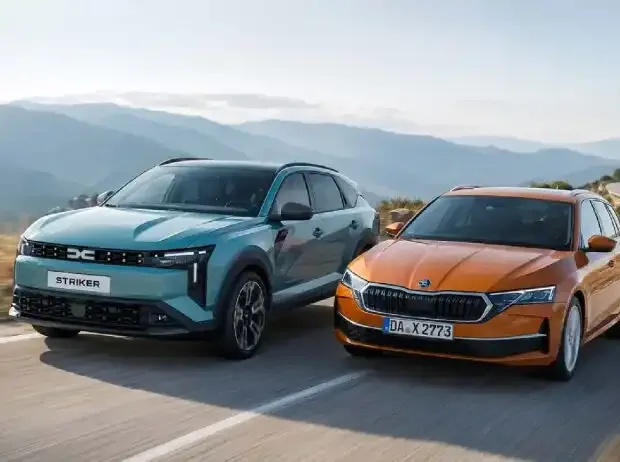
(Motorsport-Total.com/Motor1) – Dacia aims for higher goals and attacks in the mid-range segment. Recently, the new Striker was presented in detail. And many observers immediately thought of the Skoda Octavia Combi. So it’s time for a first comparison of both vehicles on paper.
Read more Opinion: Should Formula 1 really have to get louder from 2031?
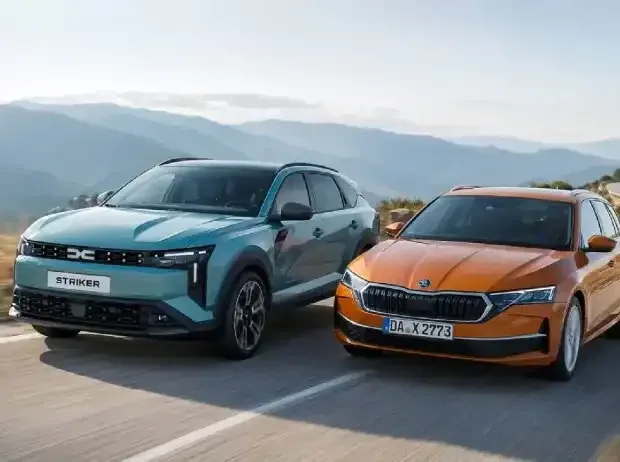
A comparison between the Dacia Striker and the Skoda Octavia Combi highlights the clash of two different philosophies in the segment of spacious family vehicles. While Skoda presents the classic, highly developed, and long-established station wagon, Dacia breaks traditional boundaries with the Striker and positions the vehicle as a crossover that merges the features of a station wagon with the visual elements and capabilities of an SUV.
Design and Dimensions
In terms of exterior design, the Dacia Striker shows an independent character. It breaks with pure station wagon conventions through an increased ground clearance of up to 20 centimeters (20 cm for the 4×4 and 19 cm for the 4×2) as well as surrounding protective plastic elements, giving it a pronounced outdoor look.
Photo series: Dacia Striker and Skoda Octavia Combi in the first comparison
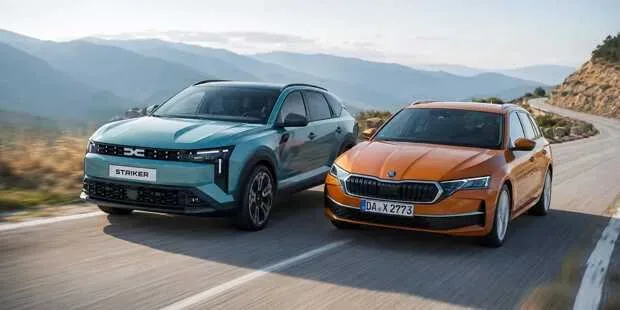
With an overall length of 4.62 meters, it is currently the largest model of the Dacia brand, but remains flat and aerodynamically designed in height at 1.53 meters, which is reflected in a good cW value of 0.29 for this class. The front is characterized by a distinctive T-shaped LED light signature.
The Skoda Octavia Combi, on the other hand, embodies the classic, elegant station wagon design with an overall length of just under 4.70 meters (exactly 4,698 mm), thus surpassing the Dacia by a few centimeters. At 1.49 meters in height, it is somewhat lower. The Skoda sits lower on the road and relies on clear, refined lines and a stretched silhouette without off-road cladding. The Octavia Scout once had this, but it has not been in the program since the facelift of the current series. Perhaps a gap for the Striker?
Interior and Versatility
The conceptual difference continues in the interior. Dacia equips the Striker with a modern, pragmatically designed cockpit. Simple plastics dominate here. In addition to a central 10.1-inch touchscreen (navigation optional), the digital LightVisio driving information display stands out, which appears three-dimensional and floating freely in front of the driver through projection technology.
The seats are partly covered with a durable, neoprene-like fabric, and clever details such as an integrated ice scraper or cable passages can be found in the dashboard. The Striker’s trunk volume is 600 liters and can be expanded to around 1,600 liters by folding down the rear seat. An electric tailgate is optionally available, complemented by a three-part, reversible modular floor that has a dirty side.
The Skoda Octavia Combi counters in this discipline with its traditional strengths in terms of maximum space utilization and higher-quality material feel. The Octavia’s trunk volume is 640 liters in the standard state and up to 1,700 liters with the rear seat folded down, again somewhat above the values of the Dacia.
The Skoda cockpit appears more upscale due to foamed plastics and optional Alcantara or leather upholstery and offers the brand-typical Simply-Clever solutions such as umbrellas in the doors or a ticket holder on the windshield. There is also an ice scraper here, but in the fuel filler cap. A 10-inch digital cockpit is always standard, as is a 10-inch touchscreen. The latter is optionally also available in 13 inches.
Read more «Null Grip»: The Sachsenring exposes Bagnaia’s problem
Engines and Performance
In terms of drive concepts, Dacia takes a purely electrified path with the Striker. In addition, there are only gasoline engines. The engine range includes a bivalent mild hybrid with 140 hp, which can be operated with both gasoline and liquefied petroleum gas (LPG), as well as two full hybrid variants. The more powerful full hybrid delivers 155 hp based on a 1.8-liter four-cylinder. Depending on the drive, there is a six-speed manual transmission, a six-speed dual-clutch transmission, or a multi-mode automatic transmission.
A unique feature compared to the classic station wagon is the optional all-wheel drive in the Hybrid 150 4×4. Here, a mild hybrid engine drives the front axle, while an additional electric motor is located on the rear axle, which automatically decouples at higher speeds from 140 km/h to save fuel.
| Engines | Gasoline | Mild Hybrid Gasoline | Full Hybrid | Diesel |
| Dacia Striker | Mild Hybrid-G 140 / 140 hp | Hybrid 150 4×4 / 150 hp Hybrid 155 / 155 hp | – | |
| Skoda Octavia Combi | 1.5 TSI / 115 hp 1.5 TSI / 150 hp 2.0 TSI 4×4 / 204 hp 2.0 TSI / 265 hp | 1.5 TSI mHEV / 115 hp 1.5 TSI mHEV / 150 hp | – | 2.0 TDI / 115 hp 2.0 TDI / 150 hp |
Skoda offers a significantly broader and more classic range for the Octavia Combi. The engine range extends from pure TSI gasoline engines through mild hybrids (eTSI) to long-range TDI diesel engines, which are completely missing in the Dacia. However, the Octavia (yet) does not offer a full hybrid. The gasoline engines deliver between 115 and 204 hp (2.0 TSI 4×4). It is 115 and 150 hp for the 2.0 TDI. For automatic enthusiasts, there is a 7-speed DSG (partly standard).
For customers with a big appetite for power, there is the Octavia RS with 265 hp. While Dacia focuses on urban hybrid efficiency and light off-road capability, Skoda perfectly covers the needs of frequent drivers with high highway shares.
Prices and Market Positioning
The price aspect is the area where the positioning of the two vehicles differs most clearly. Dacia remains true to its brand philosophy and announces an entry price of under 25,000 euros for the Striker in Germany. The market launch is scheduled for December 2026, with first orders possible from October.
Thus, the lifestyle station wagon positions itself as a price-breaking offer in the C-segment, offering a lot of equipment and modern hybrid technology at a fraction of the usual market price. Upwards, the Bigster serves as a reference, with the top model with full equipment priced at almost exactly 33,000 euros.
The Skoda Octavia Combi moves in a different price league. A well-equipped Octavia Combi usually starts well above the 30,000-euro mark, and with corresponding engines or higher equipment lines, the price quickly climbs towards 40,000 euros and beyond. It starts at 29,840 euros and goes up to 44,000 euros for the strongest diesel as Sportline and just over 50,000 euros for the RS.
More from Dacia and Skoda:
Dacia Jogger Hybrid 155 (2026) tested: Even a bit better
Skoda Octavia: Second facelift caught as a mule
Read more Cadillac: 16-year-old talent supports Formula 1 project in the simulator