








(Motorsport-Total.com/Motor1) – The original Lexus LFA once struggled with sales, but the V10-powered supercar gained a loyal fan base over time and is now highly regarded among enthusiasts. Incidentally, exactly 14 units of the 560-hp supercar were newly registered in Germany between 2010 and 2012.
Read more Tardozzi on the fight with Aprilia: «The riders make the difference»
The name now apparently stands before a reuse for a completely different performance flagship from Lexus. Namely one that will completely forgo an internal combustion engine. Initially introduced with the Electrified Sport Concept and later with a concept of the same name, the next LFA is to be fully electric at its market launch next year.
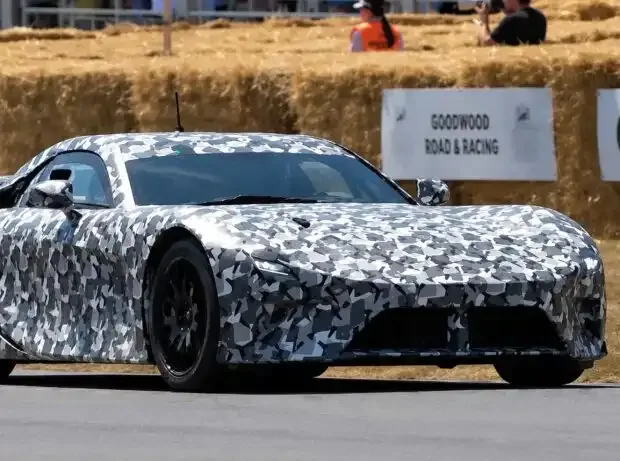
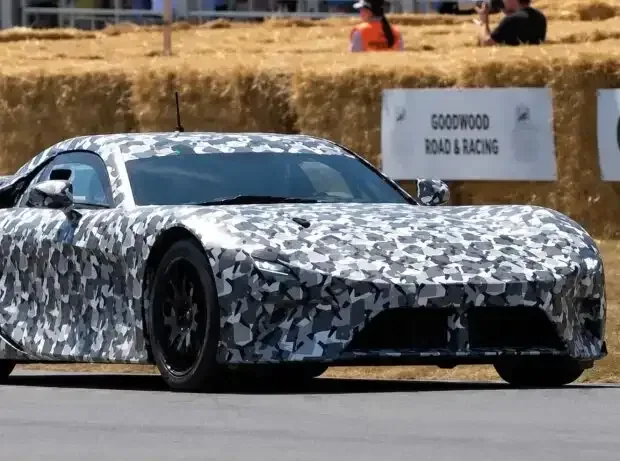
Before the market launch, a camouflaged prototype was shown to the public for the first time at the Goodwood Festival of Speed over the weekend. There it appeared in prominent company, together with the Toyota GR GT and the GR GT3, which is designed purely for the racetrack. There is a good reason for this, as the new LFA will be largely based on these two vehicles – but without the 4.0-liter V8 biturbo. The same aluminum-intensive platform is expected, which can also accommodate electric motors and a battery pack for the fully electric Lexus.
While Lexus remains silent on the technical data so far, the brand has at least published the dimensions of the electric supercar in concept form. With a length of 4,690 millimeters and a width of 2,040 millimeters, it will be significantly larger than the original LFA. At the same time, at only 1,195 millimeters in height, it sits much lower on the road. Despite its generous wheelbase of 2,725 millimeters, it offers only two seats.
Photo gallery: Lexus LFA (2027)
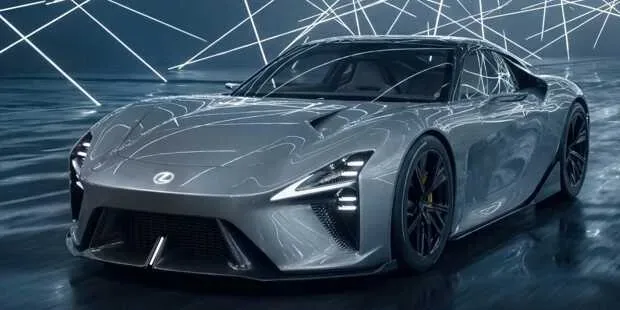
The British magazine Autocar spoke with Lexus at Goodwood and learned some interesting details about the return of the LFA. The concept’s designer, Shogo Kasamatsu, explained that the styling was developed to “express the message and not our overarching design language.” In other words: the model will not fully adhere to the current Lexus design language, something already visible on this camouflaged prototype. The production version is also expected to differ little from the concept; according to Kasamatsu, it will look “almost” the same.
Lexus is aware of the risks that the new LFA might be difficult to sell, as wealthy buyers currently show little interest in electric super- or hypercars. A similar sentiment was expressed a few years ago when Rimac CEO Mate Rimac said that extremely wealthy customers tend to prefer an internal combustion engine and a more analog driving experience.
The Product General Manager of the LFA, Yukihiro Yukita, admitted that weak demand in this segment currently represents the “biggest challenge” for the company. Despite these hurdles, the production version remains on track for a market launch in 2027.
Lexus wants to convey the appeal of an internal combustion engine
While high-performance electric cars in the upper segment often try to simulate the emotions of an internal combustion engine, Lexus wants to go a step further and give the driver the feeling of “driving with an engine.” The plan apparently is not simply to generate an artificial V10 sound and leave it at that, but rather to “recreate the sound itself.” What exactly that means is unclear. However, the statement suggests that the new LFA will not be completely silent on the road.
Read more «Completely different world»: Kimi Antonelli dominates final practice in Belgium
Possibly, Lexus will amplify the sounds of the electric motors and combine them with sound nuances inspired by the naturally aspirated 4.8-liter V10 that Yamaha co-developed for the original LFA. Either way, Lexus makes it clear that it does not simply want to imitate the sound of an internal combustion engine to artificially give the electric supercar a gasoline character.
Regarding the name, it is worth looking back: When the concept debuted at the end of last year, Lexus stated: “LFA is not tied to vehicles with internal combustion engines.” Toyota’s luxury brand therefore has no problem reusing the abbreviation for an electric car. One that might even be equipped with a solid-state battery. Since this long-awaited battery technology is expected to offer a significantly higher energy density than conventional lithium-ion batteries, the supercar could manage without a particularly large battery pack.
Accordingly, the LFA is unlikely to become excessively heavy. However, it would be unrealistic to expect a curb weight even remotely close to the original’s 1,480 kilograms. It seems more logical that it will weigh significantly more than its predecessor with an internal combustion engine. For context: Toyota aims for a curb weight of under 1,750 kilograms for the GR GT.
As much as it may seem sacrilegious to put the LFA badge on an electric supercar that replaces a high-revving V10, we are curious about what Lexus has been working on here. Solid-state batteries could be a real game-changer because they could drastically reduce the weight disadvantage associated with electric cars.
Pricing will also be tricky, especially since the first LFA generation was widely considered too expensive even for an exotic low-volume model. Its successor faces a difficult task after losing the defining unique selling point: the V10. If it ends up costing more than the GR GT, it will be hard to imagine many buyers choosing the Lexus over the Toyota with an internal combustion engine. Nevertheless, choice never hurts.
The cousin of Toyota:
Clever engineering: Why the Toyota GR GT is so special
Toyota GR GT: New supercar with 650-hp biturbo V8 delights enthusiasts
Read more Aston Martin: In Belgium it will get really painful once again!