






(Motorsport-Total.com/Motor1) – Mercedes introduces the new VLE. The electric van is considered the successor to the EQV and is intended to combine the agility and long-distance comfort of a premium sedan with space for up to eight occupants, all with a maximum WLTP range of over 700 kilometers.
Read more Alpine: New details on the electric A110
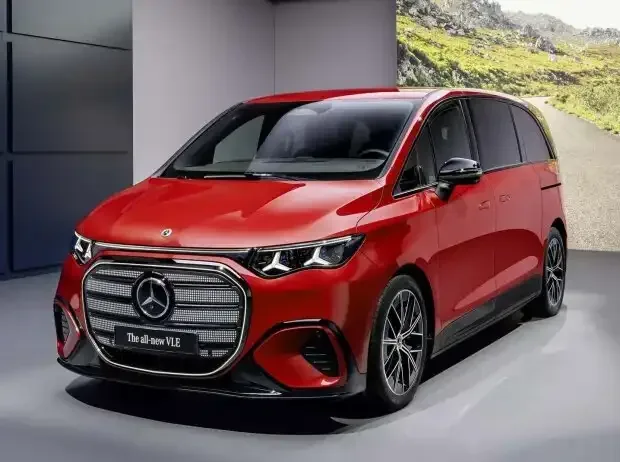
Mercedes only provided us with bullet points about the new model until the embargo; thus, information on dimensions, the interior, and most technical data on the drives and the battery are missing. The included images show the VLE 300 (in beige) and VLE 400 (in red) versions, with the VLE 400 apparently offering all-wheel drive, as a “4Matic” badge is displayed on the rear.
Exterior
The look of the newcomer is defined at the front by the huge grille, which is further highlighted by a light line as a frame. In addition, there is a light signature with two stars per side. Unlike the GLC EQ, for example, there is also a continuous light line between the headlights and above the grille. On the side, the VLE has sliding rear doors; the arched finish of the side windows is also striking. The simple rear is dominated by the vertically arranged taillights, which are complemented by the light strip at the top to form a round arch. Furthermore, the VLE has flush-mounted door handles that extend electrically when needed.
Interior
Inside, there is an MBUX Superscreen consisting of three screens. The new MB.OS is used as the operating system for the infotainment and assistance systems. Navigation uses Google Maps.
The air vents on the left and right of the dashboard feature a glowing frame that complements the ambient lighting. This also shows the contours of the “two-story” center console, which contains two mobile phone trays at the top and a lighted compartment for small items at the bottom. The steering wheel has a paddle on the left and a control wheel on the right. A Sky-View glass roof stretches over the occupants from the second row of seats to the rear.
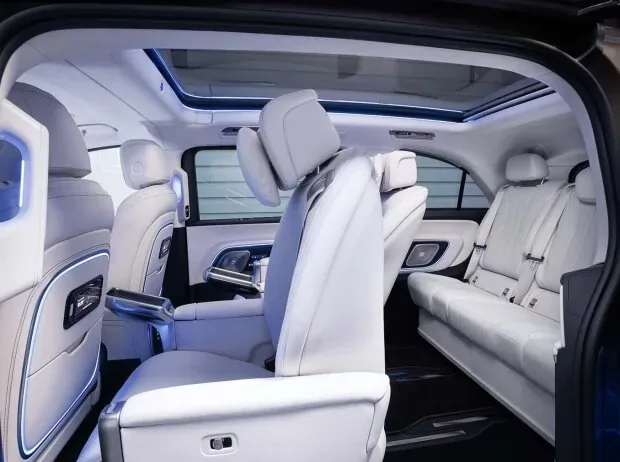
Seat configurations range from five to eight seats, optionally as individual seats or three-person benches. The seats can also be removed if necessary; thanks to the integrated rollers, they can then be rolled into the garage. With three rows of seats, the trunk holds about 795 liters, and with the rear seats completely removed, over 4,000 liters.
¿pbfs||pb¿The images show two individual seats in the second row for both versions, which can be moved longitudinally using a rail system. The red VLE 400 4Matic also has two individual seats on rails in the third row, while the beige VLE 300 has a three-person bench there, which is also longitudinally adjustable. Here, the seats in the second row look particularly comfortable. In addition, there is a large 31-inch screen for the rear passengers. Thanks to numerous streaming apps and online services, you can watch movies or play games on it and participate in video conferences with the integrated camera.
Drives and Battery
The technical basis for the VLE is the Van.EA platform. At launch, there will be a VLE 300 with 200 kW front-wheel drive and an all-wheel-drive version with 305 kW. Both receive a 115 kWh NMC battery. Versions with an 80 kWh LFP battery are to follow later.
Technical Data Mercedes VLE (2026)
| VLE 300 | VLE 400 4Matic | |
|---|---|---|
| Drive | FWD 200 kW | AWD 305 kW |
| 0-100 km/h | n/a | approx. 6.5 sec. |
| WLTP consumption | approx. 18.6-20.4 kWh | approx. 21.1 kWh |
| Battery net | 115 kWh (NMC) | 115 kWh (NMC) |
| WLTP range | over 700 km | n/a |
| Max. charging power AC / DC | 11 (optional 22) kW / 300 kW | 11 (optional 22) kW / 300 kW |
With a range of over 700 kilometers according to the WLTP standard, the VLE 300 Electric also makes long distances possible. Mercedes provisionally and summarily states the power consumption of the VLE for both versions as 18.6-20.4 kWh/100 km. The newcomer has a drive developed by Mercedes itself with a permanent magnet synchronous motor (PSM) on the front axle. The efficiency from the battery to the wheel is said to be 93 percent on long distances.
All-wheel-drive models additionally have a PSM on the rear axle. This is engaged via a mechanical clutch (Disconnect Unit, DCU) when needed. When power demand is low and traction requirements are minimal, the rear electric motor and parts of the transmission are decoupled. This reduces losses at the rear axle by up to 90 percent, according to Mercedes. The silicon carbide inverter also contributes to the low consumption. Whether this applies only to the primary front axle or also to the rear axle remains open.
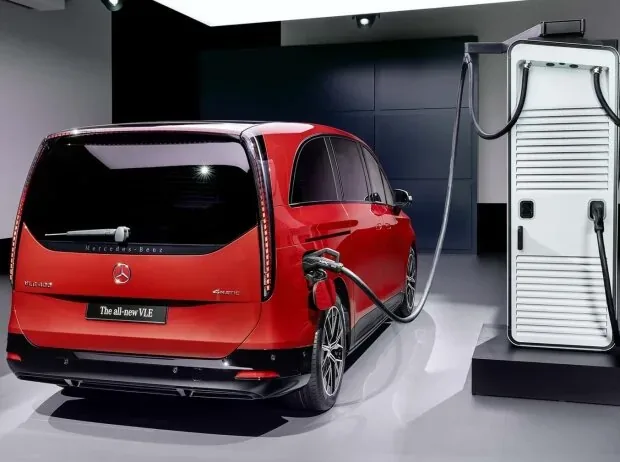
The new battery offers 115 kWh net. Charging is done thanks to the 800-volt system with charging powers up to 300 kW. The charging time is still kept secret, but the VLE should be able to recharge power for a WLTP range of up to 355 kilometers in 15 minutes. At 400-volt charging stations such as Tesla’s Superchargers, you cannot charge with the standard equipment (as with the CLA EQ); the optionally available DC-DC converter is required for this. Alternatively, you can charge with alternating current, with 11 kW supported as standard and 22 kW as an option.
Read more Formula E boss criticizes new F1 path: “They are making a mistake”
An NMC chemistry with a low cobalt content is used at the cathodes of the battery, and graphite with a silicon oxide content is used at the anodes. The high-voltage battery can be repaired, which probably means that it is constructed from cells and modules as usual and does not have a cell-to-chassis architecture. The VLE is prepared for bidirectional charging.
Chassis
As far as the chassis is concerned, the VLE optionally features Airmatic air suspension. Normal air suspension systems lower the vehicle above a certain speed and raise it again at low speeds. The new Airmatic, on the other hand, uses data from Google Maps for the first time and thus knows what type of road (highway, country road, or urban) you are on. Thus, the low chassis height is continuously maintained on the highway, even if you are temporarily in a traffic jam.
The intelligent chassis control also includes a new Car-to-X function, which is intended to offer significantly more comfort on long speed bumps, as they are common particularly in Southern Europe and the USA. If the new Car-to-X function is activated, the VLE automatically adjusts the damping shortly before reaching the threshold, which significantly improves comfort, especially in the rear, Mercedes promises.
With the air suspension, the vehicle height can be raised and lowered by 40 millimeters to increase ground clearance or facilitate entry. For the first time, this is also possible via voice control, for example with the command “Raise vehicle”.
Also optional is a rear-wheel steering system, which reduces the turning circle from curb to curb by 2 meters to 10.9 meters and from wall to wall to 11.6 meters. The steering angle of the rear axle is up to seven degrees. At speeds below 60 km/h, the rear wheels steer in the opposite direction to the front wheels; this makes the vehicle more maneuverable. From 60 km/h, the steering occurs in the same direction as the front wheels, which improves driving stability during lane changes on the highway. Another plus is the more direct steering ratio, which leads to less steering effort.
In addition, Mercedes promises good sound insulation, including through laminated glass and elastomer bearings between the body and chassis. The rotor magnets are arranged in a double-V configuration, and the stator windings use so-called chorded coils. Both measures ensure an exceptionally quiet yet efficient drive.
When the new model will be launched on the market and how much it will cost has not yet been announced; however, this information will likely follow soon.
More Mercedes news:
Mercedes-AMG GT Four-Door: First images of the cockpit
Small G-Class from Mercedes as an Erlkönig and as a rendering
The Bottom Line
Mercedes introduces the new VLE. On the outside, the huge grille makes it look too “status-oriented” for our taste, to put it politely. Inside, the car offers luxury at the upper-class level, right down to the super-soft pillows for the headrests known from the S-Class. As befits a van with transporter genes, the seating system is very variable. The newcomer is driven via the front axle, which brings space advantages in the rear. Due to the huge battery, which at 115 kWh is almost as large as the 119 kWh battery of the EQS, a WLTP range of over 700 km results. Prices are likely to be correspondingly high.
Read more Surprise at the tire test: Will an Audi be on the DTM grid in 2026 after all?
Sources: Mercedes (via email), Motor1 Italy