




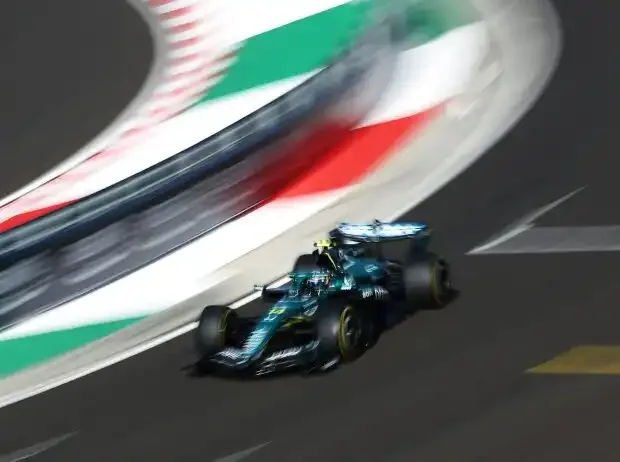
– Aston Martin has been a regular guest among the teams for whom Q1 was already the end of the road in qualifying throughout the 2026 Formula 1 season so far. In the qualifying sessions for the first 10 Grands Prix of the year, they had not managed to get past the first segment a single time.
Read more McLaren stops Mercedes’ pole streak: “And now a good race”
In Montreal, Fernando Alonso did make it into Q2 of sprint qualifying, but a slip-up by the Spaniard in SQ1 there prevented him from actually going out on track in SQ2.
As Aston Martin had fallen significantly behind at the beginning of the year due to a series of reliability issues, the team has postponed its aerodynamic updates until this weekend’s Hungarian Grand Prix.
Now at the Hungaroring, the AMR26 is running with a multitude of new parts. The front end has been fundamentally revised, the sidepods have been redesigned, the underbody has been reworked, and the rear has also seen intensive improvements.
The result: Alonso’s entry into the Q2 segment was the first such on a Saturday this year. This is a certain boost for the confidence of everyone at Aston Martin. But how much are the updates really worth? Let’s try to find out using the numbers we have.
Aston Martin’s decline without updates
The introduction of the updates for the AMR26 came after the other teams had improved through their own gradual enhancements over the first 10 race weekends of the season.
In the first five qualifying sessions of the year (Australia to Canada), Aston Martin was on average 4.028 percent slower than the theoretical best time of the respective weekend; in the following five qualifying sessions (Monaco to Belgium), this value significantly worsened to 5.311 percent.
Let’s illustrate this with numbers to make the percentages easier to understand. For a specific racetrack, let’s assume the pole time was 1:30.000 minutes, or 90 seconds. That’s our 100 percent time. Based on these average values, Aston Martin would be expected to set a time of 1:33.625 in the first five qualifying sessions of 2026 and 1:34.780 minutes in the following five qualifying sessions.
The example suggests that Aston Martin has indeed become slower. It is thus proof of the progress made by the other teams. To simplify: Aston Martin’s fastest time in the first example (Australia to Canada) was initially 3.625 seconds behind the ideal time and increased to a 4.780-second deficit in the second example (Monaco to Belgium).
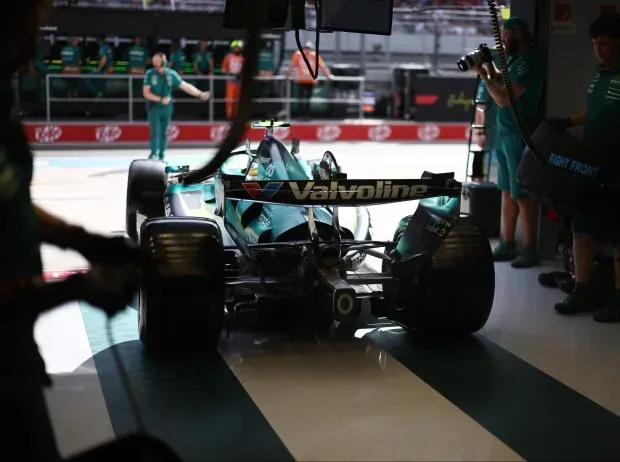
These time differences underscore one of the oldest unwritten laws of Formula 1: standing still is falling behind. In a situation with a steep development curve, as the first part of the 2026 season has shown, many teams have been surprised by this.
At last weekend’s Belgian Grand Prix, Aston Martin was 5.405 percent behind leader Mercedes, as Fernando Alonso’s lap time of 1:50.002 minutes looked pale compared to Kimi Antonelli’s 1:44.361.
Read more Alexander Albon: Upgrades like Aston’s remain a dream for us
This corresponds to a deficit of 5.641 seconds, which, however, may have been amplified by the track layout. After all, Spa, at 7.004 kilometers, is the longest track on the 2026 Formula 1 calendar. Nevertheless, Aston Martin’s percentage deficit at Spa was consistent with that of the previous four qualifying sessions.
Now that the updates for the AMR26 have debuted in Hungary, Alonso’s Q2 lap was only 3.369 percent behind Lando Norris’s fastest Q3 lap. In a direct comparison of the qualifying sessions from Belgium and Hungary, this represents a gain of 2.036 percent.
Alonso rejoices, Verstappen rages: Updates deliver qualifying sensation!

However, because the Hungaroring is not directly comparable to Spa, it is difficult to determine the time gain by a direct comparison of these two qualifying sessions. If we again assume a 90-second lap and apply these percentages, we get an answer.
How much time has Aston Martin gained?
At Spa, we have our deficit of 5.405 percent. Assuming the best lap of the weekend was 1:30.000 minutes, this gives Aston Martin a lap time of 1:34.864 minutes. This is just under a tenth of a second slower than our average from the qualifying sessions from Australia to Canada, thus within the range of the decline we observed.
Using the 3.369 percent from Hungary, Aston Martin’s lap time is 1:33.032 minutes. Over a 90-second lap, this results in a gain of 1.832 seconds.
Now let’s apply this theory to both racetracks: How would Aston Martin have performed in Belgium with the updates? And how would it have gone in Hungary if they had decided to postpone the updates until after the summer break?
Our best lap at Spa was Antonelli’s 1:44.361. Taking into account the 3.369 percent deficit, this gives Aston Martin a time of 1:47.877. While this is not enough to get out of Q1, it would be enough for one of the two Aston Martins to slot in between the two Cadillacs. Because, ultimately, we are talking about a gain of 2.125 seconds compared to Alonso’s personal Q1 best time.
On the other hand, had Aston Martin held back the updates until after the Hungarian race weekend, the theoretical maximum would have been a time of 1:21.380 minutes, which – not surprisingly – would have meant a starting position on the last row. With the deployment of the updates at the Hungaroring, Aston Martin gained 1.572 seconds.
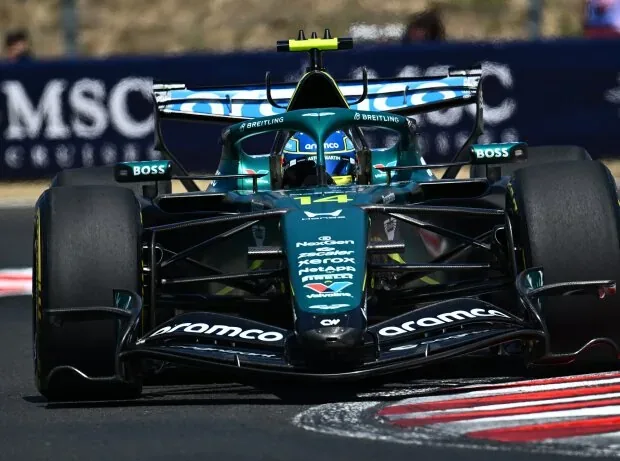
To answer the question in the headline: It depends on the racetrack. What can be said is: On an average track where the pole time is around 90 seconds, the updates have brought an improvement of about 1.8 seconds per lap.
- Formula 1Hungary Saturday: Hamilton and Antonelli retrospectively penalized!
- DTM“I’m stopping now!”: Thiim explodes after Preining’s festival
- DTM“I trusted Ben”: Penalty for Dörr after collision with Jules Gounon
- Formula 1“Car not drivable”: Red Bull sinks into problems in Hungarian qualifying
To what extent this affects race pace is still unclear, as we have not seen any long runs from Aston Martin this weekend. If the team is on average 0.7 to 0.8 seconds per lap faster than Cadillac during the race, then we can assume that most of the gained performance has carried over to Sunday.
Read more «I trusted Ben»: Penalty for Dörr after collision with Jules Gounon