





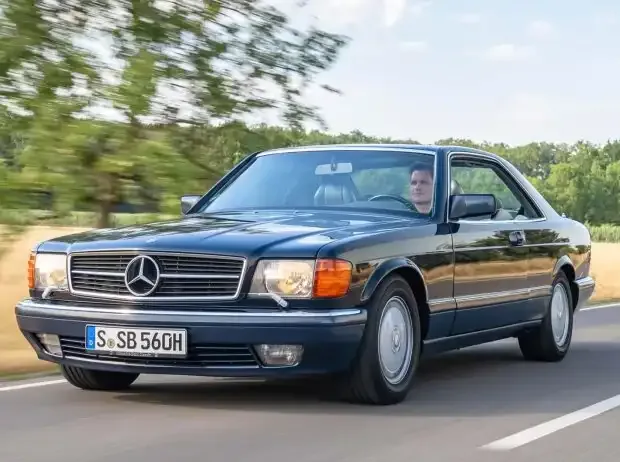
(Motorsport-Total.com/Motor1) – Bruno Sacco shaped the design of the Mercedes-Benz brand like no other. Countless classics today come from the pen of the native Italian. Last September, the designer revered by many fans passed away.
Read more Toto Wolff on son Jack: Between ambition and fun in karting
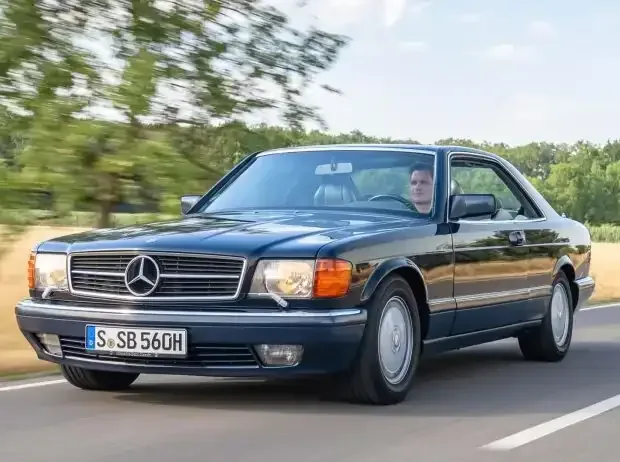
We had the opportunity to view some unique artifacts from his estate in the corporate archive and to drive his last private vehicle, as a way to pay tribute to this extraordinary legacy.
The visit to the Mercedes-Benz Classic Center in Fellbach feels like a journey through time. The corporate archive stores invaluable memories of an era that forever shaped the image of the brand. The reason for our visit is the newly handed-over collection from Bruno Sacco. His daughter Mercedes Sacco (nomen est omen!) bequeathed personal drawings and heirlooms of the recently deceased design chief to the archive.
From various awards to personal sketches and drawings to his legendary hat, the artifacts speak about their owner. But it gets even better: outside, his last own car awaits us.
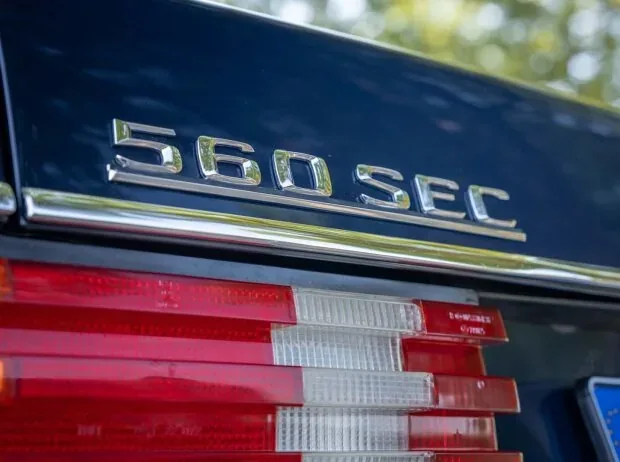
Before us gleams the dark blue sheet metal of a 1990 Mercedes 560 SEC. The C126 series is considered by connoisseurs to be Bruno Sacco’s absolute masterpiece. He designed a silhouette that perfectly balances elegance and dynamism. Sacco himself always regarded the 126 SEC as his best design, only the shells around the door handles bothered him.
The designer bought this car in 2017 from the fifth owner, frugal as he was as a long-time adopted Swabian. He wanted to drive again in retirement the car that is more than any other associated with his own name. Now the coupe belongs to the manufacturer’s official vehicle collection and we are allowed to turn the ignition key.
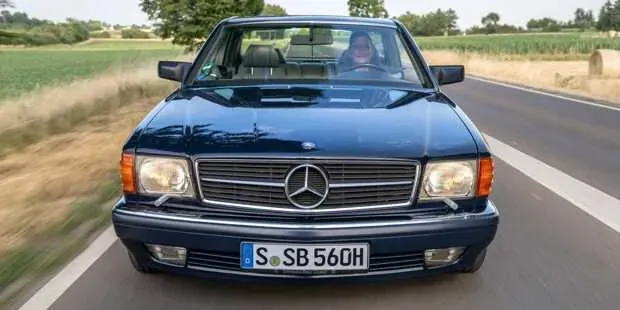
Photo series: On the road in the Mercedes 560 SEC of design legend Bruno Sacco
Sacco was born in 1933 in Udine, Italy. He gained his first valuable experience in the legendary design studios of Turin before his path finally led him to Sindelfingen in 1958, where he lived until his death.
Here, typical Italian elegance met Swabian thoroughness and the pursuit of absolute durability. From this fruitful combination, he created a distinctive style that shaped the entire brand for decades. He never saw himself as a pure artist, but as a forward-looking architect of automotive aesthetics.
An untouched monument full of life
We circle around Sacco’s private car. The classic department deliberately keeps the car in unrestored condition. Every scratch, every fine mark in the deep blue paint with color code 904 tells its own story. This honest patina gives the coupe an incredible depth.
It is not a clinically dead museum piece, but an authentic testimony from the everyday life of the famous creator. The odometer shows a mileage of around 119,000 kilometers, which can be correct after five previous owners and many decades on the roads of the world, but does not have to be.
The famous factory expertise to determine absolute originality is spared by the classic department in this case. Such an inspection costs around 20,000 euros at the Classic Center, which seems unnecessary for this prominent legacy.
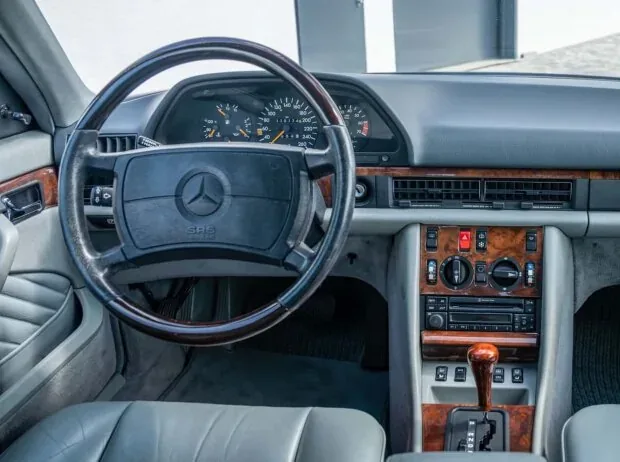
Instead, we open the heavy driver’s door and take a seat on the soft, gray leather of the seats. The interior immediately exudes the unmistakable scent of the late 1980s. The car smells absolutely clean, almost like on the first day of delivery in Sindelfingen.
We look at the perfectly crafted burl wood of the center console and stroke the high-pile, gray velour carpet. The equipment leaves nothing to be desired. Bruno Sacco found a vehicle with a sunroof, orthopedic driver’s seat, seat heating, and even an integrated fire extinguisher.
Every detail in the cockpit breathes the philosophy of the man who led Mercedes design-wise for over three decades. His designs were meant to have timeless validity and never just follow a short-lived fashion. Among the best-known designs that Sacco was responsible for as design chief are the 190, the W124 series, and the SL of the R129 series.
Fiddly technology and a twisted detail
Before we can start the engine, the car demands our patience. In the knee area sleeps a retrofitted immobilizer from the 1990s. We have to press a small black pin exactly onto a small sensor surface in the dark knee area. After a quiet click, the relays release the starter. We turn the classic metal key in the ignition. The large-displacement V8 immediately awakens with a discreet, sonorous growl.
The engineers deliberately refrained from a loud, American-style burble of the exhaust system at that time. Instead, a cultivated restraint reigns, perfectly matching the elegant appearance of the large two-door. When reaching for the automatic gearshift, we notice an amusing detail.
The burl wood shift knob on the selector lever is mounted upside down. Perhaps this unconventional position simply corresponded to Sacco’s personal ergonomics; no one will probably ever find out. We engage the drive position D and gently set the heavy car in motion.
Read more After horror crash in 1995: Mika Häkkinen doubted the F1 comeback
Outside it is midsummer, so all four windows down! Because the coupe of the 126 series does without the annoying B-pillar, a completely free, uninterrupted window line extends far to the rear. Together with the widely opened steel sunroof, the warm summer air of Stuttgart flows unhindered into the spacious passenger compartment.
We cruise relaxed over the country roads and begin to dream. In our minds, we see the creator of this masterpiece before us, sitting at the wheel of his self-designed car with hat and typical turtleneck sweater. And satisfied, he lets his gaze wander over the beautifully curved yet still dominant cockpit from his pen. A nice image.
Gentle gliding with historical weight
The V8 delivers exactly 300 hp nominally, but on the road the propulsion feels significantly gentler. The old four-speed automatic almost blurs the individual gear changes beyond recognition. However, it also swallows quite a bit of the eight-cylinder’s muscular torque in the torque converter.
Possibly, the engine no longer delivers full power after all these years. But that plays no role at all when gliding relaxed through the landscape. This car teaches us absolute composure anyway.
The legendary 15-inch alloy wheels in the classic manhole cover design turn majestically in the wheel arches. These wheels have absolute cult status, which is why they unfortunately also adorn the wheel arches of various tuned C-Classes. Here, however, everything fits visually. Remarkable considering the small size of 15 inches and the bulkiness of the car.
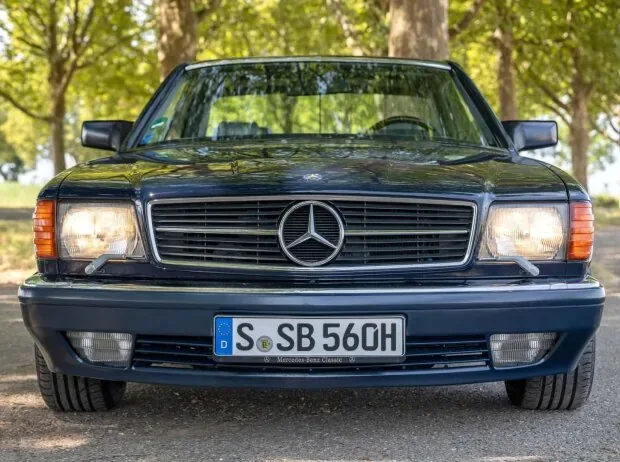
Sacco created an icon with the lines of this car that still looks incredibly modern after decades. He established two essential principles that forever changed Mercedes design. The first principle he called “vertical affinity.” A successor model was never allowed to make the predecessor look old. Every new car harmoniously referred to the brand’s history without daring a radical break.
The second principle the designer called “horizontal homogeneity.” The various models of an era had to visually match each other. Whether S-Class, the compact 190, or the elegant coupe. All carried an unmistakable, common DNA. Sacco succeeded perfectly in the difficult implementation, quite unlike one of his successors (wink emoji towards Gordon Wagener and his series 204, 213, and 222, which were hardly distinguishable even for experts).
Sacco therefore liked to compare his role as chief designer to that of a conductor. He shaped the fine overall sound of the brand while his team played the individual instruments. He always took full responsibility for the joint result.
The living legacy of the brand
Under Sacco’s design leadership, milestones such as the W124 series, the legendary SL of the R129 series, and the extremely robust G-Class matured. Even the spectacular rotary engine prototype C111 bears his signature. All these vehicles carry a soul that you can almost physically feel when driving his private SEC. When you stand today in the archive in front of the fine, hand-drawn sketches and personal items of the master, you realize the enormous historical dimension of this design philosophy.
The 190, lovingly called Baby-Benz, impressively proved his design principles in 1982. Sacco shrank the brand DNA to a more compact size without the vehicle losing status or recognizability.
The W124 series also shone through stoic perfection and formal calm, while the G-Class and commercial vehicles matured into real icons under his aegis. In the 1990s, his team mastered an unprecedented model offensive. Vehicles like the SLK or the first A-Class preserved the brand identity despite completely new shapes.
The handover of this estate by his daughter secures important testimonies for the future. The Mercedes-Benz Classic Archive does not act as a dusty storage place but as a living memory of the company. Here, the exact contexts are preserved that show how groundbreaking ideas once took shape.
The archive arranges the personal exhibits in the precise brand context and makes them accessible for research. They convey a deep understanding of the attitude behind the timeless design.
The 560 SEC with today’s Stuttgart license plate S-SB 560 is the mobile symbol of this era. It illustrates that true progress does not require a radical break with one’s own origins. Sacco’s designs age differently than ordinary cars because they radiate inner calm and unexcited authority. The car does not shine through loud splendor but through its perfect proportions. The drive in the personal coupe of the design icon remains for us a deeply impressive encounter with history.
- Formula 1Dead end F1 Academy? “Expected that the results count”
- Formula 1After horror crash 1995: Mika Häkkinen doubted the F1 comeback
- MotoGPPedro Acosta with clear message to KTM: “That can’t be”
- IndyCarOnboards show Mick Schumacher’s wild defensive battle in Portland
More Mercedes classics:
Mercedes 240 D (W 123) in the test report: Power for the farmer
Mercedes SL: End of production of the 107 series 35 years ago
Read more Franco Colapinto: Everyone was happy — except Flavio Briatore!