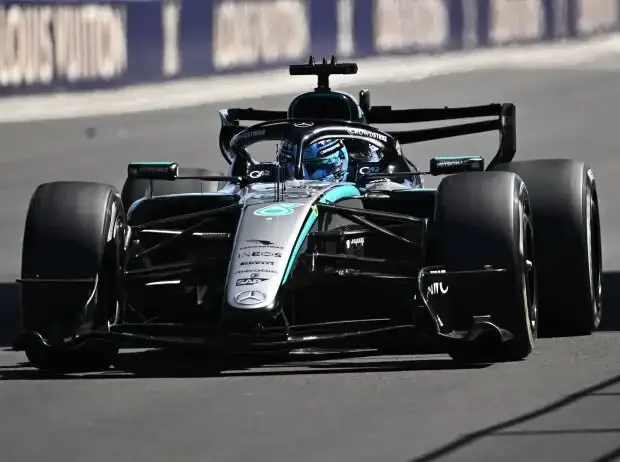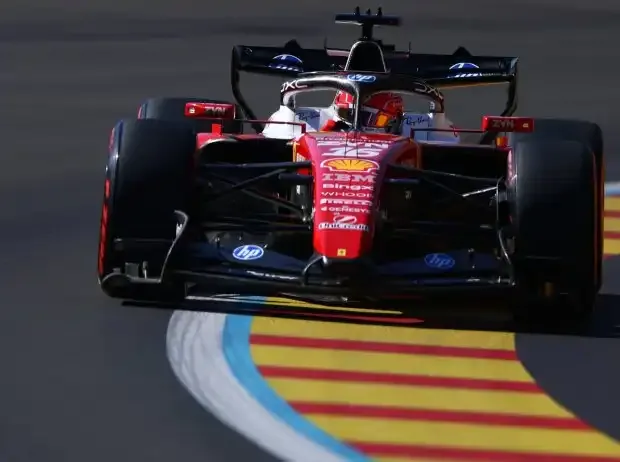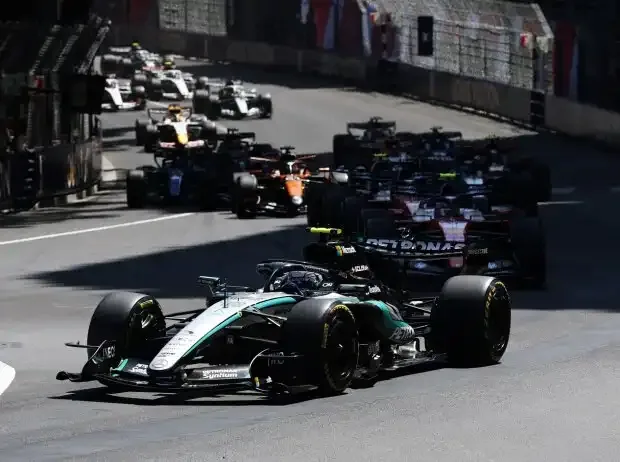
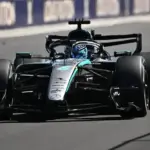



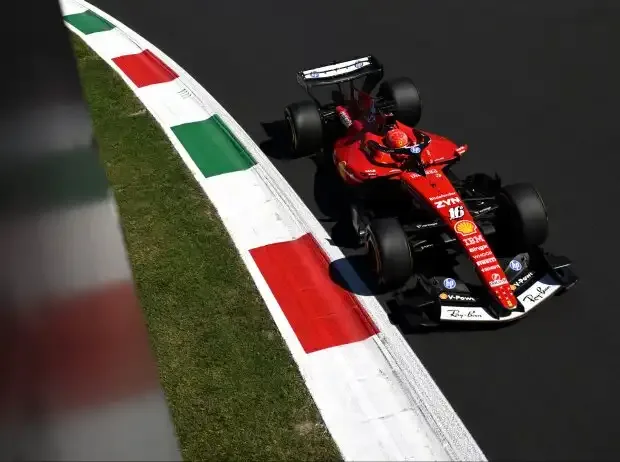
– At the Italian Grand Prix, everything seems to be heading towards a duel between Mercedes and Ferrari. After Charles Leclerc finished the first Free Practice at the top of the standings for Scuderia, Mercedes with George Russell set the best time in the more representative second Free Practice.
Read more Court date set after DTM disqualification: «We did nothing illegal»
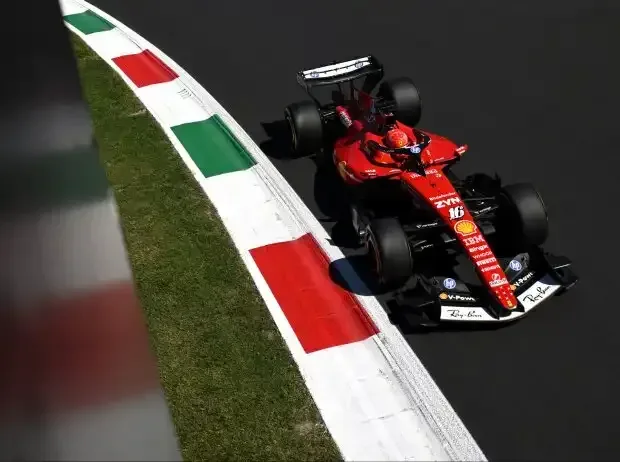
The long runs at the end of the second session were therefore eagerly anticipated. They are considered an important indicator for the possible race pace on Sunday. But the picture is more unclear than ever before.
When the long runs are adjusted for different stint lengths and tire compounds, Ferrari and Mercedes are practically neck and neck. Charles Leclerc and Lewis Hamilton were exactly equally fast (+0.00). George Russell was only two hundredths of a second per lap slower in the first Mercedes, and championship leader Kimi Antonelli was also only 0.04 seconds per lap behind.
Mercedes vs. Ferrari: Energy management the key?
Due to the long straights and few corners, energy management plays a particularly important role in Monza. And here the two top teams seem to have actually chosen different approaches: While Mercedes gains ground mainly at the beginning of the lap, Ferrari seems to catch up especially in the last sector.
George Russell set the second-best time in the first sector in the second practice with a time of 27.044 seconds behind Pierre Gasly (27.039). Ferrari, on the other hand, lost about one and a half to two tenths there with Lewis Hamilton (27.174) and Charles Leclerc (27.259).
In the second sector, no team was faster than the Silver Arrows (27.784). Ferrari lost about a tenth in the most winding section of the track (27.874). However, the tide turned in the final sector: With a time of 27.546, Leclerc took about two tenths off FT2 winner Russell (27.721) in sector three.
Presumably, Mercedes uses a bit more power at the beginning of the lap, while Ferrari apparently deploys it at the end. However, who is now the favorite for qualifying and the race remains completely unclear. The gaps are extremely tight, and the smallest mistakes could cost several positions at the front.
McLaren struggles, Red Bull powerless
It is at least certain that Mercedes and Ferrari will probably fight for the top positions among themselves. McLaren was about four tenths off a fast lap in the second practice. In the long runs, however, Lando Norris’s car was only 0.19 seconds per lap slower.
The Autodromo Nazionale therefore does not seem to suit the MCL40 as well as the tighter and more winding tracks in Budapest and Zandvoort recently. Unsurprisingly, the Papaya team performs best in the winding second sector of Monza. However, too much time is lost especially in the last sector.
Read more «Absolute idiot»: Next outrage about Antonelli at Russell’s best time in Monza
While McLaren has struggled with the car’s top speed and efficiency throughout the season, this cannot be said about Red Bull. The combustion engine is considered the class leader in Formula 1, and Red Bull also seemed to be at the other end of the spectrum in terms of efficiency so far.
Nevertheless, Red Bull seems to be at best the fourth force on the top-speed track in Monza. This is indicated by both the qualifying runs (+0.818) and the long runs (+0.22). In terms of race pace, they seem to be able to reduce the gap somewhat, but the fundamental problem remains: especially in the corners of the first two sectors, the RB22 loses too much time that cannot be made up on the straights.
Midfield: Audi falters, Alpine makes a comeback
The balance of power in the midfield also seems to have shifted somewhat due to Monza’s special track characteristics. While Racing Bulls still seem to be at the top of the midfield, the recently strong Audi team may have fallen back.
Especially in the engine department, the factory team still has deficits, which negatively affects performance especially in Monza. Besides average qualifying simulations (+1.173), Audi’s long runs were only mediocre.
Gabriel Bortoleto was only able to complete three laps before the technology in his car failed. Teammate Nico Hülkenberg was 1.42 seconds per lap slower than the top in his more representative long run. Thus, Audi was not only behind Racing Bulls (+0.72), but also fell behind Alpine (+0.88), Williams (+1.24), and Haas (+1.28).
Aston Martin also seems to be struggling particularly hard after recent upward form. While Fernando Alonso was unable to do any real long runs, Lance Stroll’s were 3.94 seconds per lap slower than the top. Thus, Aston Martin was again significantly slower than Cadillac (+2.20).
The strategic situation should be much easier to assess after Friday’s practice than the teams’ balance of power. The long runs showed no real tire wear on all three tire compounds. Therefore, the one-stop strategy in all possible tire variants is preferable to the two-stop strategy for Sunday.
Read more «My best decision»: Bastianini looks forward to Trackhouse-Aprilia