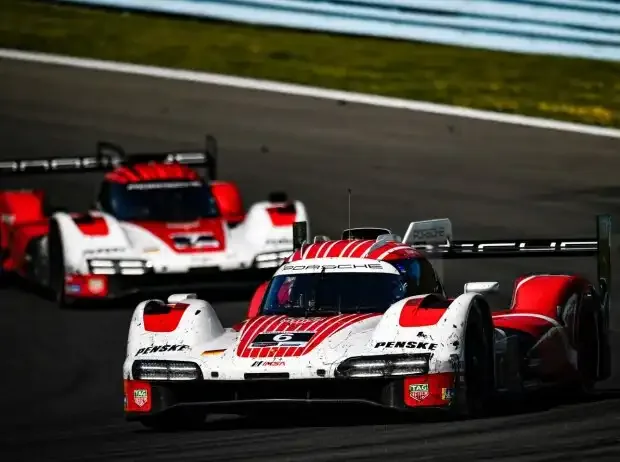










– How slow must the Porsche 963 be made so that there is exciting competition again in the IMSA SportsCar Championship? After the double victory at the 12 Hours of Sebring, officials are pulling out the biggest hammer available to them.
Read more Next Glock confidant gone: Dörr team radically restructures DTM project

For the first time in the history of the entire Hypercar/GTP regulations, a vehicle receives the most unfavorable classification possible: 480 kilowatts at 1.100 kilograms. The maximum additional weight for LMH and LMDh cars was increased to a maximum of 70 kilograms by the world governing body FIA before the 2024 season, at that time due to the Toyota GR010 Hybrid dominating the World Endurance Championship (WEC).
Now the negative maximum classification is being used in IMSA for the first time. Porsche Penske Motorsport will have to compete in the important range up to 190 km/h (different reference values apply on street circuits than on permanent race tracks) with a power-to-weight ratio of 2,292 kg/kW, 480 kilowatts at 1.100 kilograms. In contrast, the Aston Martin Valkyrie continues to receive the most favorable possible power-to-weight ratio of 1,981 kg/kW.
The additional weight compared to Sebring is no less than 45 kilograms for Porsche. With its dominance, Penske has now pushed those responsible to the limit, as more than 1.100 kilograms are not possible under the regulations. It remains to be seen what will happen with this classification in the street canyons of Long Beach.
For the first time, there is also a separate classification for the previous year’s Porsche from JDC-Miller Motorsports. This receives a significantly more moderate BoP than the 2026 963 of the Penske factory team. So the principle of “caught together, hung together” no longer applies. The different homologation statuses of the cars make it possible.
Classification up to 190 km/h: BMW benefits the most
In terms of power-to-weight ratio, the classification of the GTP vehicles for Long Beach is as follows:
1. Aston Martin Valkyrie – 1,981 kg/kW
2. BMW M Hybrid V8 – 2,057
3. Cadillac V-Series.R – 2,070
4. Acura ARX-06 – 2,117
5. Porsche 963 (2025) – 2,123
6. Porsche 963 (2026) – 2,292
Naturally, the Porsche restriction dominates the headlines. Such a blow has never before occurred in the history of the Hypercar regulations. The private Porsche must also add weight.
It almost goes unnoticed that Acura also has to take quite a hit. The ARX-06 becomes eight kilograms heavier and receives ten kilowatts less power. The Cadillac V-Series.R almost looks like a winner with 15 kilograms of additional weight and one kilowatt more power.
However, BMW comes off best: The M Hybrid V8 has to take on eleven kilograms itself, but in return receives almost seven kilowatts more power.
The reason for the weight increase of the other GTP vehicles will be the Aston Martin Valkyrie, which could not really keep up in either Daytona or Sebring. As already mentioned, its classification remains at the best possible power-to-weight ratio with 520 kilowatts at 1.030 kilograms.
Changes compared to the 12 Hours of Sebring 2026. It should be noted here that the low speed range there went up to 230 km/h and not up to 190 km/h as it does now:
1. BMW M Hybrid V8 -0,006 kg/kW
2. Aston Martin Valkyrie +-0,000
3. Cadillac V-Series.R +0,025
4. Porsche 963 (2025) +0,047
5. Acura ARX-06 +0,057
6. Porsche 963 (2026) +0,215
As the only GTP car, the BMW M Hybrid V8 thus receives a better classification than in Sebring. The Aston Martin remains at its ideal classification, while all other GTP vehicles receive a less favorable power-to-weight ratio.
Naturally, the 0,215 kg/kW for Porsche stands out. Neither in IMSA nor in the WEC has there ever been such a restriction between two races.
In 2025, Porsche determined the race in a battle with BMW, while Cadillac and Acura remained lackluster. Here are the changes compared to the previous year, which should however be taken with a grain of salt because there were updates to all LMDh cars last winter. Furthermore, the limit values of 230 and 240 km/h still applied here in 2025, so direct comparability is limited.
1. Cadillac V-Series.R -0,072 kg/kW
2. Aston Martin Valkyrie -0,070
3. Acura ARX-06 -0,042
4. Porsche 963 (2025)+0,008
5. BMW M Hybrid V8 +0,057
6. Porsche 963 (2026) +0,177
Cadillac is at the top of this list, but this is largely due to a rather unfavorable classification in 2025. The same applies to Acura and the then still quite new Aston Martin. Although BMW is classified better compared to Sebring, the classification compared to the previous year in Long Beach is even significantly worse.
Read more Jean Todt contradicts myth about Michael Schumacher’s arrogance
Within just three races, a remarkable delta has opened up between the individual vehicles: while at the season opener in Daytona all vehicles in the low speed range up to 230 km/h were within 0,017 kilograms per kilowatt, there is now a maximum difference of 0,311 kg/kW between Porsche and Aston Martin.
Classification over 200 km/h
Due to the low threshold of only 200 km/h, this range is quite relevant, especially on the long full-throttle section across the start/finish line:
1. Aston Martin Valkyrie – 1,981 kg/kW
2. Cadillac V-Series.R – 2,095
3. Acura ARX-06 – 2,097
4. BMW M Hybrid V8 – 2,102
5. Porsche 963 (2026) – 2,115
6. Porsche 963 (2025) – 2,123
Once again, the large gap from Aston Martin to the other manufacturers is noticeable. The Valkyrie has high drag and therefore needs a lot of help. This is why the power-to-weight ratio for the other GTP cars mostly increases.
Compared to Sebring, the changes look as follows, again with the restriction that the values here apply from 200 km/h, but in Sebring only from 240 km/h:
1. Acura ARX-06 -0,001
2. Aston Martin Valkyrie +-0,000
3. Cadillac V-Series.R +0,010
4. BMW M Hybrid V8 +0,026
5. Porsche 963 (2026) +0,026
6. Porsche 963 (2025) +0,034
As the only manufacturer, Acura receives a minimally better classification over 200 km/h than in Sebring. Aston Martin remains at its ideal classification, all other GTPs are further restricted.
And the changes compared to the previous year, again with the restrictions already mentioned (updates, speed ranges):
1. Aston Martin Valkyrie -0,062 kg/kW
2. Acura ARX-06 +0,043
3. Cadillac V-Series.R +0,053
4. Porsche 963 (2026) +0,058
5. BMW M Hybrid V8 +0,059
6. Porsche 963 (2025) +0,066
The 2026 Porsche goes from one extreme to the other in terms of engine power: it is allowed to use the maximum permitted 520 kilowatts over 200 km/h. Therefore, the previous year’s Porsche even loses slightly more in the upper speed range in terms of power-to-weight ratio than the current Porsche.
GTP BoP values at a glance
Values in brackets = change compared to Sebring 2026/Long Beach 2025 (note for power specifications that the limit values in both Sebring 2026 and Long Beach 2025 were at