





– The Monaco Grand Prix has always written its own technical laws in Formula 1. While on most tracks the most efficient compromise between downforce and drag is required, in the Principality one thing above all counts: maximum grip in the slow corners.
Read more Williams 2030 World Champion? Albon believes in Vowles’ prediction
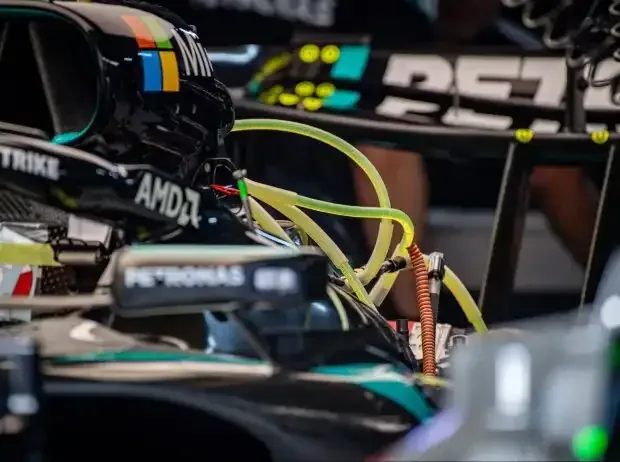
Several teams are taking advantage of precisely this circumstance at the current race weekend. By deactivating the so-called Straight Mode system in Monaco, additional space has suddenly been created on the rear wing – and some engineers have quickly realized how this can be converted into additional performance.
At the center is the rear wing actuator housing. This is located within a box defined by FIA regulations above the rear wing. Normally, this area houses the mechanics for adjusting the wing, which has replaced the former DRS function since the introduction of active aerodynamics.
However, since Straight Mode is not used in Monaco, the corresponding hardware becomes superfluous. This opens up a rare opportunity for aerodynamicists: the freed-up installation space can now be used to install additional aero elements.
Why Monaco is the perfect place for this trick
On most racetracks, such an approach would only be partially useful. Additional downforce brings more cornering speed, but at the same time causes more drag on the straights.
Normally, teams therefore try to find the optimal balance between maximum downforce and minimum drag. The most successful cars are those that achieve a good compromise in both areas. In Monaco, however, different standards apply.
Average speeds are low, straights are extremely short, and top speeds are significantly lower than on almost all other tracks on the calendar. Accordingly, additional drag loses much of its importance.

That’s why teams traditionally race with their largest rear wings of the year. Every additional kilogram of downforce can bring valuable hundredths of a second, while the disadvantages on the straights are hardly significant.
For this reason, aero solutions are often used in Monte Carlo that would be considered too inefficient on other tracks. In the paddock, this is occasionally referred to as “dirty downforce” – i.e., downforce that is effective but would normally generate too much drag. In Monaco, however, this is precisely not a problem.
More than just additional wings
The small auxiliary wings not only serve to directly generate additional downforce. At least as important is their influence on the airflow around the rear wing. The elements generate so-called upwash – an upward airflow behind the vehicle.
This increases the low-pressure area at the rear. If this effect is coupled with the diffuser, more suction is created under the vehicle floor. Air is drawn more quickly under the car, which in turn generates additional downforce.
This is particularly attractive for aerodynamicists because it allows the entire rear section to be used more efficiently. All of this is made possible by the exceptionally generous regulatory box for the actuator housing. This extends significantly beyond the actual rear wing elements and offers engineers sufficient vertical space to accommodate additional winglets there.
Read more Too bad: The Dodge Viper is not coming back
Mercedes takes a particularly aggressive approach
Mercedes is apparently pursuing the most striking approach in Monaco. The Silver Arrows have installed a veritable collection of small aero profiles around the central rear wing pylon. The construct visually resembles several small airfoils arranged one above the other.
Directly on the main pylon are three staggered winglets, with another element above them. Behind them follow two additional rows, each with two more wing profiles. A final winglet group is even attached to the upper rear wing flap.
Particularly noteworthy: The outer elements of each winglet cascade also feature so-called Gurney flaps. These small vertical edges at the wing end significantly increase the aerodynamic effect and provide additional downforce.
Big setback for Russell: Will Canada exit cost him the championship? I Race F1 Montreal 2026

Mercedes is undoubtedly one of the teams that are most consistently exploiting the potential of the loophole.
Red Bull, Audi and Cadillac choose different paths
While Mercedes relies on maximum complexity, other teams are pursuing somewhat more restrained concepts. Red Bull has apparently modified its existing actuator housing and integrated two additional winglets there. These are enclosed by small endplates and form a compact extension of the central rear wing area.
Audi, on the other hand, relies on two stacked aero elements that sit on the upper rear wing profile and are attached via a central pylon. The concept strongly resembles additional wing tabs, as can already be found in some other rear wing designs.
It is interesting that Cadillac has taken a very similar approach. The American team even removed the entire actuator area for Monaco to create space for the additional aero elements.
Racing Bulls also exploits the loophole
Racing Bulls has also become active. Red Bull’s sister team has redesigned its actuator housing to create a single extension of the central rear wing area. The aim is to increase the effective profile depth in this area and thus generate additional downforce.
As with Mercedes, a Gurney flap is also used here on the trailing edge to further enhance the effect. The different solutions show once again how creative Formula 1 engineers can be once a loophole opens up.
Since Straight Mode plays no role in Monaco, a normally purely functional component suddenly transforms into an additional development area for aerodynamicists. On most tracks, such an approach would hardly be attractive due to the higher drag.
Read more Strong criticism: Is Fabio Quartararo damaging his Yamaha legacy?
- MotoGPJorge Martin confirms Red Bull exit: “As of today, separate ways”
- Formel 1Typical Monaco: Audi Formula 1 car presented on luxury yacht
- MotoGPStrong criticism: Is Fabio Quartararo damaging his Yamaha legacy?
- Formel 1Kimi Antonelli warns about Monaco: Mercedes strong not only in engine
In Monte Carlo, however, every additional ounce of downforce counts.