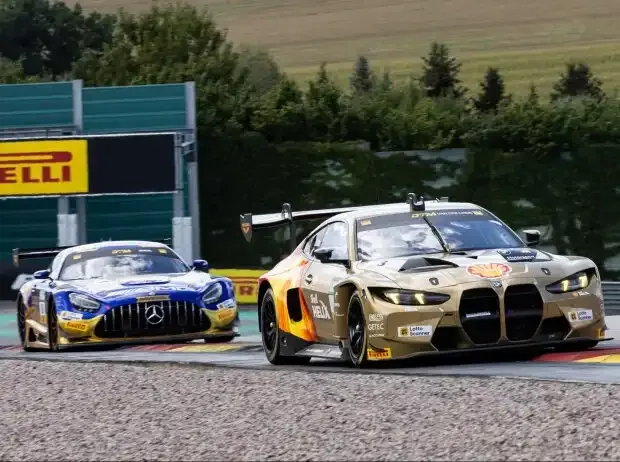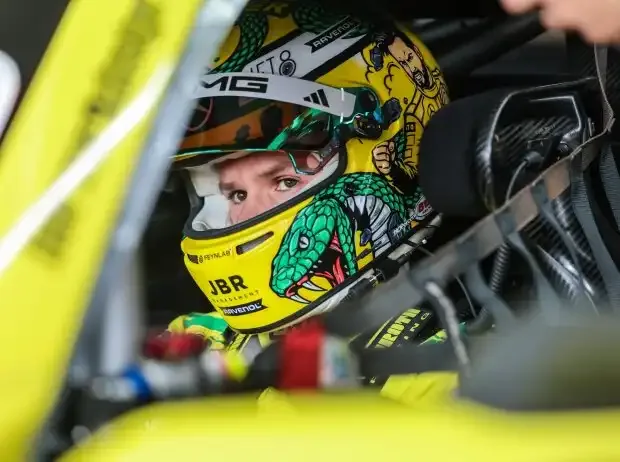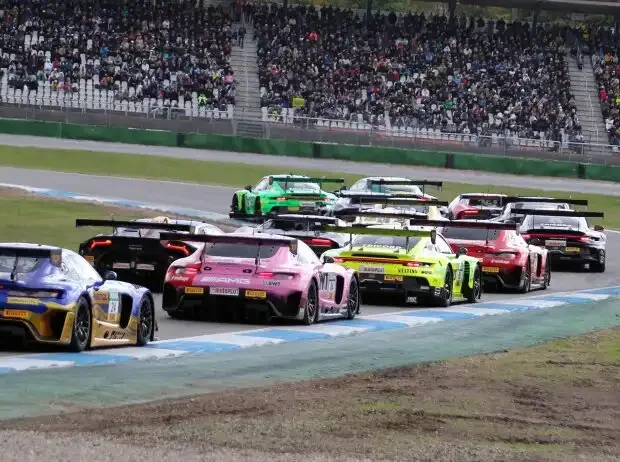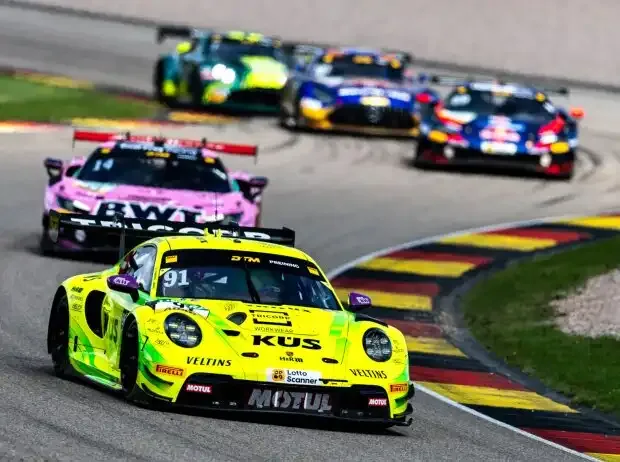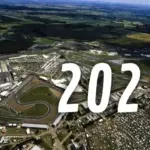
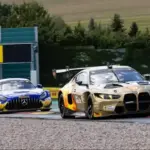



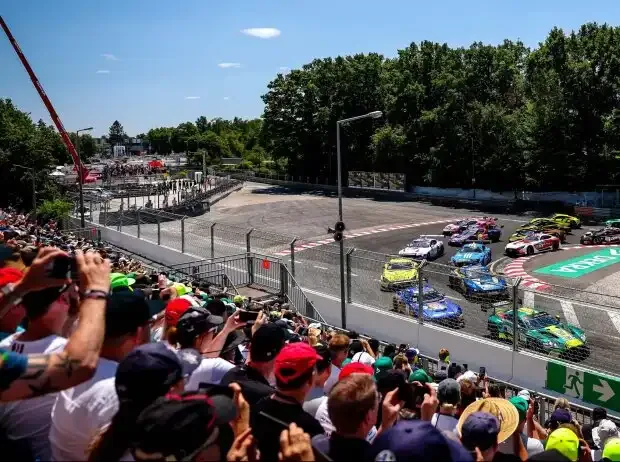
– Must safety be improved at the Norisring after one of the most severe DTM accidents in recent years? This question is not easy to answer, as street circuits always carry a higher risk. Nevertheless, Mercedes-AMG factory driver Maro Engel believes that there may be potential for improvement regarding the tire barrier into which Maximilian Paul crashed in the Grundig hairpin.
Read more Lewis Hamilton: Disappointment in Spa is on me!
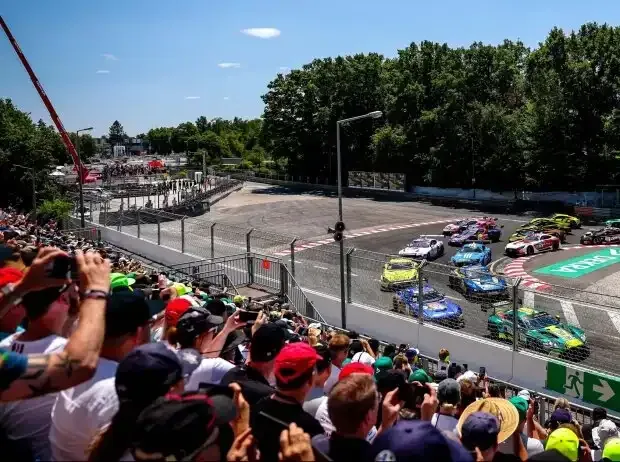
“Such an accident could probably happen in the same form in the hairpin at Hockenheim as well,” says Engel, who refers to “unfortunate circumstances” as the probable cause due to Timo Glock’s oil slick. “Nevertheless, you always have to look: What can be learned? What can be improved?”
One would have to investigate whether “another step can be taken” with the cars, “even if they have already held up very well,” says the 40-year-old. “Primarily, one could perhaps look at whether there would be space at the tire barrier, into which Max drove, to move it back a little further, so that the run-off area is enlarged again.”
Van der Linde: Norisring carries “a certain risk”
However, these are “details” that need to be analyzed, because such an accident “could probably happen in this form on any race track if unfortunate circumstances come together,” Engel is convinced.
Kelvin van der Linde, who sustained bruises when Paul’s Lamborghini hit his driver’s door and is already fit again, was “positively surprised” by how well his BMW, in particular, withstood the crash. “My cockpit was very badly damaged at the cage, but my seat and pedals were untouched,” says the German-South African. “These are the parts that protect the driver.”
The Norisring, as a non-permanent circuit, carries “a certain risk,” van der Linde is aware. “Especially Turn 1, if something happens. Even without me, Max would probably have hit the wall a bit further ahead,” says the Schubert BMW driver about the crash, in which Paul broke his tibia and fibula as well as a lumbar vertebra.
It’s clear: Had the Lamborghini factory driver not hit the BMW, he would have crashed into the tire barriers with enormous force. Nevertheless, the BMW factory driver considers it inappropriate to question the traditional circuit – and currently sees no need for action.
“I think the Norisring absolutely belongs on the DTM calendar. I don’t want to say that one has to rethink this race. But clearly: it’s a street circuit that has fewer run-off areas,” he says. “Such things happen there.”
Could more run-off be created in the first corner?
Indeed, it is noticeable that the tire barrier, into which Maximilian Paul’s Grasser Lamborghini crashed, is significantly closer to the Grundig hairpin than the run-off area on the far right in the direction of travel. This is due to the fact that there is a permanent guardrail behind the tire barrier.
Read more Lewis Hamilton: Overtakes will be 2026 “not as satisfying anymore”
Behind the guardrail is an asphalt area where a photographer’s podium and the crane for the TV camera are located on the DTM weekend. So there would presumably be room to make the run-off area a bit larger.
Photo gallery: The most spectacular accidents in the “new” DTM since 2000
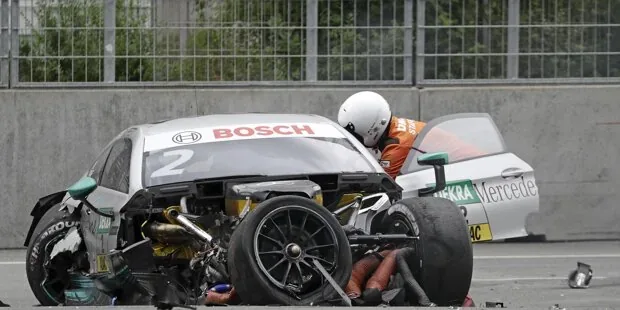
However, the question of whether a change makes sense is not as trivial as it seems: First, it must be checked whether anything can be done at all. And: Just because an accident would be less severe due to a measure does not mean that safety would also be improved in other incidents – or, in the worst case, even lead to a deterioration.
It can be assumed that those responsible will calmly review the matter in winter to consider potential improvements for 2027.
Rosberg narrowly avoided a catastrophe in the Grundig hairpin in 1994
Accidents are not uncommon at this point – also due to the enormous deceleration: in 1994, ex-Formula 1 world champion Keke Rosberg sped straight ahead at 240 km/h in the first DTM race due to complete brake failure in the Grundig hairpin – and was lucky in misfortune.
Because the Finn lightly touched Michael Bartels’ Alfa Romeo, his Calibra was slightly spun and at least somewhat slowed down. In addition, according to the specialist magazine Rallye Racing, a truck was parked crosswise at the end of the run-off area, which Rosberg fortunately missed.
“Hitting a tree shouldn’t be possible either”
Instead, the Opel slid backward against trees and a wall. “Hitting a tree on an internationally approved race track shouldn’t be possible either,” he was quoted as saying at the time.
In the severe DTM accident between Gary Paffett and Mike Rockenfeller in 2017, in which the Mercedes driver lost control of his car on a bump and – similar to Maximilian Paul – crashed into Rockenfeller’s Audi door, the run-off area played no role.
- Formula 1Aston race director says thank you: “Good that you journalists helped us”
- MotoGPJorge Martin and Ai Ogura: This is how they explain their move to Yamaha
- Formula 1After all: McLaren brings Macarena rear wing to Hungary
- DTMBoP trouble and curious tire tactics at BMW: “There is artificial intervention”
The deceleration was caused exclusively by the impact into the other car – Rockenfeller suffered a metatarsal fracture.
Read more Aston race director says thank you: “Good that you journalists helped us”