

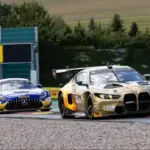

– The Lamborghini teams are leaving no stone unturned after the botched DTM start to get the major problems with the new Temerario GT3 under control. And that, even though Grasser and Abt, whose drivers were all at the back of the field in Spielberg, have only limited opportunities to make up the enormous deficit due to test restrictions.
Read more WEC Spa 2026: Numerous Interruptions in the Training Sessions
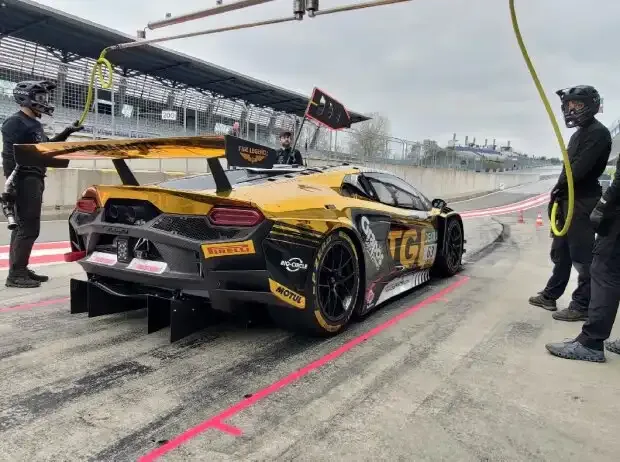
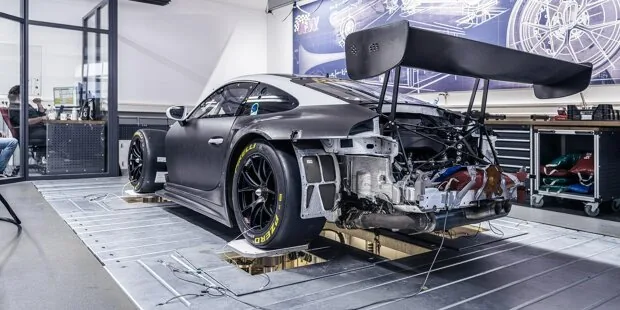
“We are on a chassis and damper test bench for five days this week,” reveals team boss Gottfried Grasser from the Grasser racing team in an interview with Motorsport-Total.com. “We hope that this will allow us to present our problems a bit more targeted and take another step forward.”
For this reason, the Grasser crew has rented space this week at Team Rosberg Engineering (TRE) in Neustadt an der Weinstraße. The company, which is located right next to the former DTM team, is owned by former Formula 1 world champion Nico Rosberg.
What Grasser expects from the week on the test bench
There, the Lamborghini team uses the so-called “Seven-Post-Rig.” This is a seven-post vehicle dynamics simulator, like the one also owned by the suspension manufacturer KW Automotive, on which the Temerario is moved not only by the four movable posts at the wheels but also at the rear and front. This simulates downforce and pitching during braking in different track sections.
Although the team hopes for progress, no miracles are expected. “We are aware that this only helps to a limited extent,” says Grasser. “With our current deficit, this might make up a quarter to half. It is a very long and hard road.”
Photo gallery: F1 technology in the DTM: How the KW vehicle dynamics test bench works
In Spielberg, where there are only nine corners, the Lamborghini drivers were almost a second per lap behind the top. “If you find two or three tenths, that is a good performance for a week of work,” is Grasser’s assessment. “But if a second is missing, it could also be that you find a bit more.”
“I think none of us has hit the window yet”
Because the new Lamborghini cars were apparently delivered without a functioning basic setup, much potential is likely still untapped.
“The difficulty right now is understanding the car because it does not react to our input as expected,” describes Grasser the current situation. “Every car has a certain window in which it works well and brings the tire to work. And I think none of us has hit that window yet.”
Read more MotoGP live ticker Le Mans: Marini with first best time on Friday
This can be interpreted as follows: The adjustment screws the engineers turn do not show the usual effect, even if the measures would theoretically be correct, causing a vicious circle.
Grasser remains combative despite the difficult situation: “Even if things don’t go well once, we step on the gas. Only one letter is given up – that is not our mentality.” (SPONSORED LINK: Secure tickets now for the 2026 DTM season!)
Why was the Temerario stronger in the IMSA series?
But how is it possible that the Temerario used by the Canadian Pfaff team was surprisingly strong with fifth place in the GTD-Pro class at the IMSA event in Laguna Seca? This could be due to the fact that those responsible for the Balance of Performance (BoP) there work with significantly more ballast, which also benefits the Ford Mustang GT3, which is capable of winning in the USA, unlike in other series.
Not only the Ford but also the Lamborghini is currently used at the lower weight limit. For example, the new Porsche Evo version carries 63 kilograms more weight than in the DTM, while the Temerario is only 17 kilograms heavier in the IMSA classification.
Why the BoP cannot help the Temerario in the DTM
However, analyses like these should be taken with caution, as parameters such as ride height, rear wing angle, and especially engine power also play a role in the classification. And while restrictors are still used in the DTM, power in the IMSA series is controlled via torque sensors, making a comparison difficult.
The fact is: With the SRO BoP used in the DTM, the responsible parties already have their hands tied. Less than the current 1,320 kilograms is not possible. The same applies to the ride height. And with additional boost pressure, the performance window jointly defined by the FIA and manufacturer during homologation would be exceeded.
Read more Why the “Yo-Yo Racing” Will Return Despite Rule Adjustments