

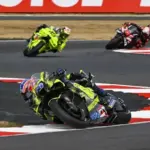

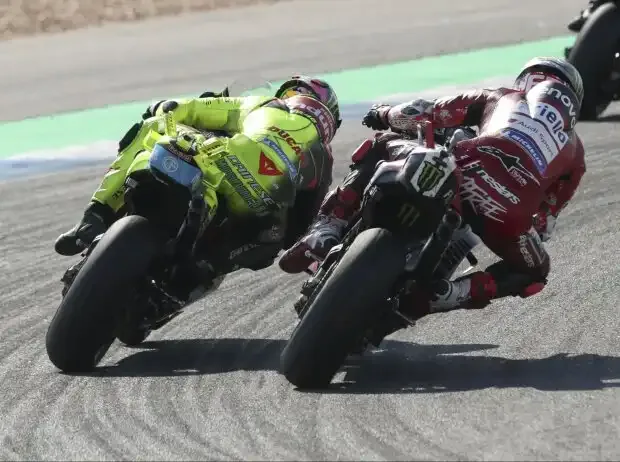
– Asymmetric tires have long been a fixed part of the MotoGP repertoire when track layouts show a clear imbalance in corner distribution. Especially courses with many corners in one direction – predominantly right or left turns – place one-sided stresses on the tires.
Read more Due to Formula 1 Break: Racing Bulls Delivers Rapid Double Update
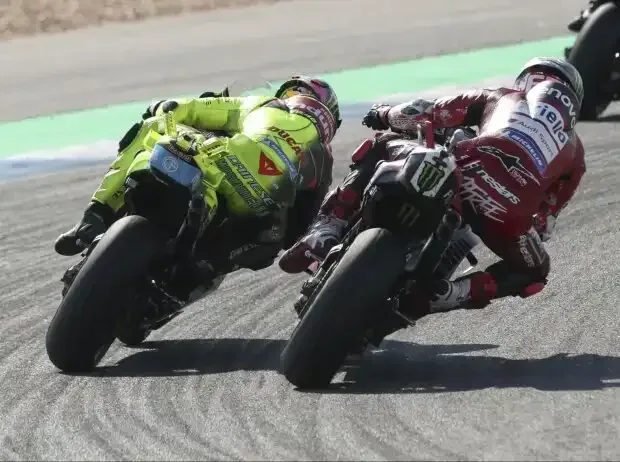
To counteract this, the supplier uses different rubber compounds within one tire: a harder side for the more heavily stressed flank and a softer one for the less stressed side. The goal is to balance wear, ensure consistent performance over the distance, and provide the rider with as neutral a driving feel as possible despite the asymmetric demands.
For Franco Morbidelli, such tires are long more than just a technical detail. They are a central factor for consistency and confidence at the highest level of competition. The Italian makes clear how subtle or indeed barely noticeable the differences between the tire sides are.
“Very similar performance on both sides”
At its core, asymmetric tires are about optimally mapping the track’s load. “You have different compounds because there is a strong and a weak side of the tire,” describes the VR46 Ducati rider.
The “weak” side is not inferior but simply less stressed because fewer corners are taken there. Accordingly, a softer compound is used there, while the more heavily loaded side is equipped with a harder compound “to better manage durability.”
Photo series: The motorcycles and teams of the 2026 MotoGP season
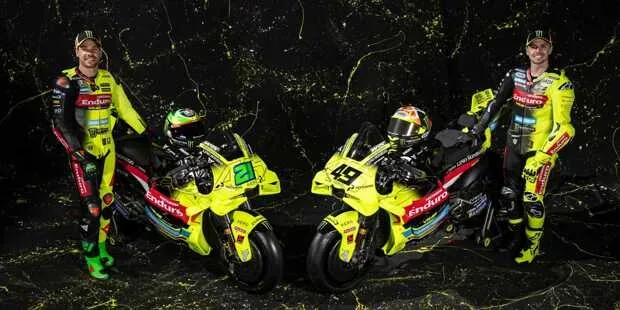
Ideally, the rider should not perceive this difference at all. “You don’t feel it, and not feeling the difference between the sides is a good thing,” emphasizes Morbidelli. Because that means “you have very similar performance on both sides, and that’s exactly how it should be.” For the engineers, this is a clear goal: maximum balance despite different demands.
Read more Due to Formula 1 break: Racing Bulls replaces Miami update already in Canada
Morbidelli especially praises the medium option
On the topic of temperature behavior, Morbidelli describes the current tires as particularly forgiving. While there is an optimal working window in which the tire delivers the best performance, this window is by no means narrow. “Yes, there is a window,” he says, but clarifies: “It is actually quite wide.”
In practice, this means the tire works reliably over a wide temperature range without performance suddenly dropping sharply. A sudden loss of grip, as was sometimes known in the past, is hardly an issue.
A decisive factor for this, according to Morbidelli, is the current tire compound. He especially highlights the medium option. “We have a really good tire that has a very wide range,” explains the Italian. This tire works equally convincingly on completely different tracks.
Photo series: The contract durations of the current MotoGP tracks
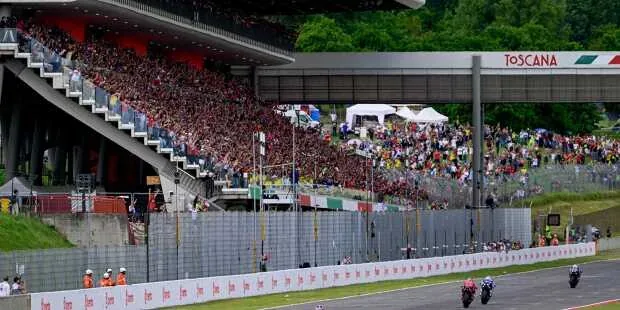
“It can be used from Phillip Island to Sepang, and the feeling is very good on both tracks,” even though these courses could hardly be more different.
- Formula 1Frentzen advises Verstappen: Better to quit if motivation is lost!
- MotoGPDespite KTM future: Alex Marquez continues to push Ducati development
- Formula 1Still 2026: Stefano Domenicali pushes for engine decision
- Formula 1Due to Formula 1 break: Racing Bulls brings rapid double update
The asymmetric version of this tire has also already proven itself. Morbidelli points to uses in Brazil and at the Sachsenring: “It is also really good, and the feeling with it is very positive.” The consistency across different layouts underlines the progress in tire development – an aspect that often makes the difference in a closely contested field like MotoGP.
Read more Still 2026: Stefano Domenicali pushes for engine decision