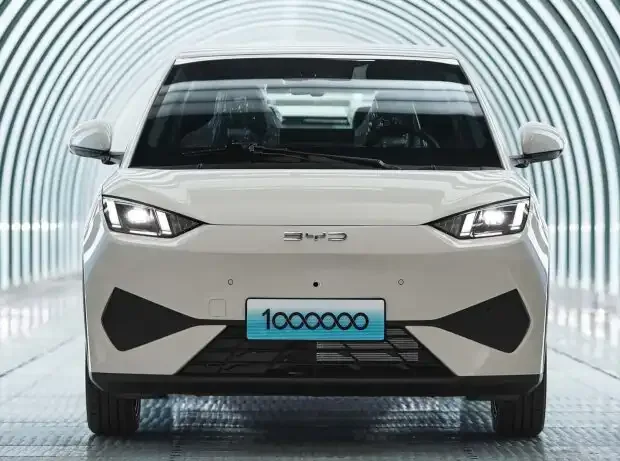



(Motorsport-Total.com/Motor1) – Is China taking over the German new car market? Well, certainly not. But some manufacturers from the Middle Kingdom are reporting notable successes, led by BYD. A total of 26,264 new registrations in the first half of 2026 in Germany, to be exact.
Read more Huge mistake: Chrysler said no to the anti-Ferrari sports car
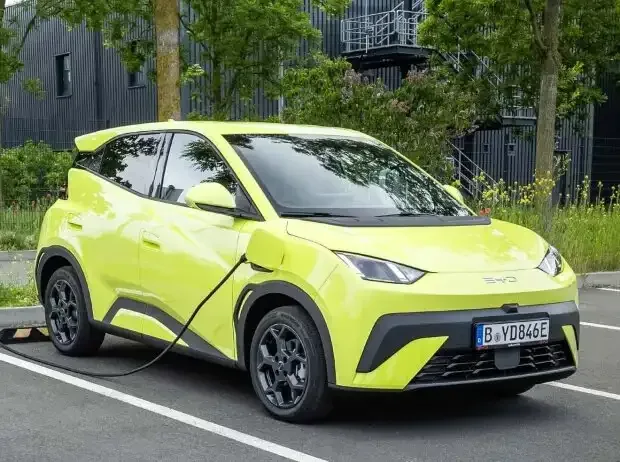
BYD, which claims to be the world’s leading manufacturer of electrified vehicles, was able to record another record month in June 2026 with 6,265 new registrations. The market share was again over two percent. However, the share of company registrations remains unclear. But BYD cars are now seen more frequently on the roads.
Particularly noteworthy is the share of private registrations in June: The 3,186 newly privately registered cars represent for the first time a share of more than 50 percent of the total result and a market share in the private market of almost three percent.
An interesting model for private customers is the Dolphin Surf. Including all state and BYD bonuses, it is currently available from 13,490 euros, with the larger 43.2 kWh battery it costs 15,940 euros. Is it worth going for the small dolphin? We have tested it extensively.
Body / Design
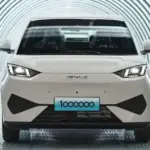
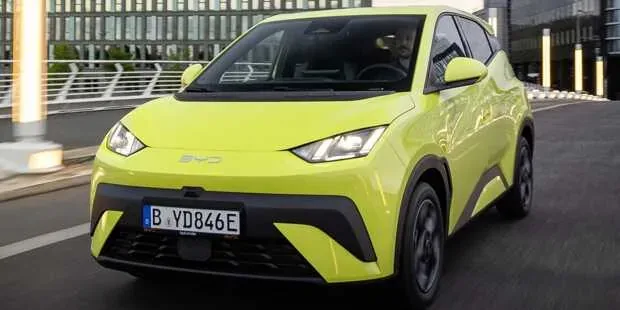
The 3.99-meter-long BYD presents itself as a angular small car with an overall length of around four meters and a distinctly independent character. At the front, the design shows quite sporty influences: The color scheme (“Lime Green” at no extra cost, more like a highlighter yellow) and the strikingly designed headlights almost remind one a bit of a Lamborghini Huracán.
Towards the rear, however, the designers seem to run out of steam (and length) visually, causing the Dolphin Surf to end very abruptly there. Surprisingly, there is no rear window wiper. Nevertheless, the Asian car leaves a fresh and coherent visual impression in urban traffic. The width is 1.72 meters, the height 1.59 meters, by the way.
Interior
Inside, BYD relies on a bold and innovative mix. The fact that a lot of hard plastic is used in this price-sensitive vehicle class is forgiven, especially since the designers have set clever accents. The armrests in the doors are covered with a pleasantly soft, leather-like fabric, and the dashboard surprises with a fashionable fabric cover and unusual, almost punched-out-looking ventilation holes.
Photo gallery: BYD Dolphin Surf (2026) in test
A real eye-catcher in the center console is the metallic control roller for the gears, which can be tilted up and down functionally. Unfortunately, despite the ribbing, the finger sometimes slips here; a lever would be better. The large storage compartments in the cockpit are well done.
Technically, the multifunction steering wheel stands out, which is intuitive to operate. In general, however, the operation is sometimes cryptic and not immediately intuitive. The software reacts super fast and is easy to understand. A real highlight (albeit with a slight gag character) is the central display, which can be rotated 90 degrees vertically at the push of a button on the steering wheel or via touchscreen.
Here, however, one occasionally stumbles over sloppy translation errors: If the rotation is triggered via the steering wheel button (which would have been better to make freely assignable), the system reports “not supported,” while pressing the monitor shows the English message “Not supported.” Wireless Apple CarPlay is set up in no time and runs absolutely flawlessly. Less so is the sometimes poor DAB radio reception.
The space in the second row surprises with surprisingly generous legroom. Where this space comes from becomes clear when looking behind the tailgate: The Chinese noticeably sacrifice trunk volume. At four meters exterior length, you can’t have everything, so the luggage compartment is rather below average at 308 liters. A plus here is the large compartment under the trunk floor. The tailgate itself closes with a strangely metallic sound.
The seats also falter in the comfort chapter, as they never really become cozy. Tall drivers sit too high in front. Also missing is automatic climate control, which can be annoying in everyday life, even though the manual system cools or heats quickly and reliably. In the tested top equipment, the car compensates for this deficit with features such as a 360-degree camera, seat heating, an electrically adjustable driver’s seat, as well as light and rain sensors.
Drive / Driving impressions
The electric drive with 115 kW equal to 156 hp convinces across the board and quickly makes one forget the classic combustion engine. The electric car offers a wonderful start at the traffic light and proves decent elasticity even at higher speeds – by no means a given in this vehicle class.
BYD does offer different driving modes, but in practice, you can skip them as no noticeable difference between the settings is measurable. The Dolphin Surf delivers an absolutely convincing performance in all situations in the drive department and is also surprisingly well insulated, making the interior pleasantly quiet.
A major criticism in driving operation is the range of assistance systems, especially the extremely aggressive lane keeping assistant (Lane Assist). The system reacts far too sensitively and constantly suspects an unauthorized lane departure. On the highway, this leads to an unpleasant, constant staggering, as the assistant pushes the vehicle into the lane with vehement force, only to countersteer far too strongly immediately afterward.
Read more George Russell explains his problems: «Like having to paint the Mona Lisa»
Consumption/Price
In our test operation, the energy consumption for a car of this size was somewhat too high. While values of 8.3 to 10.7 kWh were achieved in pure commuting between office and home, thirst climbs in mixed operation on country roads and highways to 14.7 to 15.4 kWh. On short trips, even peak values of 16.7 kWh were measured. However, BYD itself states a factory consumption of exactly 16.0 kWh, so the Dolphin Surf we tested was in the green zone.
That the test car with its generous full equipment already demanded a charging station after about 300 kilometers on the highway is no coincidence but due to the manufacturer’s model policy: BYD installs the 43.2 kWh battery in the top Comfort equipment. Combined with the powerful 114 kW (156 hp) electric motor, this results in an official combined range of 310 kilometers according to the WLTP cycle.
So if you are on the highway, this window naturally shrinks quickly. At the DC fast charging station, the Dolphin Surf draws up to 85 kW of power (65 kW in the base model), with which the battery is recharged from 10 to 80 percent in about 30 minutes. Not a great peak value, but the charging curve remains stable at 40 kW for a long time.
The Chinese compact car can be configured in three clearly tiered variants, with list prices being pushed extremely aggressively by the current BYD e-bonus and government subsidies. Somewhat like the Konsul-Haffenloher principle, for those who still know “Kir Royal.” “I’ll f*** you up so much with my money”:
Active as the base starts at a list price of 22,990 euros, but drops to almost unbeatable 13,490 euros including the bonus. This version combines a smaller 30 kWh battery with an 88 hp motor and delivers a pure city range of about 220 km (WLTP combined). So really only something for short distances.
The Boost equipment is listed at 26,990 euros and goes to the customer for 15,940 euros with bonuses. Here, the larger 43.2 kWh battery is already under the floor. Because it is combined with the smaller 88 hp motor, the Boost marks the range king of the series with an official 322 kilometers. Those who can do without the amenities of our test car (such as the 360-degree camera or seat heating) will find the rational best deal here.
Comfort (top equipment): Comes with a gross list price of 30,990 euros. After all subsidies, you end up at exactly 18,140 euros for the fully equipped version driven, including the 156 hp drive unit. It is to be assumed that most buyers – very similar to the Dacia phenomenon here in Germany – will go directly for this fully loaded variant.
And what does the competition have to offer? Mention should be made here of the somewhat shorter Hyundai Inster and Renault Twingo, but also Kia EV2 as well as the Fiat Grande Panda Electric. Looking at the German prices without bonuses: Inster with 42 kWh from 24,600 euros, Twingo with only 27.5 kWh from 19,990 euros. The Kia costs 26,600 euros with the same battery size as the Hyundai, the Fiat starts with a 43.8 kWh battery at 24,990 euros. You can see well: Without in-house subsidies, the BYD would not be a price breaker.
There is also very fresh competition from its own country: The MG4 Urban is almost 30 centimeters longer but costs only 24,990 euros before bonuses in the base with a 43 kWh battery.
More from BYD:
BYD Atto 3 Evo (2026) launch and first test: More than a facelift
BYD Great Han: First pictures of the new premium flagship
Conclusion
A price breaker with edges and corners: Apart from the increased highway consumption and the highly annoying, because much too rough-acting lane keeping assistant, there is simply not much to complain about. The initially very low prices relativize quickly without bonuses. Then the Dolphin Surf is no longer unrivaled.
If you are looking for an affordable electric car, you only have to agree on two things with yourself before buying: Either you accept the range limitations on long distances, or you reflect on whether you want to support the politically subsidized dumping price game of the Chinese car manufacturers. Viewed purely rationally, the BYD certainly offers a lot of value for money.
Pros:
– balanced drive
– independent design
– good space
– lots of standard equipment
- Formula 1“Shock to the system”: Spa reveals the problem of Formula 1 2026
- MotoGPWhy Alex Marquez and “Diggia” switch from Ducati teams to KTM
- Formula 1Don’t feel like Spa? New rules cause skepticism among drivers
- Formula 1Hadjar announces penalty: “Will probably start 22nd”
Cons:
– overaggressive lane keeping assistant
– sometimes complicated operation
– not so cheap without bonuses
– Do you want a China car?
Read more Formula 1 Live Ticker: The practice sessions for the Belgian GP in Spa live!