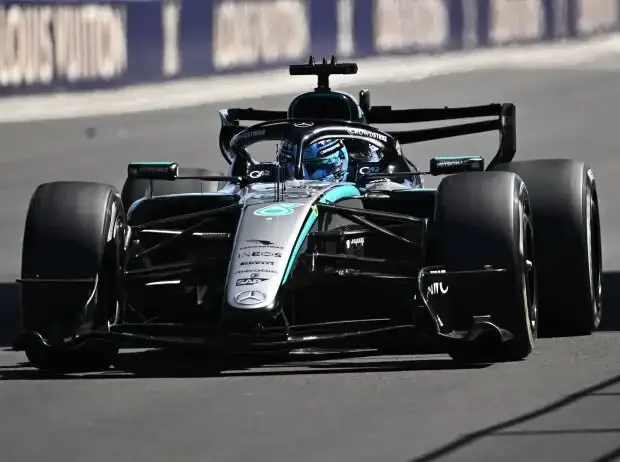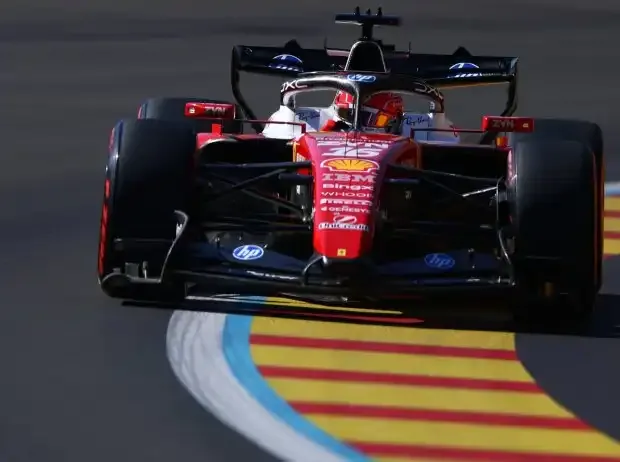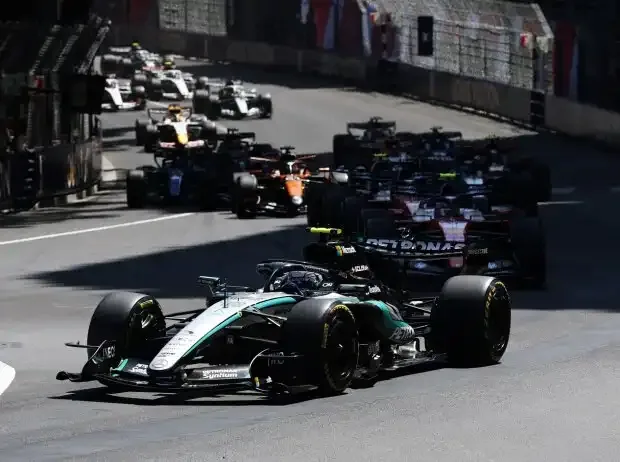



– When the assembled media representatives gathered in the McLaren hospitality on Saturday for a Q&A session with Andrea Stella, the Italian delivered one of the most insightful quotes of this Formula 1 season.
Read more Racing in the Blood: The Gjerdrum Brothers and Their Shared Goal
“If we try to analyze that, it immediately becomes extremely complicated. When I left the debriefing to come here, there were actually still discussions about why we are seeing deviations that, according to the underlying parameters, shouldn’t actually be there.”
In other words: Even Formula 1 teams don’t always fully understand what’s happening. This was the case at McLaren on Saturday evening, when Piastri lost a massive amount of time to Lando Norris on the straights – and apparently also with George Russell, who openly admitted in the media zone that he had no idea what was causing his time loss on the straights.
What exactly is happening there?
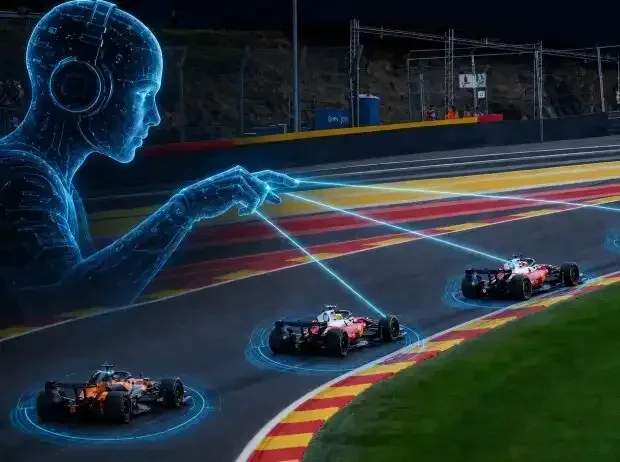
According to Stella, the phenomenon is related to the “self-learning elements” of the power unit.
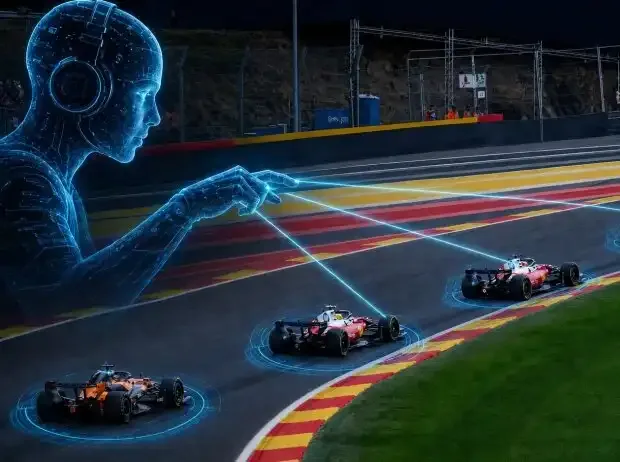
This is not artificial intelligence in the classical sense, but rather the interplay of predictive algorithms and self-learning systems. Based on numerous parameters, these continuously calculate the supposedly optimal strategy for power delivery.
The algorithm thus learns from previous laps and constantly adapts to the driver’s inputs to optimize power delivery for the next lap – which, according to Piastri, even applies to the warm-up lap.
“The engines are so highly complex, they react extremely sensitively to every little thing. Even what you do on an outlap can dictate what happens next. It’s a damn tricky way to race, but we just have to deal with it,” says the Australian.
This calculation does not only take place from lap to lap, but dynamically during the drive. If events deviate even minimally from simulations and standard values, the algorithm instantly calculates a new, adapted strategy for the remaining course of the track.
What sounds positive in theory can catch drivers cold in practice. The most vivid example was provided last weekend by Isack Hadjar in Q3: The Frenchman wanted to give Max Verstappen a slipstream and therefore waited for the four-time world champion at the exit of Turn 14.
This naturally did not correspond at all to the programmed deployment strategy. The result: The power unit control was confused and delivered a completely unexpected response when Hadjar got back on the throttle.
“The difficult thing is to assess what the engine will deliver to you in the next moment. If you almost stop at the exit of Turn 14 and then demand power again, the software is completely confused because you slowed down for no apparent reason,” explained Hadjar.
Without a grid penalty: Could McLaren have won in Belgium?
“On my first attempt in Q3, I suddenly had too much power and pulled away from him. On the second attempt, I then had too little power. So he came closer, and I couldn’t give him a slipstream for the entire straight. That was extremely difficult to judge.”
Even if this is an extreme example: The power unit already reacts to much smaller deviations. This is precisely why many drivers in Spa admitted to feeling helpless at times, as Piastri illustrated.
“If the starting grid in qualifying depends on whether the computer is behaving ‘well’ or ‘badly’ at the moment, that’s a pretty frustrating situation for us racing drivers,” he said.
“Here in Spa, the whole thing is naturally extremely amplified. But it’s not a nice feeling when you get out of the car after qualifying, look at the data from all the corners, and realize: ‘I’m driving exactly at my teammate’s level and yet I’m still two tenths behind at the end.'”
How much influence do drivers actually have?
This raises the question of how much drivers can actually control these fluctuations in power delivery themselves. Norris answered this in Spa as follows: “As a driver, you honestly have little influence on it. Sometimes it’s about whether you press the button a few meters earlier or later – that can make huge differences at times.”
“But while you have some things in your own hands, there are also an extreme number of things – far too many – that are completely beyond your control,” said the reigning world champion.
“It’s extremely unfortunate that so many external factors determine your qualifying pace. It’s no longer about driving skill, but simply about whether you’re lucky and the engine does exactly what it’s supposed to, instead of something unpredictable.”
However, it’s not quite so black and white. Part of the responsibility certainly lies with the driver – but in the realm of tiny nuances in pedal inputs that can have enormous consequences.
If a driver comes off the throttle a split second too late at one point or applies more than 60 percent throttle a touch too early at the corner exit, it throws the entire energy management into disarray. The sequence no longer corresponds to the calculated ideal, whereupon the algorithm immediately intervenes and sets a new strategy for the rest of the lap.
Photo gallery: Spa: Driver ratings from Marc Surer and the editorial team
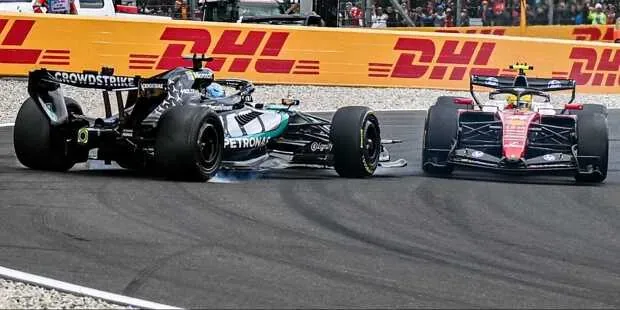
This explains why Norris already emphasized at the race in China that drivers no longer make the difference today with “the biggest balls,” but only by operating the power unit exactly “according to regulations” – however unnatural that may sometimes feel at the wheel.
Read more ID. Buzz with gasoline engine? VW tested range extender concept
It also explains why Mercedes initially told George Russell after the Silverstone race that his mysterious deficit on the straights was probably due to his driving style. The Brit worked intensively on it until Spa, but had to realize there that the deficit remained unchanged.
This aligns with Norris’ statements and Andrea Stella’s explanations. According to the McLaren team principal, the subtle differences in driver inputs only tell half the story. Other influences are indeed completely beyond the driver’s control – such as fluctuating grip conditions or the wind.
“The algorithm reacts highly sensitively to external influences,” explained the McLaren team principal.
“For example, if you suddenly encounter strong headwind, the drive on the straight effectively takes longer. This is a parameter that can hardly be reliably incorporated into a model because it has a purely random character.”
In the event of headwind, the system mistakenly assumes that the straight is longer than in the simulation. The planned energy deployment no longer matches reality, and the algorithm attempts again to spontaneously recalculate the energy management for the remaining lap.
“Whether it’s wind, fluctuating grip, or minimal driver inputs – all these factors are difficult to precisely capture in models and simulations,” said Stella.
How does this affect the balance of power?
These factors affect drivers in two ways. Firstly, in the way Piastri and Russell experienced it in Spa: Reduced power on crucial sections of the track simply leads to time loss against competitors or teammates.
Secondly, according to Stella, the fluctuations influence the driving behavior as a whole – especially the braking points.
“The whole thing not only affects the full-throttle limited sections on the straights but also shifts the braking points. If the system recovers an extreme amount of energy through super-clipping just before the braking zone, you suddenly arrive at the corner ten km/h slower – and the ideal braking point shifts.”
Light and Shadow at Mercedes: Antonelli wins, Russell crashes I F1 Spa-Francorchamps Race
“That’s extremely difficult for drivers to judge. It also explains why so many of them emphasize how complicated it has become to drive the car at the limit. It’s no longer just about getting the maximum out of the engine, but also about the fact that the usual reference points when approaching corners are constantly shifting,” said the McLaren team principal.
Precisely this unpredictability – and the fact that behavior can change unannounced from lap to lap – makes driving at the limit an extremely unnatural challenge.
Is there a solution?
There’s both good and bad news regarding this final question. The good news: On tracks like Budapest or Zandvoort, the issue will likely be much less in focus, as these circuits are less energy-intensive and energy management plays a subordinate role there.
The bad news, however, is that the problem on energy-hungry circuits will not disappear quickly. For one thing, even the engineers are repeatedly surprised by the control variables that Stella referred to as “random factors.”
“Previous analyses have only partially enlightened us. We are not yet at the point where we can say with absolute certainty that we understand every deviation in electrical power delivery in detail,” Stella admitted. “There are still unpredictable variables – although ‘unpredictable’ is relative. After all, nothing happens without a reason in engineering.”
“It’s simply the case that these systems react so sensitively to the smallest parameters that it’s almost impossible to isolate the causes, at least in the short term. I therefore think that we are still a few races away from fully understanding the behavior and optimal utilization of the power unit.”
Photo gallery: Formula 1 Fails: These rule changes were a flop
A key lies in the continuous refinement of simulation tools. The more precise the models become, the better teams and manufacturers understand the systems, and the rarer the unpleasant surprises will be.
McLaren confirmed in this context that they had received new simulation tools from engine supplier Mercedes HPP shortly before the Spa weekend, which they had been requesting for some time.
Nevertheless, Oscar Piastri’s honest assessment is sobering: These peculiarities simply lie in the basic architecture of the current regulations. While the two-stage adjustment step towards a 60-40 ratio from 2028 will slightly shift the focus away from pure electric drive, this will not eliminate the fundamental weaknesses, according to the Australian.
- IndyCarRLL reverts to two cars in 2027 – Mick Schumacher facing team change?
- MotoGP“Their Grand Prix”: Officials explain Sachsenring’s success
- MotoGPJorge Martin and Ai Ogura: How they explain their move to Yamaha
- Formula 1Komatsu explains Haas crash: “We were simply out-developed”
“That’s solely due to how the systems manage power. Adjustments to fuel flow and reduced energy delivery don’t solve this specific problem. It’s about how the engine is calibrated and how the software learns – that’s deeply embedded in the DNA of these power units.”
Read more Ducati CEO defends Spanish duo: “Don’t choose by passport”