







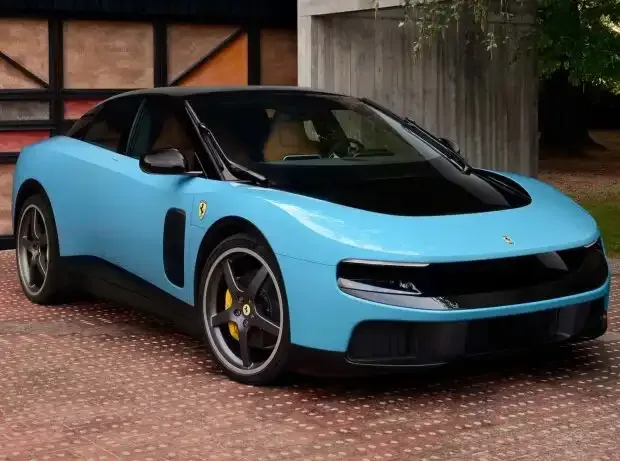
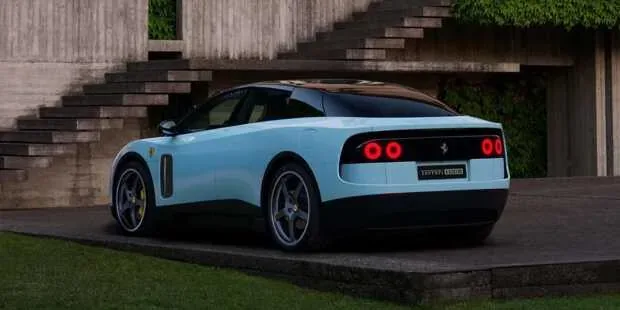
(Motorsport-Total.com/Motor1) – Hell freezes over, the unprecedented has happened: Ferrari presents its first pure electric car with the Luce. Now all the key data and the final look are available. It is (depending on the point of view) unusual, extravagant, or an acquired taste.
Read more Leclerc searches for answers to Canada debacle
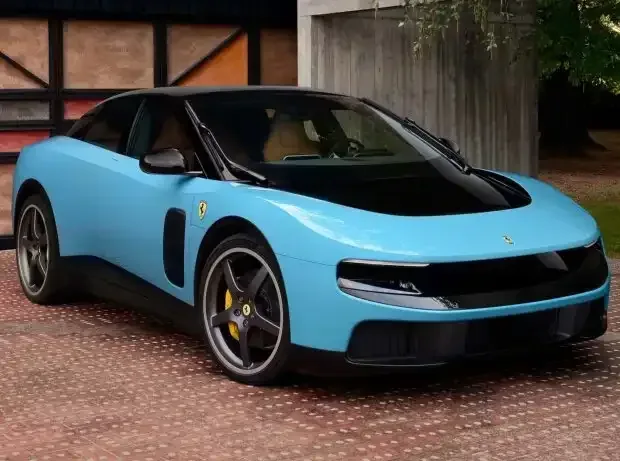
To ensure full control over product quality, all core components – including the electric motors and the battery pack – are manufactured in Maranello. The design was created in an interdisciplinary collaboration between Ferrari’s in-house Design Studio under Flavio Manzoni and the external creative collective “LoveFrom” led by Sir Jony Ive and Marc Newson.
But let’s not judge the aesthetic taste, instead let’s look at the hard facts. The packaging of the electric drive enabled a fundamentally new vehicle architecture for the Luce (Italian for “light”). The length of the four-door is 5,026 mm, the width 1,999 mm (without mirrors), and the overall height 1,544 mm. The wheelbase is 2,961 mm, while the track width at the front axle is 1,696 mm and at the rear axle 1,690 mm.
The important data
The total curb weight could be limited to 2,260 kg despite the heavy drive components. The axle load distribution is slightly rear-biased with 47% on the front axle and 53% on the rear axle, which supports dynamic driving characteristics. By eliminating the classic central tunnel and compactly integrating the components, the interior offers, according to Ferrari, “a generous amount of space,” complemented by a luggage compartment volume of 597 liters.
The aerodynamic development program, which included around 6,000 CFD simulations and 330 hours of wind tunnel testing over five years, primarily aimed at minimizing air resistance. Contributing to this are a smooth, continuously convex outer shell, a completely flat underbody, active radiator grille flaps (Active Aerodynamic Grilles), and a speed-dependent level control of the active suspension that lowers the front by 10 mm during driving.
The wheels have the largest staggered diameters ever used on a series Ferrari: 23 inches at the front axle, 24 inches at the rear, with the jet turbine design reducing air resistance in the wheel housing by about 5 percent. The thermal management relies on three separate cooling circuits for low temperature (800-volt battery), medium temperature (inverter, axles, chassis, and interior waste heat), and coolant (condenser), controlled by energy-optimizing software.
That much power
The fully electric all-wheel drive consists of four permanent magnet synchronous motors with radial flux technology derived from the F80, with the front units reaching a maximum speed of 30,000 rpm (peak power up to 210 kW, regular 105 kW) and featuring a decoupling system for pure rear-wheel drive, while the rear motors spin up to 25,500 rpm and each deliver 310 kW.
Photo gallery: Ferrari Luce (2026): This is the first pure electric Ferrari
The 800-volt system uses extremely compact inverters and a DC/DC converter with over 98% efficiency, powered by a 122-kWh battery built in Maranello with 210 cells connected in series, enabling a WLTP range of over 530 km and supporting DC fast charging up to 350 kW.
The battery housing is integrated as a fully load-bearing element into the chassis made of aluminum castings and extruded profiles. The Luce accelerates from 0 to 100 km/h in 2.5 seconds, completes the sprint from 0 to 200 km/h in 6.8 seconds, and reaches a top speed of over 310 km/h.
Read more 24h Nürburgring, Spa, Zandvoort: The crazy week triple for many DTM stars
From comfort to sound
The driving dynamics are controlled by the central Vehicle Control Unit (VCU), which compares parameters 200 times per second with the Side Slip Control X (SSC X) and regulates the three actuators per wheel (traction/regeneration, steering angle via independent rear axle steering, and vertical damping via ball screws).
A mechanically isolated, elastically mounted rear subframe minimizes mechanical vibrations in the passenger compartment. A proprietary, patented system also allows the driver to activate an artificially stepped torque increase via the right steering wheel paddle to simulate the feeling of progressive acceleration similar to an internal combustion engine, while the left paddle regulates the recuperation stepwise.
Instead of artificial sounds, a central acceleration sensor on the axle captures the real vibrations of the rotating components to filter, equalize, and reproduce this signal as functional acoustic feedback via external and internal speakers, speed- and throttle-dependent, based on the principle of an electric guitar.
Digital cockpit
The HMI concept strictly separates control (input) and information (output) and relies on a steering wheel milled from a single aluminum monoblock with ergonomic analog modules as well as a swiveling instrument cluster (binnacle).
For the displays, four Samsung-developed, backlight-free OLED panels are used: a 12.9-inch main display (binnacle) with two stacked layers and ground lenses for a three-dimensional parallax effect, a swiveling 12-inch central panel with palm rest and physical direct selection buttons for climate control, as well as a split rear panel in the back with 10.1 inches and 6.3 inches diagonal for real-time data transmission to the passengers.
The vehicle key made of Gorilla Glass features a world-first automotive “E-Ink” display that starts the system and releases the gear selector when docked in the center console.
The interior is upholstered with Italian leather and Alcantara, features electrically closing rear doors and individually adjustable seats with optional massage function. The acoustic finish is provided by a 3,000-watt high-end audio system with 24 channels, Class-D amplifier, and 21 specific speakers. Ferrari has not yet disclosed the price of the Luce.
Read more «Finally»: Lewis Hamilton experiences turning point at Ferrari
More from Ferrari:
Ferrari HC25: New one-off based on F8 Spider
Ferrari Amalfi Spider (2026): Open towards Roma