









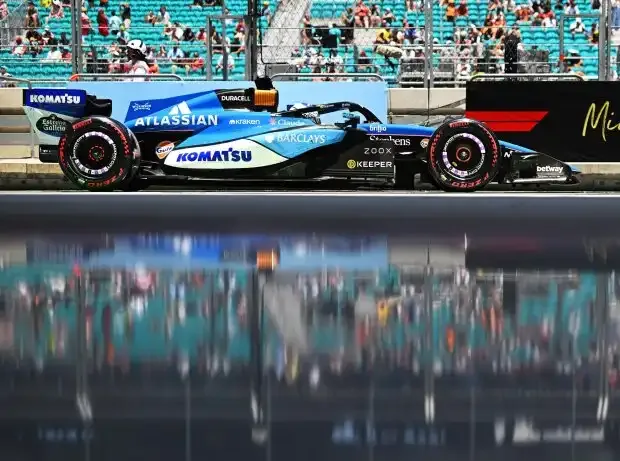
– In the sprint qualifying for the Miami Grand Prix, there was an unusual delay in the evaluation of track limit violations in Formula 1. Alexander Albon initially benefited from this.
Read more New Pecking Order in Miami: Why the Lead Suddenly Shrinks
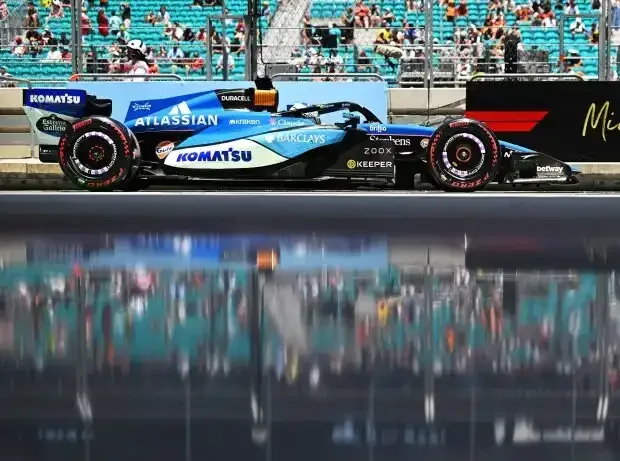
The Williams driver made it into the second part of qualifying, but the lap that allowed him to advance was subsequently deleted. The victim was Liam Lawson, who was no longer allowed to compete in the second part of the sprint qualifying.
While the clock was already running in SQ2, the TV images showed an unusual scene: Lawson was sitting ready to start in his Red Bull car in the garage. The New Zealander had actually been eliminated in the first part as 16th, but his team hoped for a return to the track.
Why the violation was recognized too late
The officials assumed that Albon’s time would have to be deleted due to a track limits violation. At that time, Albon was listed 14th with a time of 1:30.216 minutes, which had cost Lawson a place among the top 15.
Albon had indeed left the track at turn 6, but the FIA’s system did not immediately register the violation. An FIA spokesperson explained that tire marks on the asphalt, coming from other racing series such as the McLaren Trophy, the Porsche Carrera Cup, or Formula 2, had impaired the automatic detection.
F1 Miami: Friday Analysis

Race director Rui Marques did report the incident to the stewards, but by that time SQ2 had already started. As a result, after review, not only the questionable lap from SQ1 but also all times achieved in the second part by the Williams driver were deleted. With his remaining time of 1:31.322 minutes, Albon dropped to 19th on the starting grid.
Albon only 19th on the grid after penalty
“The stewards heard the team representative and examined the data from the positioning and marshalling system as well as video evidence,” the reasoning stated. “During SQ1, car 23 clearly exceeded the track limits at turn 6. However, this was only reported to the stewards after SQ2 had already started.”
Read more Formula 1: FIA rules cause new problems in Miami
The stewards further explained: “Car 23’s time in the lap where the track limits were exceeded was sufficient to place him in SQ2. When the stewards were informed that car 23 had left the track and that his lap potentially should have been deleted, he was already on the track in SQ2.”
“Since this was an unusual situation, the stewards decided to resolve the matter by exercising their authority under Article 11.7.1.a of the International Sporting Code by deleting the lap time of the relevant lap in SQ1. Since car 23 should not have advanced to SQ2, all lap times from SQ2 are consequently deleted.”
Precedent case Perez in Spielberg 2022
This case is reminiscent of a precedent from Austria in 2022. At that time, Sergio Perez reached Q3 and qualified fourth before it was found that he had exceeded track limits in Q2. All subsequent times were also deleted then. Red Bull team principal Christian Horner criticized this at the time and emphasized that the issue “should have been resolved before Q3”.
However, the stewards already stated at that time: “The team argued that it had taken risks and used resources to compete in Q3. The stewards accept this point. However, when assessing a penalty after a session, this does not differ from any other situation.”
- Formula 1Alessandro Zanardi passed away at the age of 59
- Formula 1Formula 1 live ticker: Sprint and qualifying live in Miami
- Formula 1Miami Friday in analysis: McLaren breaks Mercedes dominance
- Formula 1New pecking order in Miami: Why the lead suddenly shrinks
“The usual penalty is the deletion of the relevant lap time, and the stewards impose the same penalty here. As a result, however, the driver would not have advanced to Q3, and therefore the stewards order, in fairness to all other participants, that all lap times of the driver for Q3 are also deleted.”
Read more Trackhouse looks for Ogura replacement: Why Davide Brivio doesn’t want to get a rookie