






(Motorsport-Total.com/Motor1) – Do you know Absurdistan? The place where all reason is thrown overboard? That must be exactly where this Kia EV9 GT hatched from its dinosaur egg. Absurdly large, absurdly heavy, and absurdly fast, it is above all one thing NOT: reasonable.
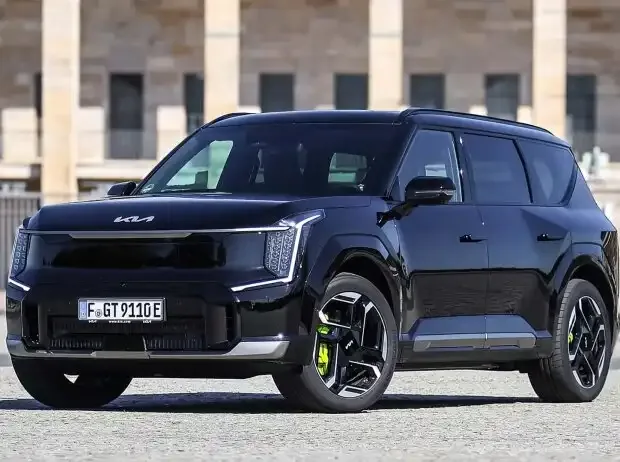
That is exactly why it is somehow fascinating. Over five meters long, up to seven seats, 374 kW, and an appearance like an FBI SUV from a manga film. At the same time, it wants to be a Grand Tourer, family hauler, tow vehicle, and long-distance electric car. That is a lot of demands for a single car. And surprisingly much of it this colossus actually manages.
For InsideEVs, the EV9 GT is especially exciting because it is not just a pumped-up EV9 with a green thread in the steering wheel. Kia packs here a 99.8 kWh battery, 740 Nm, 210 kW DC charging power, 2.5 tons towing capacity, and plenty of standard equipment into a car that costs 90,490 euros in Germany according to the price list, clearly below many electric prestige SUVs. That sounds like a pretty good deal at first. Until you start taking the “GT” literally. But step by step …
Quick data Kia EV9 GT (2026)
Drive: Two permanent magnet synchronous motors, all-wheel drive
System power / torque: 374 kW (508 hp) / 740 Nm
Battery (net): 99.8 kWh
Range (WLTP): up to 510 km
DC charging power: up to 210 kW
Base price: 90,490 euros
Body/Design
In black, the EV9 GT does not just look big, but almost absurdly big, which it certainly is. By the way, the first test car that I only got into my standard garage with great difficulty. How I got out then, I’d rather not mention. Just this much: it was not fun! At least for me. Probably for observers it was …
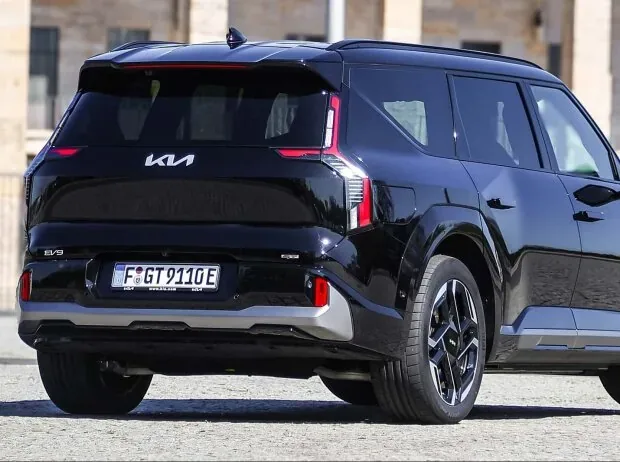
Officially, we are talking about 5,015 millimeters in length, 1,980 millimeters in width, and 1,755 millimeters in height, but subjectively there is clearly more car in front of you because the body is so angular, tall, and uncompromisingly upright designed. Especially the front has impact. Very high nose, sharply designed lights, lots of surface, lots of presence. The thing stands there like a rolling security service for intergalactic state guests.
Photo series: Kia EV9 GT (2026) in test
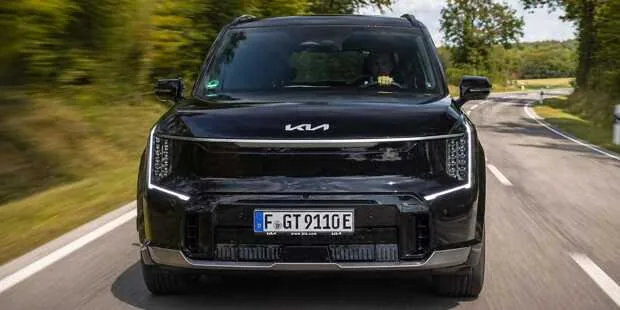
And the amazing thing is that this massive appearance still looks coherent. The GT version brings its own light signature, 21-inch wheels, and neon-colored brake calipers with GT lettering, plus Panthera Metal as an exclusive GT color in the program, although black suits the car almost even better. Kia did not try to build an elegant foil here. Rather a sledgehammer with clean edges. You have to like that. We do.
Interior
Inside, the EV9 GT remains clearly recognizable as a Kia. In front of the driver sit two 12.3-inch screens, between them the 5.3-inch climate screen, plus head-up display, Meridian sound system, Kia Connect, Digital Key 2.0, and plenty of other technology. It looks modern and in the GT also pleasantly dark, with black Alcantara, leather look, and bright green details. The neon accents are actually a tricky number. Here they work, as already with the EV6 GT.
Not everything is gold just because 90,000 euros are on the price tag. Up top in the interior, many things are soft, finely made, and partly even really noble, but down below there is surprisingly much hard plastic. That is simply too much in this class. Also, the climate display is located in a place partially obscured by the steering wheel. That is not a catastrophe, but quite an unnecessary blunder in a car that otherwise puts so much effort into its tech appearance. Kia probably knows that because there are at least physical buttons for the most important climate functions.
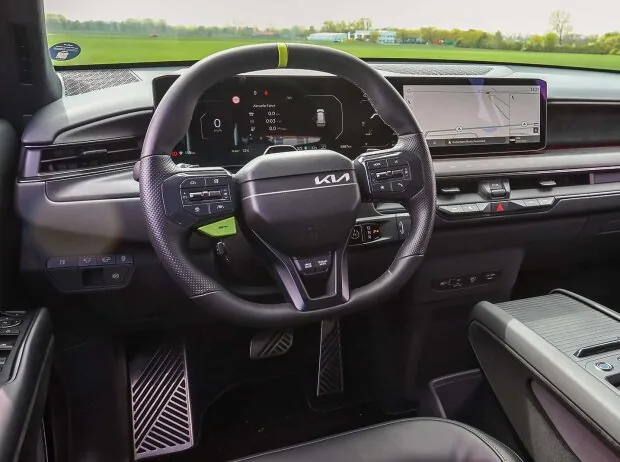
The (touch-heavy) operation otherwise leaves no puzzles. The system is now very well organized and logically structured. Together with the good voice control and the control buttons on the steering wheel (only the plastic rollers are very slippery), a logic emerges that is quickly understood. Only why the seat control was distributed both on the side of the seat and in the door is questionable.
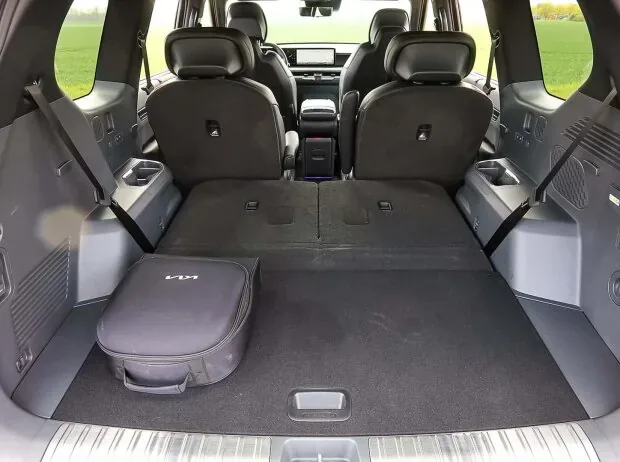
Regarding space, the EV9 GT then breaks almost all criticism. The wheelbase of 3,100 millimeters is not just brochure fodder; you feel it everywhere. Up front, you sit on absurdly comfortable relaxation seats with massage, heating, ventilation, and plenty of adjustment options; in the tested six-seater, two captain chairs with leg rests and lots of space in every direction reign. Even the third row is not just for show. And the trunk remains fully family-suitable with 333 liters with all seats up, 828 liters in the six-seater with the third row folded down, and up to 2,393 liters maximum. Plus 52-liter frunk. There really is hardly a dry eye here.
Drive/Driving impressions
The facts: Two electric motors, all-wheel drive, 374 kW, 508 hp, 740 Nm, 0 to 100 in 4.6 seconds, top speed 220 km/h. And yes, this beast actually goes as the numbers promise. Especially in GT mode, the EV9 GT pulls surprisingly energetically, even if you cannot ignore the 2.7 tons curb weight. Only beyond 100 km/h do you notice more clearly that frontal area and weight take their toll.
In city traffic and on country roads, the efficiency initially surprised us positively. For such a large and powerful SUV, consumption under 20 kWh per 100 kilometers is absolutely respectable if you use recuperation sensibly and do not constantly press the carnival button on the steering wheel. The latest generation i-Pedal works well, brakes cleanly to a stop, and remains active even after restart, even in reverse gear. That’s exactly how it should be.
The downside comes on the highway. At a constant 130 km/h, we calculated a maximum range of 310 kilometers, with a consumption of 32.8 kWh per 100 kilometers. That is not a drama for a car of this size, but also far from efficiency romance. The official WLTP range of up to 510 kilometers thus clearly remains a laboratory value, while the WLTP highway consumption of 28.9 kWh per 100 kilometers at least indicates where the journey goes at higher speeds. Weight and shape always come along.
Technical data Kia EV9 GT
Drive: Two permanent magnet synchronous motors, all-wheel drive
Power: 374 kW (508 hp)
Torque: 740 Nm
Battery capacity: 99.8 kWh
Battery weight: 566.5 kg
0 to 100 km/h: 4.6 seconds
Top speed: 220 km/h
WLTP range: up to 510 km
Combined power consumption (WLTP): 21.7 kWh/100 km
Highway power consumption (WLTP): 28.9 kWh/100 km
Max. DC charging power: 210 kW
AC charging: 11 kW, three-phase
Charging time DC 10 to 80 percent: approx. 24 minutes
Towing capacity braked: 2,500 kg
Towing capacity unbraked: 750 kg
The EV9 GT charges with a maximum of 210 kW at the DC station; the sprint from 10 to 80 percent should succeed in 24 minutes. In a spontaneous charging test without preconditioning, our test car started at around 140 kW, later rose to about 190 kW, and was still around 133 kW at 80 percent. This is exactly where the 800-volt architecture plays its trump card. Not necessarily with the highest peak, but with a stable charging curve. This was confirmed in the extensive charging test, where we actually needed only 22 minutes from 10 to 80 percent with a preconditioned battery and even reached the full 210 kW at times.
We liked the charging planning via the Kia app better than the display in the car. In the app, the state of charge (SoC) at arrival is calculated and displayed precisely during charging planning. Unfortunately, this info is no longer shown in the car. This info is not unimportant on long trips. However, the new Kia app works convincingly in everyday life, from charging monitoring to pre-climatization.
The steering is really a pity. For a car with GT in the name, it is too indirect, somewhat too heavy in city traffic, and overall lacks feedback. In sport mode, it becomes firmer but not really more precise. Also, in long highway curves and on on- and off-ramps, the clean line guidance is missing; the return moment feels listless. Kia can actually do better, which is why it is so unpleasantly noticeable here.
The chassis delivers a mixed but ultimately rather good picture. At low speed, the EV9 GT occasionally feels a bit stiff-legged; on the highway, however, the electronic damper control does a very good job, especially if you put together a sensible mix of light steering, soft chassis, and sharp drive in individual mode. Then this colossus rolls over bumps surprisingly calmly. That fits the character of the car much better than the artificial transmission simulation.
Because yes, there is also Virtual Gear Shift here with synthetic engine sound via the Meridian system. Technically, it is surprisingly well done; content-wise, it remains somewhat questionable. In the EV6 GT or Ioniq 5 N, you can debate it. In the EV9 GT, the whole thing feels more like a party trick that nobody really needed.
The assistance systems show light and shadow. Positively, the speed limit warning and lane assistant can be calmed down pleasantly easily by long press, and the attention assistant works pleasantly unobtrusively. Less convincing was the automatic lane keeper on the highway, which constantly oscillated between the markings on straight stretches, as well as the parking assistant, which was too slow, too cumbersome, and too clumsy in practice when parallel parking. The hardware is there; the fine tuning does not yet seem to be at the level of the rest of the car everywhere.
The noise comfort also shows a divided picture. Rolling noise and outside noise remain pleasantly low; the double glazing helps noticeably. From about 130 km/h, however, you hear distinct wind noise at the A-pillar. That is hardly surprising with this shape but still present. Whoever builds such a rolling wardrobe does not get physics for free.
Dimensions: Kia EV9 GT
Length: 5,015 mm
Width: 1,980 mm
Width incl. exterior mirrors: 2,263 mm
Height: 1,755 mm
Wheelbase: 3,100 mm
Ground clearance: 177 mm
Turning circle: 12.4 m
Trunk volume (all seats upright): 333 liters
Trunk volume (3rd row folded): 807 liters (7-seater) / 828 liters (6-seater)
Maximum trunk volume: 2,318 liters (7-seater) / 2,393 liters (6-seater)
Frunk: 52 liters
Curb weight: 2,718 to 2,750 kg
Price / Competitors
According to the German price list, the EV9 GT starts at 90,490 euros, plus options such as the relaxation package for the second row for 990 euros, the panoramic glass roof for 990 euros, or digital exterior mirrors for 1,190 euros in combination with the glass roof. That is a lot of money. But measured by space, power, charging performance, equipment, and warranty package with 7 years manufacturer warranty, 7 years Kia Connect, and map updates, it almost seems surprisingly fair.
In the price segment around 90,000 euros, there are some tough competitors. The Mercedes EQE SUV 500 4Matic starts at about 112,000 euros and offers more prestige but less space and only a 90 kWh battery with similar charging power. The BMW iX xDrive50 is priced close at 105,000 euros but has a larger 111.5 kWh battery and a somewhat better WLTP range of 630 kilometers—however, with fewer seat rows and less trunk flexibility.
The Tesla Model X Long Range Plus costs around 105,000 euros, offers 100 kWh and Falcon Wings, but falls behind the EV9 GT in towing capacity and interior variability.
The Kia EV9 GT stands out with its unique 7-seater variability, 2.5 tons towing capacity, and aggressive price for this equipment density. It sacrifices some efficiency and driving dynamics but remains a serious underdog in the family electric giant field.
Conclusion 7.5/10
The Kia EV9 GT is best when you do not confuse it with a sports SUV. The GT in the name raises expectations that the steering and parts of the driving dynamics do not quite fulfill. As an extremely fast, very comfortable, huge electric cruiser with strong charging behavior and almost absurdly much space, it is really good. It is not refined enough for a full dynamic rating. But as an electric family express with power in the back and plenty of character, it hits a nerve that many sterile premium electric cars now miss.
Pros:
– Impressive presence with distinctive GT design
– Fantastic space in all three rows
– Strong drive and convincing charging performance
– Very good seats and high long-distance comfort at speed
Cons:
– Steering too indirect and not precise enough
– Hard plastic in the lower interior inappropriate for the price class
– Assistance systems not consistently well tuned
– Highway consumption at 130 km/h quite high
- Formula 1Miami analysis: Verstappen and Leclerc penalized afterwards!
- Formula 1Formula 1 live ticker: Does Ferrari have a problem with the simulator?
- Formula 1Who slept best last night: Kimi Antonelli
- Formula 1Who slept worst last night: Mattia Binotto
More large SUVs in test:
Porsche Cayenne Turbo Electric (2026): 850-kW rocket in test
Citroën e-C5 Aircross (2026) in test: extravagance with pitfalls