






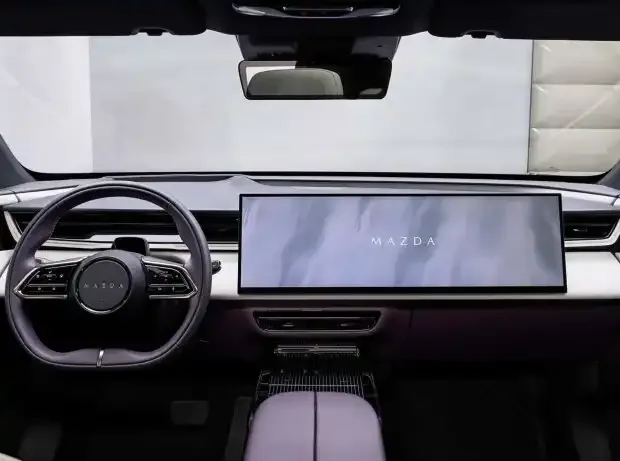
(Motorsport-Total.com/Motor1) – For many years, Mazda resisted the trend toward more and more screens, not only deliberately doing without oversized displays but also avoiding touch operation. However, current new models show a clear change of course. By now, the Japanese company can probably no longer escape current developments.
Read more Haas: How the smallest Formula 1 team mastered the storm of the rules
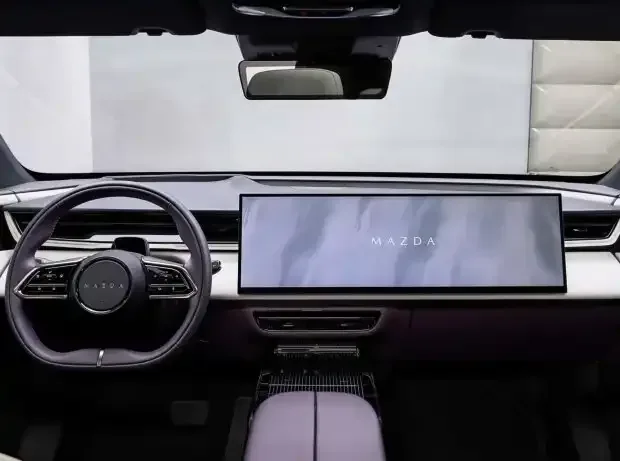
The rotary-push controller is history; instead, the Japanese are increasingly relying on giant infotainment systems. But as understandable as the concern is that tablet-sized screens could be distracting, Mazda’s European design chief sees it differently. In an interview with the Dutch magazine Autoweek, Jo Stenuit defended the move toward significantly larger infotainment solutions.
Looking at the CX-6e and its gigantic 26-inch touchscreen, Mazda’s Europe Design Director said regarding increasing distraction: “A screen offers many more possibilities to present information more clearly. And therefore not necessarily more. In the CX-6e, we invite the passenger to become part of the driving experience.”
Mazda relies on head-up displays#b
Despite the large screen, Mazda still sees the interior as driver-oriented. This sounds contradictory at first – but Jo Stenuit argues that a head-up display, which replaces the classic digital instrument cluster, directs the gaze to the road: “Even with the CX-6e and its screen that extends to the passenger, the focus remains on driving. I consider a head-up display to be significantly more important than an instrument cluster. With a good head-up display, you don’t need round instruments because you can concentrate better on the road.”
It is worth mentioning: Mazda’s other electric car, which is developed and built in China together with joint venture partner Changan, still has a screen directly in front of the driver. The 6e as a liftback has a 10.2-inch instrument cluster combined with a rather moderate 14.6-inch touchscreen. These are also not the only models with a strong screen focus: the bestseller CX-5 is now available with a 15.6-inch central display.
Read more BoP NLS3 2026: The Balance of Performance for the GT3 cars
Larger displays, fewer buttons#b
One might be tempted to interpret the disappearance of most physical buttons and the rotary-push controller in the style of BMW iDrive as a cost-cutting measure – however, Mazda presents it differently. Allegedly, this corresponds to customer wishes. Speaking to Motor1 last year about the simplified cockpit of the CX-5, Tamara Mlynarczyk, Manager for Public Affairs at Mazda North American Operations, said:
“Based on customer feedback, we have developed a new Human-Machine Interface (HMI) that prioritizes ease of use while maintaining Mazda’s philosophy for safe driving. The new CX-5 switches from the Commander to a touchscreen central display, which is best suited to keep hands off the steering wheel as little as possible.”
It is rare for a manufacturer to make such a U-turn compared to previous generation models and some vehicles still on offer. Jo Stenuit explained to Autoweek, “technology and the market have changed,” suggesting that interiors will develop in this direction in the future. Hopefully, Mazda will make an exception appropriate for the model with the next MX-5 and not overload the dashboard with a screen that is too large.
Read more After Bearman crash: Haas team principal warns against quick rule changes
More on Mazda:
Mazda wants to keep the next MX-5 under one ton in weight
Mazda CX-5 (2026) first test: Bestseller reloaded