





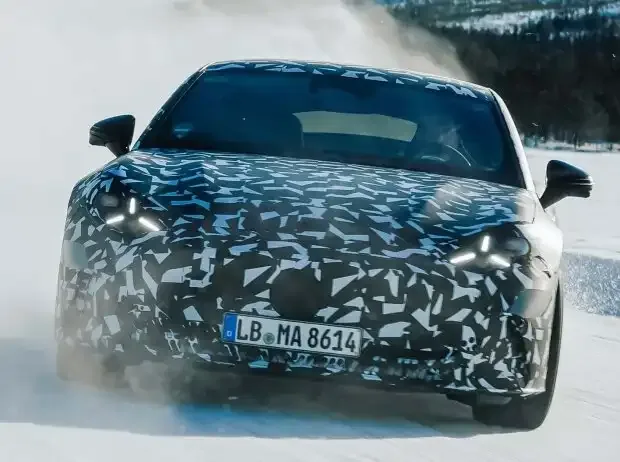
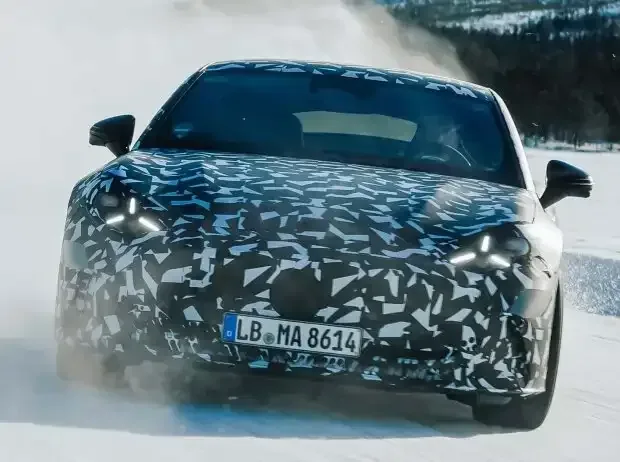
(Motorsport-Total.com/Motor1) – Mercedes-AMG is preparing for the market launch of the new GT 4-Door Coupe. Ahead of the upcoming world premiere, the all-electric sports car has completed final winter testing in Arjeplog, northern Sweden. The tests at AMG’s own site focused on fine-tuning the control systems and testing the powertrain under extreme climatic conditions.
Read more Coulthard says: George Russell must “undermine” Antonelli’s confidence
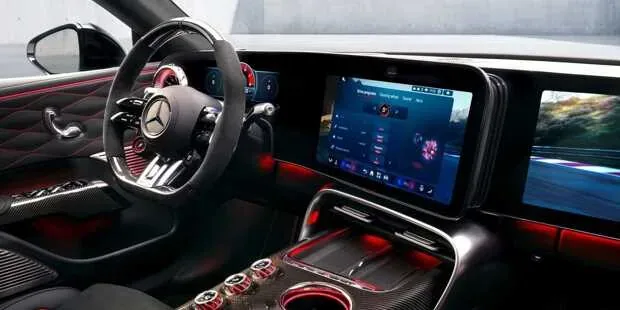
The central element of the driving dynamics control is the AMG RACE ENGINEER system. It bundles the control of hardware and software components and can be operated via three rotary controls in the center console. The goal is an individual configuration of the vehicle characteristics.
The “Response Control” regulates the response of the electric motors to the accelerator pedal position. The range extends from a comfort-oriented design to direct power delivery. The “Agility Control” influences steering and cornering behavior through variable torque distribution.
The system simulates different wheelbases, which according to Mercedes-AMG allows for a spread between understeer and controlled oversteer. This function is linked to the S, S+, or Race driving programs and requires ESP to be deactivated. “Traction Control”: As with the combustion models AMG GT R and Black Series, the slip at the rear axle can be regulated in nine stages.
All-wheel drive with three motors
The drive of the new GT 4-Door Coupe is based on three axial-flux motors. The configuration enables the fully variable AMG Performance 4MATIC+ all-wheel drive. Since the electric motors are decoupled from each other, the drive torque can be distributed not only between the axles but also between the individual rear wheels (torque vectoring). The sensors detect spinning wheels and adjust the power distribution according to the situation, which is intended to stabilize traction, especially on snow and ice.
Photo gallery: Mercedes-AMG GT 4-Door (2026): The cockpit
For the braking system, AMG relies on a mixed solution: a carbon-ceramic braking system is used on the front axle, while steel brakes are installed on the rear axle. A hydraulic composite system coordinates the transition between recuperation by the motors and the mechanical friction brake.
Read more Dovizioso sounds the alarm: “Marc Marquez’s situation is much more serious than it seems”
Suspension and thermal management
The vehicle features the AMG ACTIVE RIDE CONTROL air suspension. The special feature lies in the semi-active roll stabilization, which functions without mechanical stabilizers. Instead, the struts are interconnected via a hydraulic system. An 8.2-liter pressure accumulator also enables speed-dependent level control to optimize aerodynamics.
To ensure the performance of the battery at low temperatures, AMG uses a direct cooling system. An electrically non-conductive coolant flows around each individual cell within the laser-welded modules. This thermal management is intended to ensure both the rapid heating of the battery to operating temperature and cooling during high power demand.
In total, the testing program included more than 500 individual tests, in which the tuning of the ESP and the power distribution on split-friction surfaces and ice surfaces were validated in particular.
More from Mercedes-AMG:
New Mercedes-AMG GT Black Series shown as a prototype in detail
Mercedes-AMG C 63: Straight-six instead of four-cylinder?
Read more “Rusty”? Sergio Perez reacts surprisingly clearly to Andretti