




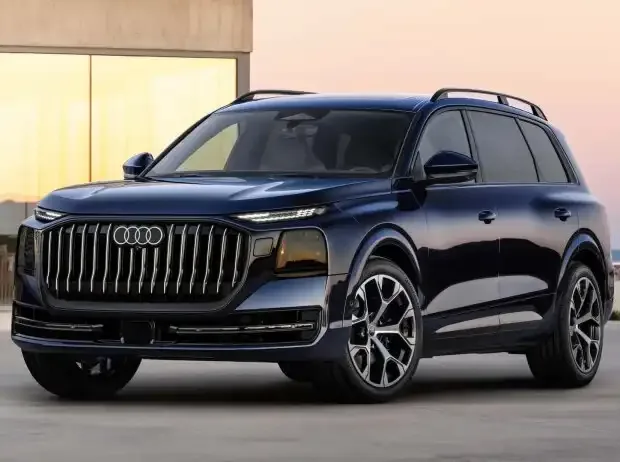
(Motorsport-Total.com/Motor1) – Why is Hildebrandt standing next to this big SUV in Schalke gear, you might ask? Well, it goes back to a lost bet. But it actually fits quite well. Because Audi is also making a rise with the new Q9. Whether S04 or Q9 polarizes more is debatable. So let’s take a look at the facts about the Q9 and take a seat. There are almost as many of those there as in the Veltins Arena.
Read more A Century of Automotive History: The Birth of Mercedes-Benz
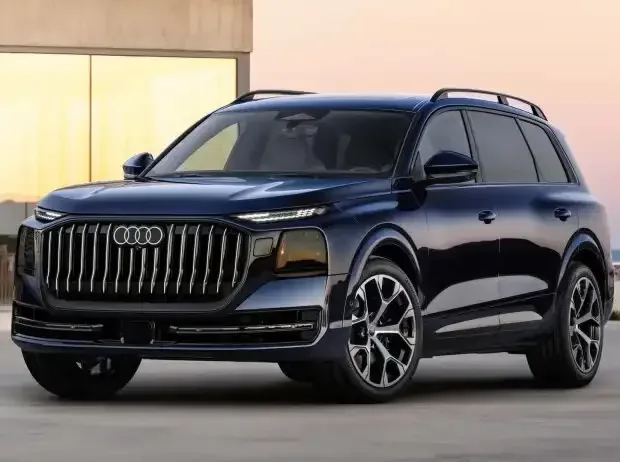
The new Audi Q9 comes across impressively. You can guess it by my person next to the vehicle, I am 1.88 meters tall. And of course, the Q9 is closely related to the new Q7. But 25 centimeters longer: At 5.31 meters long, 2.21 meters wide (including exterior mirrors), 1.81 meters high, and a wheelbase of 3.14 meters, it is the largest Audi ever. (Apart from the A8 L Extended, which reached 6.36 meters but was only a one-off.)
The two trim levels of the Q9, Advanced as standard and S line as an option, differ significantly. The former impresses with vertical slats in the Singleframe grille, while the S-line exterior focuses on sportiness. There is also an SQ9, but it is initially not intended for Europe. Just as Audi generally targets more global markets with the Q9. Two-thirds of production are likely to be sold outside Europe.
So let’s turn to the “normal” Q9: The front integrates the Audi-typical Singleframe and the headlights into a unified black mask. The radiator grille extends far down; optionally, an illuminated Singleframe with LED technology is available for an even more prominent vehicle design at night. This is meant to recall the first Q7. Note: Light is the new chrome.
The window line of the Q9 runs straight and thus emphasizes the elongated silhouette. Added to this is a strong shoulder line. Especially in the rear cabin area, the long wheelbase, the larger rear door area, and the extended overhang come into play and distinguish the Q9 from the Q7.
But there are also clear differences from the Q7: At the rear, the license plate is positioned in the bumper. Curved digital OLED taillights are, according to Audi, the world’s first use of this technology in a production vehicle. The carrier glass is only 0.1 millimeters thin. A continuous LED light strip with illuminated Audi rings connects the two taillights.
Photo series: New Audi Q9 (2026)
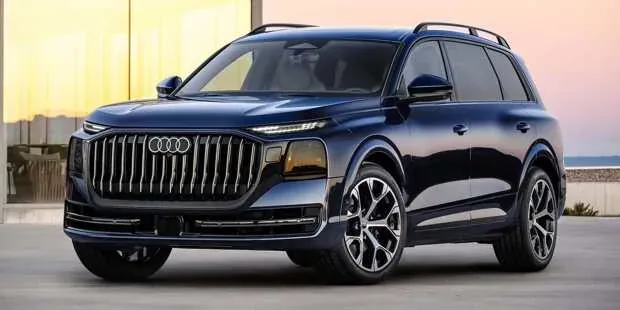
A second lighting technology highlight in the Q9 is the extended turn signal, which is available in conjunction with the digital OLED taillight and the digital matrix LED headlights. When turning or changing lanes at night, it creates a stylized turn signal on the ground synchronized with the dynamic turn signal at the front and rear. Useful? Practice will have to show.
As a highlight on the vehicle side, a ground projection welcomes passengers when entering with a rolling carpet of light: The graphic projected next to the doors picks up the motif of the diamond shaped by Audi Sport. The Q9 is available with alloy wheels in sizes from 20 to 23 inches in different designs and finishes. All tires in 22 and 23 inches are factory-equipped with acoustic foam inserts that reduce tire noise. Valves and balancing weights are color-coordinated with the respective rim design.
Interior/Cockpit
The Q9 comes standard with three rows of seats with seven seats. All seats are electrically adjustable. Alternatively, a second seating configuration offers six electrically adjustable seats. The highlight here is the electrically adjustable individual seats in the middle row. For the first time, Audi uses electrically opening and closing doors, nicely still with solid grab handles outside. The large opening angle is supposed to allow comfortable entry. An obstacle detection automatically stops the door if a person or object is in the opening area.
The Q9 is equipped with sports seats as standard. Optionally, the front sports seats are available with ventilation function. The also optional sports seats plus have heating, ventilation, and massage functions in the front and can be conveniently electrically adjusted via switches on the seat. Optionally, the armrests in the doors and the center armrest both front and rear can be heated with the plus surface heating.
In the seven-seat configuration, the second row is divided according to the 35/30/35 scheme. Here, child seats can be mounted on all three seats via Isofix-compliant attachments if needed. The seats in the second row are electrically longitudinally adjustable and the backrest inclination is foldable in the 65/35 split. Additionally, a 30-percent part in the middle can be manually folded in the 65-percent part of the backrest. This creates a 35/30/35 split.
For comfortable entry into the third row, the respective outer seat of the second row moves electrically forward and tilts forward without folding. Thanks to this function, child seats mounted there do not have to be removed for entry. The comfort entry can be activated via the MMI or a button in the rear door entry area.
In the Q9 with seven-seat configuration, all seats in the second and third rows can be folded down sequentially. The seats in the first row also have a special map pocket in the backrest. Various seat functions, such as folding down the third and second rows, can also be controlled from the trunk.
And how does one sit in the Q9? During a first seating test in the still camouflaged vehicle in mid-May, I wrote the following: “Although the respective seat in row two folds forward, boarding for tall people like me doesn’t really slip smoothly. Once in the rearmost seats, I sit surprisingly well there.” This means: The classic limousine comfort of the discontinued A8 is not offered by the Q9, nor is it supposed to be. More family luxury than chauffeur car. Mom or Dad sit as executives up front, behind them the youthful staff. If needed, ventilated by a five-zone automatic climate control.
A panoramic sunroof with 1.5 square meters of glass surface is standard in the Q9. Audi also does not skimp on LED technology in its big ship. But it no longer tries to cover up a mediocre material feel in the interior with disco lighting. High-quality fabric and wood applications, new decor, and coordinated interior colors actually create the “premium atmosphere” described by the manufacturer. Put differently: This is how an Audi has to feel. Especially since the Q9 is priced quite high.
Read more Friday rule: Who has already delivered and who still has to skip?
The MMI panoramic display, designed in curved style and OLED technology, also consists in the Q9 series of the 12.3-inch digital cockpit and the 14.5-inch MMI touch display. The 12.3-inch passenger display with distraction-free dynamic privacy mode is standard equipment.
Only the frames of the cockpit displays could be a bit more high-quality in my opinion. In the A6, they were introduced later; the Q9 has rotary controls on the steering wheel from the start. It’s a pity they are not made of metal. The flanking touch surfaces also still offer potential for model refinement. The stalks known from the new Q3 look quirky at first glance but are easy to operate.
Engines/Drivetrains
At market launch, a V6 diesel engine with 220 kW (299 hp) is available in Germany. In selected European markets, a variant with 180 kW or 245 hp is also offered. Worldwide, for example in the USA and China, V6 or V8 gasoline engines are also used.
But back to the diesel: The 220 kW variant has 630 Nm of torque, the 180 kW diesel offers 500 Nm. For more efficiency and sprint power, both power levels use an MHEV plus system consisting of a drivetrain generator further developed for the Q9, a belt starter generator, and a lithium iron phosphate battery.
The drivetrain generator contributes up to 18 kW (24 hp) of power when starting and overtaking. This enables electric driving and supports the combustion engine during driving, reducing CO2 emissions and fuel consumption. An 8-speed automatic transmission and permanent quattro all-wheel drive are always on board.
The V6 TDI also has an electrically driven compressor (EAV (it really is called that!) with 7.5 kW peak power, 3.5 kW continuous power), which complements the MHEV plus system, and a two-stage charging system. If needed, the electric compressor builds up to 3.6 bar absolute boost pressure in just 1.2 seconds, ensuring dynamic response.
By enabling more torque at low engine speeds, the use of the electric compressor also reduces fuel consumption according to Audi. How powerful the drivetrain is thanks to the combination of V6 diesel, drivetrain generator, and electric compressor should be especially noticeable when starting from a standstill. We will check that.
The Q9 comes standard with adaptive air suspension. It combines continuously variable damping with adjustable ride height. The adaptive system automatically adjusts to speed, load, and driving conditions. Users can also manually influence the ride height via “drive select” if needed.
The total adjustment range between the lowest and highest lift mode is 90 millimeters. From the “balanced” mode, the car can be lowered by 62 millimeters to the comfort exit level. The adaptive air suspension not only provides comfort but, in combination with progressive steering and all-wheel steering, also delivers a driving experience that conveys calm and confidence according to Audi.
The optional “adaptive air suspension sport” air suspension with controlled damping makes the Q9 even more agile and versatile. The all-wheel steering increases maneuverability at low speeds, such as in parking lots or narrow city streets, and improves steering precision and stability at high speeds. The system can steer the rear wheels up to 5 degrees. The all-wheel steering works fully automatically: At low speeds, the rear wheels turn opposite to the front wheels, reducing the turning circle.
The towing capacity of the Q9 is up to 3.5 tons. Accordingly, there are some assistance systems only for this complex: The trailer maneuvering assistant takes over steering when reversing with a trailer attached; the driver controls the direction via the Audi MMI display.
The trailer stability control detects trailer sway and stabilizes by targeted braking of individual wheels. The integrated trailer brake control is factory-installed for seamless control of trailer brakes.
Price and Market Launch
The Q9 is produced in Bratislava, Slovakia. The SUV can be ordered from July 2026, with market launch in Europe and Germany starting in November. The entry price for the Q9 TDI with 220 kW is 108,400 euros.
The competitors of the Audi Q9:
Mercedes GLS and GLE (2026) Facelift: Goodbye, diesel plug-in hybrid
BMW X7 (2022) in test: The high seven for seven sovereignties
Read more Middle East crisis: Formula 1 prepares for further cancellations in 2027