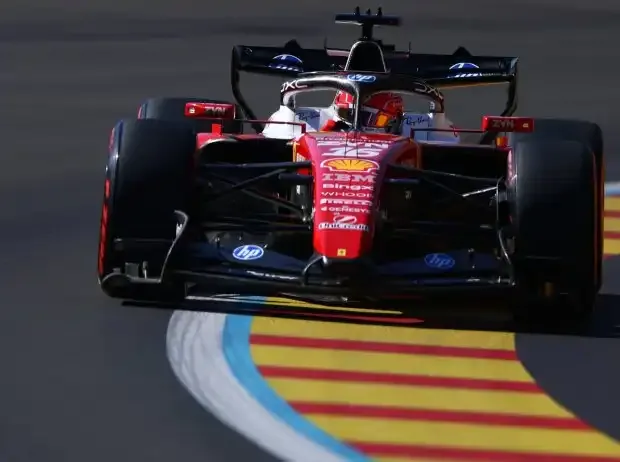
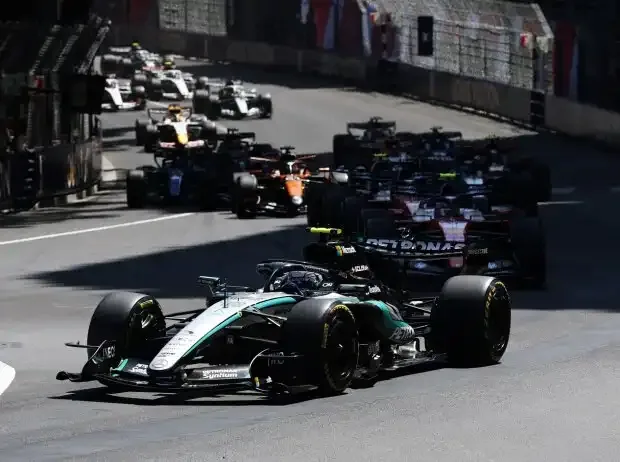
– The handbook of racing driver excuses is a massive and widely read tome. The peculiarities of the new technical regulations of Formula 1 seem to have added another entry to it this year.
Read more Tech3-KTM: Pol Espargaro instead of Vinales also in Spielberg — last time or not?
Across the entire field, seemingly inexplicable differences between teammates have appeared, which are difficult to explain even with extensive data analysis. One theory suggests that tiny differences in driving style could be responsible for the varying top speeds.
Accordingly, the driving style causes a driver to have slightly less electrical energy available at a certain point on the track than his teammate. The software reacts to this and reduces power.
But there is also an opposing view. Red Bull driver Max Verstappen, for example, believes that the complex energy management has even reduced the driver’s influence. For him, Liam Lawson is the best example: Verstappen had clearly beaten him in the Ground-Effect era in the same car. In 2026, Lawson moved to Red Bull and was suddenly almost as fast as Verstappen.
Verstappen also points to Yuki Tsunoda, who joined the Racing Bulls in Zandvoort and was immediately competitive, despite having no prior experience with the cars of the new Formula 1 generation.
However, Tsunoda himself later provided a counterargument: things went significantly worse in Monza, partly because the returnee repeatedly forgot to activate the Straightline Mode during practice and qualifying.
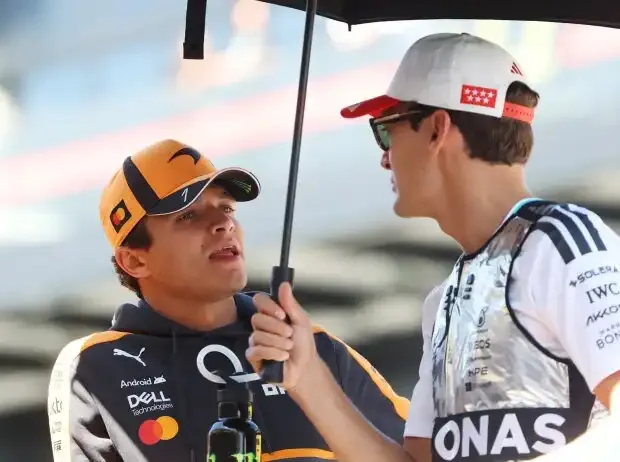
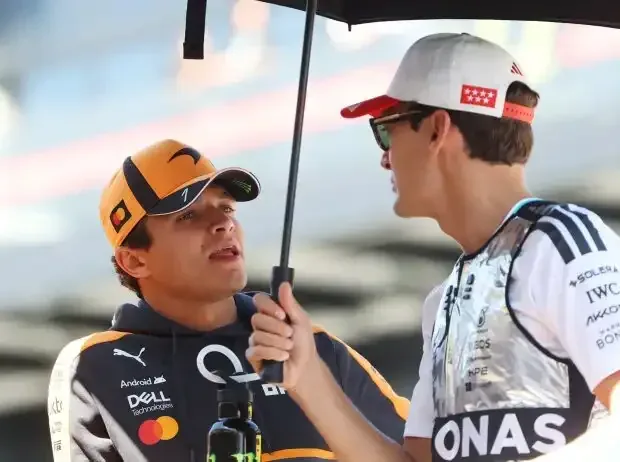
Nevertheless, there are enough peculiarities that suggest there might be some truth to the driving style theory. This becomes particularly clear when comparing George Russell and his Mercedes teammate Kimi Antonelli, as well as the McLaren duel between Lando Norris and Oscar Piastri.
The management of Mercedes and McLaren have also supported the theory. Cynics might argue: “What else would they say?”
In Spain, Russell was once again asked where the speed difference to Antonelli comes from and why his teammate is sometimes faster. “I have an answer to that and am working on it,” said Russell.
How the wrong winner won the Spanish GP | F1 Race Madrid 2026
“And I think it has improved significantly. That’s why I am very satisfied with this step. Basically, it is possible for many drivers to change their driving style. But to actually be fast with the new style is another matter.”
“I feel that my performance has improved significantly since the summer break. In the three qualifying sessions, I was always ahead of him, and my race pace in those two races was on par with him. Before the summer break, I couldn’t have said that. So I am definitely very satisfied with this development. We will see where the rest of the season takes us.”
The problem with electrical energy
The differences become particularly clear with electrical energy on tracks with long straights. If a driver has a lower charge level, he either gets less electrical support on the straight and thus reaches a lower top speed, or he enters the so-called ramp-down phase earlier, commonly referred to as the “staircase” in the paddock.
To drive the “optimal lap” targeted by the engineers, drivers must master a rather counterintuitive interplay of the various systems. It is not necessarily enough to simply slide less at certain points. The throttle position must also be exactly right at the right points.
This is mainly trained in the simulator. Because the days when drivers could test practically unlimited on the race track are long gone.
“It’s like in football,” explains Russell. “If you have some difficulties, you’re told that you can only go to the training ground the day before the game. Then you have two one-hour sessions to improve.”
“So it was difficult. We had to use the training sessions to try things out, and sometimes even test new things during the races themselves and work on these techniques. That’s just the challenge of Formula 1.” Russell sees an unusual pattern in the 2026 season.
“If you look at how competitive Piastri was against Lando last year, Charles [Leclerc] against Lewis [Hamilton], and even Max’s dominance over all his teammates, this season is already strange.”
“This year, Charles, Oscar, and I have significantly more difficulties compared to our teammates. And Max’s teammates have been closer than they have been in six years. Kimi, Lewis, and Lando also have quite similar driving styles,” Russell searches for an explanation.
“For me, it is quite clear what I need to achieve with this car and these tires. The trends are clear among the four drivers I just mentioned.”
Norris contradicts Russell’s theory
Norris had already rejected this theory earlier in the season. And he sticks to it: “Honestly, I wouldn’t say my driving style fits this car. I think my driving style is good because I can adapt better.”
“I don’t believe there is a single driving style that works. And I also don’t think I drive the same way as Kimi. Of course, I have never been his teammate or Lewis’s, so I have no idea. He [Russell] can probably give a better picture of that. But he was never my teammate either and therefore can’t speak from personal experience.”
Photo gallery: The 15 most dramatic team duels for the title
“My driving style definitely does not fit this car,” Norris emphasizes. “My adaptability allows me to drive the car I get. I think my strength is my ability to adapt to different driving styles.”
Norris admits that this ability also played a crucial role in 2025. “That was not necessarily my greatest strength last year,” he confesses.
“I believe the car suited Oscar a bit better at the start of last year. My strength was to adapt better and eventually understand how I had to drive the car in a better way. That’s why my second half of the season was better. And it’s the same this year.”
“This car is not driven anything like last year’s car. It doesn’t even feel the same to me by one percent. That’s why I think it’s wrong to say my driving style simply fits this car. My ability to adapt better is, in my opinion, my strength.”
Read more Honda: Misano plays into RC213V’s hands, but yield not optimal
Adaptability is the key
With this statement, Norris moves dangerously close to a contradiction. Nevertheless, the Brit makes an important point: adaptability is crucial.
The 2026 cars demand a rather counterintuitive approach from drivers in many ways, from the unusual restrictions on throttle position to the fact that higher cornering speed can often even cost time.
At the start of the season, many drivers reached their limits exactly at this point. Only gradually did they realize that it is more productive to work with the cars’ limitations rather than fight against them or complain.
Russell had a certain advantage at the start of the season. He had significantly more Formula 1 experience than Antonelli and was also in a car that was faster than the competition. But the closer the teams got in performance and the more Antonelli focused on understanding the peculiarities of the new cars, the more Russell had to catch up.
After the Italian Grand Prix, where Antonelli beat Russell from 19th on the grid, aided by a well-timed Virtual Safety Car, Mercedes team principal Toto Wolff compared him to an AI agent that is constantly learning.
The message is simple: there is a way to drive the current generation cars fast. It may not look particularly elegant, but you have to learn it.
It’s true: Norris drives differently than Russell
Norris, in turn, differs significantly in driving style from Mercedes rival Russell. He approaches the apex of a corner more flatly, overlaps throttle and brake more, and uses the point where the front tires reach their maximum lateral grip to steer the car.
On the other hand, if he lacks confidence in the rear or the front axle does not adequately convey how much grip is actually available, Norris has big problems. An example of this was Bahrain last season.
But if these conditions are met, Norris can adjust his racing line and the interplay of braking and throttle. An important turning point was the development of an alternative front axle geometry by McLaren. It sacrificed some theoretical performance in favor of a better “feel.”
Combined with Norris’s adaptability, this advantage more than compensated for the aerodynamic disadvantage brought by the alternative front axle.
Conversely, it is also true that there are similarities between the driving styles of Russell and Piastri. Both separate braking and steering more and overlap throttle and brake less. Basically, they give the car more instructions on what to do rather than working with its natural characteristics.
Several drivers, including those who spend many hours in the simulator to further develop the models, believe that this approach is particularly difficult to reconcile with the peculiarities of the 2026 cars.
Driving style or partly a matter of mindset?
So driving style may be less of an excuse than some believe. It is also an important psychological factor and reveals a lot about a driver’s mental state. Elina Haukipuro, former Mercedes team doctor and now working as a performance coach, speaks of the danger of a “negative spiral” that drivers can easily fall into after setbacks.
The easiest reaction is often to blame the car. But drivers can also start to question their own abilities, as Russell did during his mid-season slump or Norris at the start of the 2025 season.
“Taking these negative thoughts from one race to the next is really, really bad for concentration, focus, and performance,” Haukipuro tells Autosport, a sister platform of Motorsport-Total.com.
“The drivers who perform best in such situations, especially after a difficult race or several difficult races, are those who leave it behind and focus on the current situation. They must not carry the burden of the entire season on their shoulders.”
“As soon as we start thinking: ‘Where am I in the championship? Who is ahead of me? What happens if I continue like this?’, we are already paying too much attention to other things instead of the race itself,” says Haukipuro.
It is crucial to be able to separate performance and self-worth: “You have to be able to separate results from your own identity and especially from your own self-esteem. Even if your world or a large part of it revolves around racing, that can’t be all you stand for.”
“You have to trust that you have your abilities. And you have to be able to analyze something that happened as neutrally as possible, or even just accept it. ‘That happened. I made a mistake. What do we learn from it? Why did it happen?’ We have to understand it.”
“I always say: Everything has a cause. There is always an explanation for why you react in a certain way or why something happens during a race.”
“Especially in Formula 1, we have an incredible amount of data. The drivers who can look at this data objectively, are open enough and say: ‘Okay, that was my mistake. It really wasn’t the car. I caused that. What can I do next time so it doesn’t happen again?’ and don’t blame something else, have the right attitude,” the expert analyzes.
Most read
- MotoGPQuartararo interview: “Think about this first Honda test every evening”
- DTMNew time! That’s why the DTM finale in Hockenheim starts later than usual
- Formula 1James Vowles: Shyness is Carlos Sainz’s only big weakness
- CarBMW i3 Touring: First look at the electric station wagon of the New Class
If the current Formula 1 season has taught us one thing, it is that the perfect driving style does not decide driving style. It depends on who can adapt best.
Read more Alex Marquez: Will double victories with Marc eventually become routine?