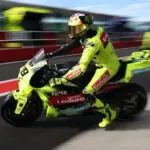



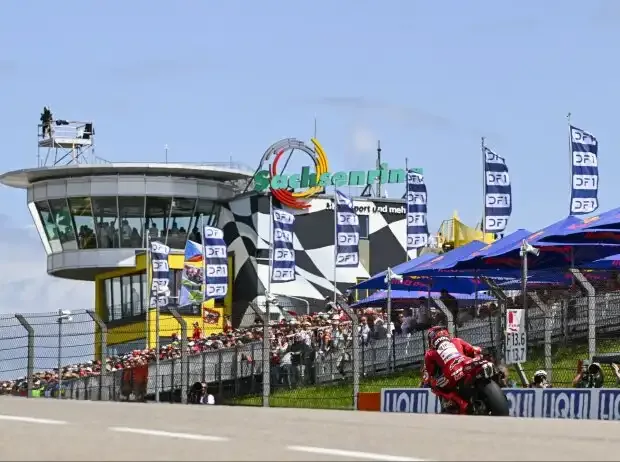
– The Motorcycle Grand Prix at Sachsenring impressively continued its success this year. With 261,831 spectators, a new visitor record was set on the race weekend (including Thursday). On race Sunday alone, 98,423 spectators created a nearly sold-out atmosphere.
Read more Optimism at Audi: Three consecutive World Championship points?
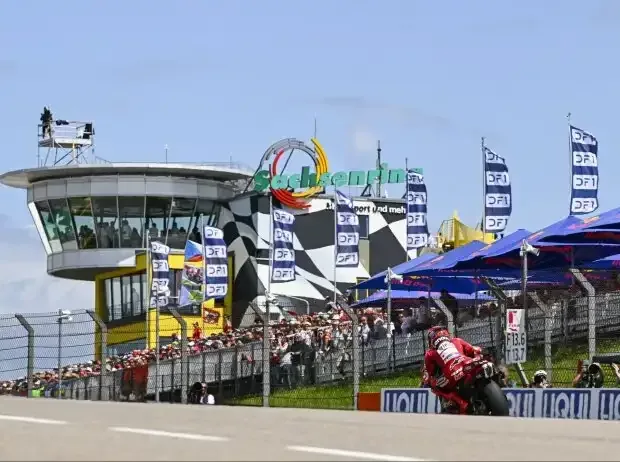
Thus, the motorsport festival in Saxony continues to grow and underlines its status as Germany’s largest regular individual sporting event. However, the focus of the final press conference was not only on the record figures, but above all on the long-term perspective of the traditional race.
ADAC Sports President Dr. Gerd Ennser is impressed by the atmosphere at the Sachsenring. “We are happy to be here every year. It’s simply a fantastic, very unique atmosphere at the Sachsenring,” he says.
Ennser: Sachsenring region lives motorsport
For Ennser, the Grand Prix has long been much more than just a motorsport event. Looking at the spectator numbers, he spoke of the “second largest individual sporting event in Europe”. Only the 24-hour race at the Nürburgring attracts more visitors, while even Wimbledon and Bundesliga matches lag behind. “Saxony and the entire region can be incredibly proud of this achievement.”
Thomas Voss, Managing Director of Sachsenring Event GmbH, also sees the key to success primarily in the deep roots of the event in the region.
Anyone driving through hotels or villages around the Sachsenring during the Grand Prix weekend immediately notices that people regard MotoGP as their own Grand Prix. Private parking spaces, accommodation, or camping areas are offered in many places – for Voss, a sign that the event was not artificially created but is supported by the local population.
“They don’t just want any Grand Prix in Germany, but they explicitly insist that it takes place at the Sachsenring,” says Voss, referring to discussions with the MotoGP promoter and the owners Liberty Media.
The decisive factor is the unique identification of the people with the event. Despite the demanding logistics, all involved parties work with great commitment to successfully implement the Grand Prix year after year.
The fact that the Sachsenring has now also been officially recognized as an intangible cultural heritage in Saxony is seen by Ennser as confirmation of this special fan culture. At the same time, he made it clear that tradition and further development are not a contradiction: “The circuit must remain modern, and it is modern.”
Sachsenring Future: Growth yes, but in moderation
According to Ennser, discussions are already underway to secure the Grand Prix at the Sachsenring long-term, well beyond the current contract. More than half of all visitors still come from the direct regional vicinity. Therefore, every effort must be made to maintain this close bond permanently. He expressed optimism that the corresponding efforts would pay off.
Read more Successors for Marko & Lambiase: What does that say about Red Bull’s F1 future?
The new spectator record confirms the ongoing boom of MotoGP at the Sachsenring. Voss reported that around 80 percent of the grandstands were already occupied on Friday. “Saturday and Sunday were packed anyway,” he says. The new record was therefore no surprise.
Voss particularly highlights the work of his team. “At this point, I must pay a huge compliment to my entire team at Sachsenring Event GmbH.” Just six employees prepare the Grand Prix year-round and constantly look for ways to create additional grandstands. Demand is so high that additional capacities are regularly needed.
MotoGP: German Grand Prix (Sachsenring) 2026
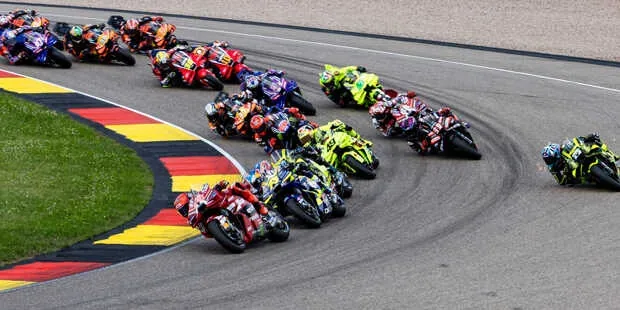
At the same time, growth must not come at the expense of visitors, Voss emphasizes. The organizers want to continuously improve the infrastructure and deliberately keep the event affordable. Admission prices and catering should remain “popular and accessible,” says the motorsport boss.
Looking to the future, Voss advocates for continuity. The proven time slot during the Saxon summer holidays has once again paid off, as Friday was already exceptionally well attended. His conclusion: “Never change a running system,” combined with the demand to implement necessary modernizations. Merely managing what has been achieved is no longer enough today.
The Grand Prix continues to receive support from state politics. Ennser explicitly praises the support of the Free State of Saxony. Especially in economically difficult times, it is extraordinary that a federal state supports a major sporting event so sustainably, emphasizes the Sports President.
Kretschmer announces further investments
And so it is not surprising that Michael Kretschmer, Minister President of Saxony, also emphasizes how deeply motorsport is rooted in Saxony. This is also shown by the renewed visitor record. People have “engine oil and petrol in their blood”.
At the same time, however, the success is by no means self-evident, but the result of years of joint work with the ADAC. After difficult discussions in the past, planning security has now been created for the next five years. At the same time, the Minister President announces further investments.
For Saxony, the Sachsenring has far more than sporting significance. In addition to racing operations, the facility is used year-round for road safety training.
- MotoGPJorge Martin and Ai Ogura: How they explain their move to Yamaha
- Formel 1Successors for Marko & Lambiase: Fitting Mekies’ Red Bull Vision
- Formel 1Aston Race Director says thank you: “Good that you journalists helped us”
- Formel 1Komatsu explains Haas crash: “We were simply out-developed”
The combination of both tasks is demanding but desired. The Grand Prix is an important economic factor for the region and at the same time Saxony’s contribution to top-level sports in Germany. Or, as Minister President Kretschmer puts it: “In our Free State, motorsport is very welcome.”
Read more McLaren with big update and Macarena wing in Hungary