
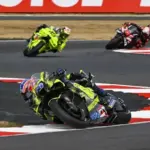
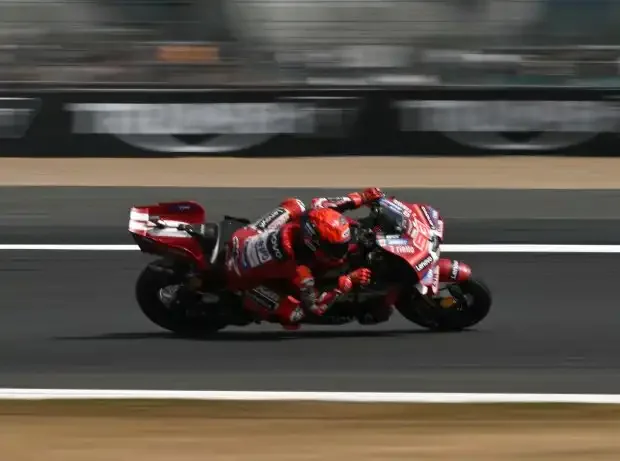
– MotoGP is facing a technical turning point. In 2027, a new regulation will come into effect that will fundamentally change the motorcycles. But behind the planned changes lies more than the usual restart after a few years.
Read more Wittmann fights for BMW title chance: «Nürburgring has to be a blast»
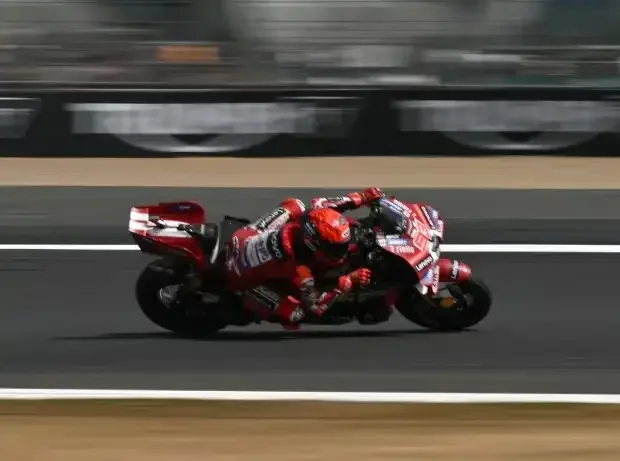
The officials of the Motorcycle World Championship are increasingly dealing with a fundamental question: How fast are MotoGP bikes actually allowed to be?
Carlos Ezpeleta, MotoGP Sporting Director, views the development with some concern. The current season shows that the championship is working excellently from a sporting perspective. Precisely for this reason, the discussion about 2027 must focus on another problem: the speed of the motorcycles.
“We cannot allow the motorcycles to reach 400 km/h,” explains Ezpeleta with regard to the long-term development in an interview with Autosport, a sister platform of Motorsport-Total.com in the Motorsport Network.
The paradox of technical development
The problem begins for Ezpeleta already with the question of what actually counts as a safety gain. Technical developments can make a motorcycle safer or more controllable in a certain area. At the same time, they also enable the riders to go faster and faster.
As an example, the MotoGP sporting director cites the ride-height systems: A rider comes to his engineers with a problem, they develop a technical solution and improve a certain aspect of the motorcycle.
“They will say that they have made the motorcycle safer. But in reality, they have made it faster.” This is exactly where the fundamental dilemma lies for him.
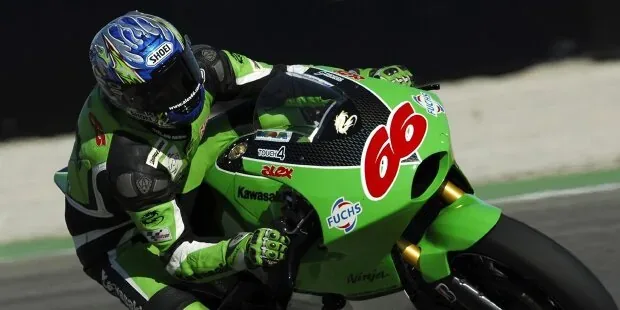
Photo gallery: The motorcycles of the 2005 MotoGP season
Because just because the motorcycle has become technically more powerful, the rider is not driving with a safety margin. His natural reaction is rather to exploit the additional potential and push back to the limit. And as the possible speed increases, this can further increase in crashes.
At the same time, race tracks cannot be enlarged indefinitely. From the perspective of the MotoGP officials, this creates a limit that is set not only by the regulations but also by the existing infrastructure.
Regulation 2027 to usher in a new era
Against this background, the new technical regulation for 2027 gains additional significance. Ezpeleta explicitly speaks of a “new era” on the track.
Several changes ensure this simultaneously. In addition to the new technical regulation, a new tire supplier will be added. At the same time, the ride-height devices and launch systems will disappear. For the riders, this changes the way they have to control the motorcycles. Visually, the bikes will also differ significantly from the current generation.
However, Ezpeleta does not expect a complete sporting revolution: “I would be surprised if everything turned upside down.” The riders and teams at the top are likely to continue playing an important role in his assessment.
Read more Brabus hauls 1,000-HP Bodo as a roadster to Pebble Beach
The turning point lies rather in the technical philosophy. 2027 will change the way motorcycles are developed and ridden, and possibly also how far engineers can go with technical upgrades.
Slowing down MotoGP for the sake of safety
It is interesting that Ezpeleta does not justify the need for a limit by saying that MotoGP currently delivers poor racing. On the contrary: He describes the current championship as extremely exciting.
Unexpected riders, teams, and manufacturers are able to fight for top positions. The rules have helped create a strong sporting product.
“We have incredible sport on the track, fantastic races,” emphasizes Ezpeleta. He therefore explicitly does not see a budget cap as a measure to make racing more exciting. MotoGP has no problem in this regard.
Interview: Carlos Ezpeleta talks about the future of MotoGP
It is rather about controlling a technical development that could eventually become a problem itself. “We have to bring some logic into it,” says Ezpeleta. Because a situation could easily arise where a manufacturer is willing to pay practically any price for a technical advantage. “That pulls the other teams and manufacturers into an endless escalation.”
MotoGP therefore has to perform a balancing act: It wants to remain the most technically demanding motorcycle racing series in the world, but at the same time prevent technical advances from leading to an ever-higher speed spiral.
The new generation of MotoGP bikes is more than just another regulation change against this background. It is an attempt to steer development in a new direction.
Ezpeleta emphasizes that the motorcycles should remain powerful and technically fascinating. At the same time, development must proceed with a certain degree of reason, the sporting director warns: “Unlike four-wheel racing, we have an insurmountable limit, and that is safety.”
The upcoming generation will therefore have to show whether MotoGP can operate at the same level without some of the previous technical aids, and whether the development of the motorcycles can be controlled in the long term.
The big challenge that comes with this is not only: How fast can a MotoGP machine be, but increasingly, how fast should it actually be?
- DTMDTM-BoP Nürburgring: Will the Porsche be “eaten” again on the straights?
- MotoGPAprilia: Raul Fernandez names the reason for the MotoGP dominance
- Formula 1FIA lifts ban on Russian athletes again
- DTMDisqualification and appeal! Huge fuss about DTM winner Bortolotti
For Ezpeleta, the answer is at least clear in one point. Development towards ever higher speeds cannot continue indefinitely. Because at some point, not only the motorcycle reaches its limits, but also the track, the safety infrastructure, and thus the sport itself.
Read more Aprilia: Raul Fernandez names the reason for the MotoGP dominance