

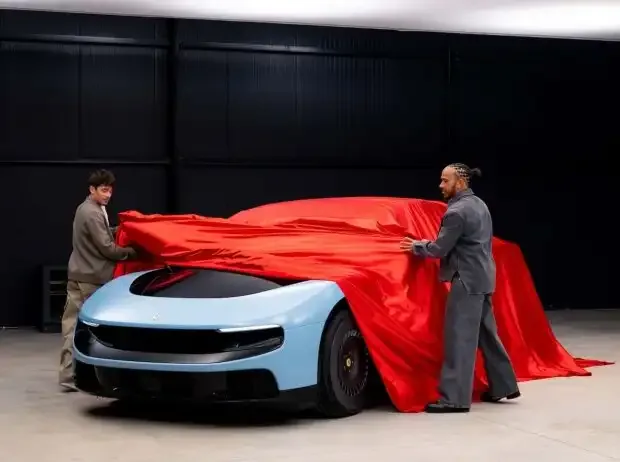
(Motorsport-Total.com/Motor1) – It’s hot in Balocco. Even if the calendar shows a top-secret date at the end of April. The location is important, because it was exactly there years ago that I experienced the official presentation of the Alfa Romeo 4C.
Read more David Coulthard: Just don’t ban all innovations!
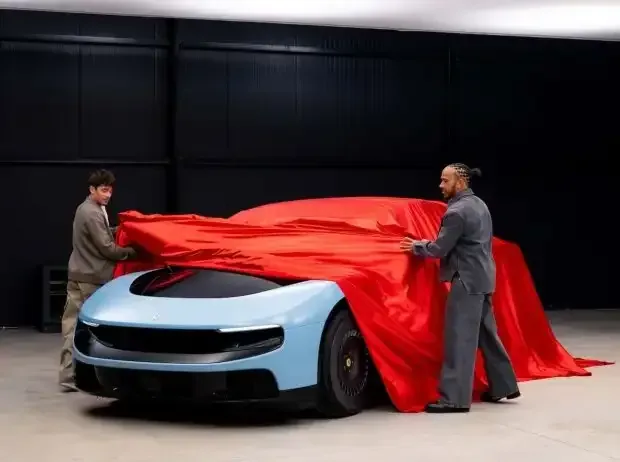
Today, the day is potentially even more historic. Because I will be the first to see the new Ferrari Luce. A unique opportunity, considering that there are still about 30 days until the official premiere.
The first look with Newson
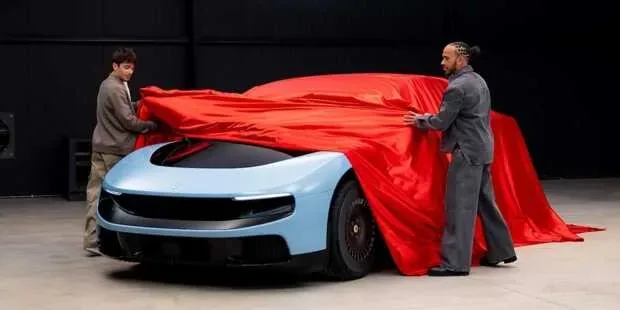
Behind a tent in Balocco, hidden under a red tarpaulin, stands the Ferrari Luce. Next to me is Marc Newson. We are only a very few people, and one must say: the tension is high. When the cover was pulled off, I was, I admit, surprised.
Because the Luce is, as we all know by now, something completely different. Beautiful? Ugly? I don’t want to judge that. I admit: the first impression left me a little bewildered. You can feel these “full” shapes, which are somewhat reminiscent of some prototypes from Carrozzeria Bertone from the 1970s.
The lines certainly appear softer, while Marc Newson, who also tells me about his passion for classic automobiles, explains some key points that we already know today. A drag coefficient of 0.254 without active aerodynamics (a conscious decision not to make the car heavier and not to interrupt the clarity of the lines).
In addition, a black teardrop-shaped passenger cell with a contrasting aluminum body from which the front fender emerges; newly developed and patented windshield wipers that create micro-vortices on the A-pillars; 23- and 24-inch wheels, the largest ever fitted as standard on a Ferrari; round headlights.
It looks like a crouching predator, and today I can confirm it: in person, it appears significantly “larger” and more planted on the road than it does in videos. The rear, viewed from a three-quarter perspective, will, however, spark discussions. I sense that immediately.
In the interior, on the other hand, I appreciate – beyond any subjective viewpoint – what you can actually touch, and this idea of analog mechanics transferred into the digital world. It is precisely this abundance of levers, instruments, glass surfaces, and the steering wheel that I unreservedly like.
Photo gallery: Ferrari Luce: Photoshoot with Charles Leclerc and Lewis Hamilton
And you know what? When I returned to the editorial office the next day, it was interesting to see how practically everyone asked me what I had seen. I only remember one sentence: “Do you know all the drawings, all the renderings, with which people tried to guess this car? Well, none of them were even close.”
The Ferrari stars behind the wheel
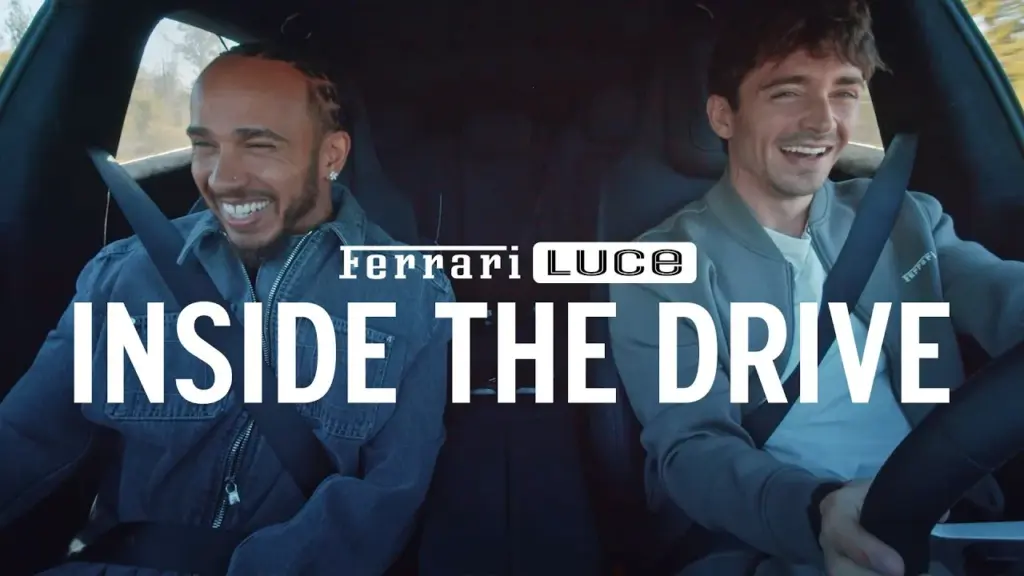
The focus of this hot day is not just the production-ready car. There is also that prototype, equipped with a whole range of cameras and action cams, to capture the emotions of the drivers and technicians. Yes, today Charles and Lewis are driving it… and that is ultimately the key to any car.
And quietly observing the goings-on behind the scenes of the video crew is another spectacle. Those in the know are familiar with this kind of work. At Motor1, we have great professionals who shoot and edit videos. And not only that. Here, however, the crew is even larger, probably more comparable to a film set than a regular production.
Enough talk. Let’s see what happens…
Leclerc is the first to get behind the wheel himself. The Luce shoots off, I can just make out a few fast-driven corners from a distance, and after a few minutes, he returns. Lewis, in the passenger seat, hints at a smile. But it seems slightly tense. Apparently, that promise among drivers “we won’t drive too fast” remains a typical tall tale. Charles doesn’t yet suspect what awaits him…
Meanwhile, I talk a little with the technicians. I see Raffaele De Simone, who asks me what I think about electric drives…
The Technology: Weight is the Devil
“I grew up with bread and gasoline, so the doubt about what we were actually doing was legitimate. Then I understood that the prototypes show gigantic potential.” That’s what Raffaele De Simone, chief test driver in Maranello, says: If the first skeptic of all can be converted and this man drives every Ferrari before anyone else, then that means something.
Hamilton and Leclerc in the Ferrari Luce
In Maranello, the project is explained using five emotion generators. Longitudinal acceleration, lateral acceleration, deceleration, rev changes, and sound. These must be perfectly integrated. Because building a car that is fast in a straight line is easy, anyone can do that; building one that tries to translate these digital stimuli into “analog” emotions is significantly more difficult.
Read more Chancellor’s Car: On the road in Helmut Schmidt’s Opel Kadett GSi
“Weight is the devil in a sports car,” says Gianmaria Fulgenzi. “We see the dimensions and the wheelbase and let ourselves be deceived. The Luce contradicts this expectation: it completely redefines the dynamic proportions, and this could only be achieved through electrification.”
The battery developed and assembled in Maranello, with 800-volt technology and 122 kWh capacity, is a structural element of the chassis and lowers the center of gravity by almost 95 millimeters compared to the Purosangue. The perceived effect is said to correspond to that of a car 400 kilograms lighter.
With torque vectoring via four independent electric motors, active suspension, rear-axle steering, and Side Slip Control in Version X, the most demanding of all comparisons is circulating in Maranello: handling close to that of a 296 GTB. In a five-seater with a curb weight of 2,260 kilograms.
Brakes and Paddle Shifters: The Analog Remains
Deceleration is the first area where the Luce challenges the electric car world: recuperation works seamlessly with the carbon-ceramic brakes with diameters of 390 and 372 millimeters. A dual braking system of electric and mechanical deceleration that, according to Ferrari, other electric cars simply do not offer.
The real highlight, however, sits behind the steering wheel. The iconic paddle shifters remain, even though there are no more gears to change: The system is called Torque Shift Engagement and is a novel concept. With the right paddle, you select five levels of torque delivery, with the left, five levels of engine braking effect: When turning into a corner, the negative torque is modulated, and when accelerating out, the power is adjusted to grip and cornering radius.
All of this follows another goal: to offer a sound that does not seem artificial. In the Luce, an accelerometer detects the real vibrations of the drivetrain and rear subframe; an algorithm filters out unpleasant frequencies and reproduces only the noblest components, both inside and out. No samples, no synthesis. And the final decision is left to the driver: active in some driving modes, deactivable in others.
The Missing Puzzle Piece
Weeks have passed since then. The Luce has sparked discussions like few other new cars, such as the Jaguar Type 01. It has divided purists and the curious, those who see the Luce as a betrayal, and those who understand it as a necessary risk. All legitimate, all heard before. But from that day at the end of April, two things have particularly stuck in my mind.
The first are the words I exchanged with Raffaele De Simone, who admits to having doubted and changed his mind when he experienced the prototypes. Because the Luce, he tells me, is not just a new car: it opens up development scenarios that did not exist before, a different way of thinking about the driving dynamics of a sports car.
The second is that no one has seen it in motion to this day. Everyone has judged a photo, a rendering, an idea, a video. But all static. The true judgment, the one written with hands on the steering wheel and not with thumbs on a smartphone, is still pending.
And perhaps it won’t change the opinion of many. But there’s no getting around one principle. You can judge the optics, but cars must be driven.
That day I had a visual taste. Actually even less, because I could only glimpse a few corners. But I could also sense certain things with my ears and, from a distance, in reverent silence, catch the words of the drivers.
Final act: The prototype returns to the pits, Hamilton gets out with a half-smile, this time significantly less tense. And Leclerc, also smiling but sweaty and slightly pale in the face, asks for a glass of water. You should never trust drivers when they say: “We’ll take it easy.”
- Formula 1Explained: Are F1 drivers really remotely controlled by AI in the car?
- Formula 1First details on Aston Martin’s big Hungary update
- IndyCarRLL reverts to two cars in 2027 – Mick Schumacher facing team change?
- Formula 1Ralf Schumacher: Isack Hadjar is better than Verstappen would like
More about the Ferrari Luce:
No, Ferrari does not force regular customers to buy the Luce
The first production model of the Ferrari Luce is incredibly expensive
Read more Ralf Schumacher: Isack Hadjar is better than Verstappen would like