– The month of May is traditionally the month in the IndyCar Series calendar that receives the most attention. It is the month in which the absolute highlight of the season takes place, the 500-mile race at Indianapolis, briefly called: Indianapolis 500, even shorter: Indy 500.
Read more Doriane Pin: Formula 1 dream becomes a concrete goal after Mercedes test
The Indy 500 has been held since 1911 on the 2.5-mile oval of the Indianapolis Motor Speedway in Indianapolis, Indiana, USA. The history of this race is thus significantly longer than the history of the IndyCar Series (complete list of Indy 500 winners see below).
Over the decades, the Indy 500 has been organized by different associations. It started with the American Automobile Association (AAA), followed by the United States Auto Club (USAC), and finally IndyCar. During the entire period since 1911, the Indy 500 was part of the Formula 1 calendar (1950 to 1960) as well as the CART calendar (1979 to 1995; exceptions 1981, 1982). However, Formula 1 was never the official organizer of the Indy 500, nor was CART.
Indianapolis Motor Speedway: Oval in Rectangle Shape
In the 2026 IndyCar calendar, the Indy 500 is the seventh of 18 races, the second on an oval (after Phoenix), and the only one on a large oval (superspeedway). The Indianapolis Motor Speedway, with its lap length of 2.5 miles (4.023 kilometers), is not a classic oval in shape but a rectangle with four corners, each having a radius of 90 degrees.
The start/finish straight and the back straight in Indianapolis are each 0.625 miles (1.006 kilometers) long. The two short straights each measure 0.125 miles (201 meters). And the four corners each have a length of 0.25 miles (402 meters). The banking of the four corners (turns) is 9 degrees and 12 minutes. Thus, despite its length, the Indianapolis Motor Speedway is a comparatively flat, i.e., moderately banked, oval. The straights in Indianapolis are not banked at all (Explained: How IndyCar racing works on ovals).
That the Indy 500 is much more than just a race is shown not least by the extensive schedule. The start of practice is not, as with other IndyCar races, two days before the race, but already 12 days before the race. This year, practice begins on May 12 (Tuesday). Including race Sunday (May 24), there are a total of nine days with track activity (complete schedule for the Indy 500 see below).
This year’s edition of the Indy 500 is the 110th running in the history of the race since 1911. Although theoretically it would be the 116th running, the Indy 500 was not held in six years (First and Second World War).
In the corona year 2020, the Indy 500 took place, but uniquely not in May, but in August, and uniquely in front of completely empty grandstands. The Indianapolis Motor Speedway can accommodate up to 400,000 spectators, more than 250,000 in the fixed seats of the grandstands. The Indy 500, known as the “Greatest Spectacle in Racing,” is the largest one-day sporting event in the world.
New Indy 500 Qualifying Format Premieres
The qualifying format for the Indy 500 has been adjusted for 2026. Since it was foreseeable that 33 entries would come together for the 110th running but no more (complete entry list for the Indy 500 see below), a new format was presented the day before practice began, which still includes four qualifying segments even without the unnecessary and therefore not held Last-Row Shootout (Last-Chance Qualifying).
After Qualifying Day 1 (Saturday) with a single segment for all 33 cars (Q1), not the usual top 12 but the top 15 advance to the second qualifying day. This means that, unlike usual, starting positions 13 to 30 are not already set on Saturday, but starting positions 16 to 33 (rows 6 to 11). The fastest nine drivers from Q1 on Saturday are already qualified for the Q3 segment (Top-12 Shootout) on the second qualifying day.
Qualifying Day 2 (Sunday) then includes three segments. The drivers in positions 10 to 15 from Q1 on Saturday first compete in the newly introduced Final-15 Shootout (Q2) on Sunday. This Q2 segment has six participants, with the fastest three subsequently advancing to the Top-12 Shootout (Q3). At the same time, starting positions 13 to 15 (row 5) are set after the Final-15 Shootout.
The Top-12 Shootout has twelve participants, with the fastest six advancing to the decisive Fast-6 Shootout (Q4). After the Top-12 Shootout, starting positions 7 to 12 (rows 3 and 4) are set. As a crowning moment, the Fast-6 Shootout decides the starting positions in the first two rows, including the prestigious pole position.
For all four qualifying segments (Q1 to Q4), the rule is: For a valid attempt, each driver must complete four flying laps in a row. However, only in the Q1 segment on Saturday, which lasts 6:50 hours, are multiple four-lap attempts allowed. In the Q2 to Q4 segments on Sunday, only one four-lap attempt is allowed.
Mick Schumacher: First German at the Indy 500 since 1923, but …
In the 33-car starting field for the 110th running of the Indy 500, Mick Schumacher is one of the rookies. When he takes on the race on May 24 at 12:45 local time (18:45 CEST), Mick Schumacher will be the first participant from Germany in the Indy 500 since Max Sailer, Christian Werner, and Christian Lautenschlager all competed in 1923. That was more than 100 years ago.
To find the last Indy 500 participant who was a native German, you do not have to go back nearly as far. Dominic Dobson made his last of seven Indy 500 starts in 1994. Dobson is American but was born in Germany in 1957, specifically in Stuttgart. By the way: Mick Schumacher is not a native German. He was born in 1999 in Genolier, Switzerland.

Mick Schumacher will contest the 2026 IndyCar season’s Indy 500 for Rahal Letterman Lanigan Racing (RLL). For all season races except the Indy 500, RLL is a three-car team, with Graham Rahal from the USA (son of team founder Bobby Rahal) and Louis Foster from Great Britain (IndyCar Rookie of the Year 2025) as Schumacher’s teammates (25 questions and answers about the 2026 IndyCar season with Mick Schumacher).
However, at the Indy 500, RLL has been expanding to four cars for years. The team’s additional car (number 75) will again be driven this year by Takuma Sato. The Japanese driver once raced in Formula 1 against Michael Schumacher and stood on the podium in Indianapolis in 2004 together with him. It was Sato’s only podium as a Formula 1 driver. Sato has already won the Indy 500 twice: in 2017 for the Andretti team and in 2020 for the Rahal team RLL.
Photo gallery: Multiple Indy 500 winners
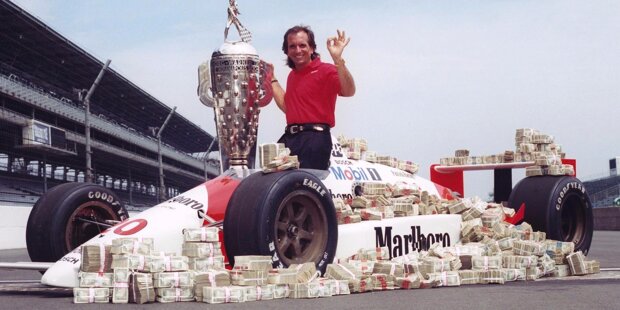
But not only for Sato, also for the Rahal team, Sato’s victory at the “ghost race” in August 2020 was the second Indy 500 win. The team’s first win at the season highlight was in 2004 with Buddy Rice in the cockpit. That was the time when the IndyCar scene was split into the CART/ChampCar series on one hand and the Indy Racing League (IRL) on the other. The Indy 500 was then part of the IRL calendar, which in that year 2004 was the last time a pure oval racing series.
RLL team founder Bobby Rahal even has three Indy 500 wins to his name. In addition to his two triumphs as a team owner, he also has a victory as a driver. That came in 1986, exactly 40 years ago, driving for Truesports. For Bobby Rahal, 1986 was the year of his first of three titles in the unforgettable CART series. Apart from 1986, Rahal also won the CART title in 1987 and 1992, with the third title achieved in his own team (then Rahal/Hogan Racing).
Indy 500 Schedule (CEST)
For local time, six hours must be subtracted.
Tuesday, May 12
18:00 – 00:00: 1st Practice
Wednesday, May 13
18:00 – 00:00: 2nd Practice
Thursday, May 14
18:00 – 00:00: 3rd Practice
Friday, May 15 (Fast Friday)
18:00 – 00:00: 4th Practice *
Saturday, May 16
14:30 – 15:30: 5th Practice *
17:00 – 23:50: Qualifying 1 *
Sunday, May 17 (Pole Day)
19:00 – 21:00: 6th Practice *
22:05 – 22:35: Qualifying 2 (Final-15 Shootout) *
23:00 – 00:00: Qualifying 3 (Top-12 Shootout) *
Monday, May 18
00:35 – 00:55: Qualifying 4 (Fast-6 Shootout) *
19:00 – 21:00: 7th Practice
Friday, May 22 (Carb Day)
17:00 – 19:00: 8th Practice (Final Practice)
20:30 – 22:00: Pit Stop Competition
Read more Why Cadillac is in a «huge hurry to find performance» in Formula 1 2026
Saturday, May 23 (Legends Day)
18:00: Driver parade in downtown Indianapolis
Sunday, May 24 (Race Day)
16:00: Pre-Race Show
18:45: Race start
* increased boost pressure for the engines
Livestream and TV Broadcast Indy 500
The TV rights in Germany for the entire 2026 IndyCar season including the Indy 500 are split, but the series is not available on free TV: As usual, the pay-TV channel Sky in Germany broadcasts all IndyCar races – again on Sky Sport F1, the channel primarily covering Formula 1. (IndyCar 2026 on TV and livestream: All details)
Motorvision is another pay-TV channel that has been broadcasting IndyCar races live since 2025. The coverage is broadcast via Motorvision+ and is available not only in Germany but also in Austria and Switzerland.
Additionally, there is a paid offer from IndyCar with livestreams of all sessions on the official website Indycarlive.com. These can also be watched “on demand” at any time.
Saturday, May 16
17:00 – 00:00: Qualifying 1 live (Sky)
17:00 – 00:00: Qualifying 1 live (Motorvision+)
Sunday, May 17
08:00 – 15:00: Replay Qualifying 1 (Sky)
22:00 – 01:00: Qualifying 2/3 live (Sky)
22:00 – 01:00: Qualifying 2/3 live (Motorvision+)
Monday, May 18
15:00 – 18:00: Replay Qualifying 2/3 (Sky)
Sunday, May 24
16:00 – 18:30: Pre-Race Show live (Sky)
18:30 – 22:00: Race live (Sky)
18:30 – 22:00: Race live (Motorvision+)
Monday, May 25
17:00 – 20:00: Replay Race (Sky)
22:00 – 01:00: Replay Race (Sky)
Entry List Indy 500
In the 2026 IndyCar Series, 25 cars from ten teams are basically entered. These 25 cars have a so-called charter, which entitles them to start all races but also obliges them to do so.
Additional cars are entered for the Indy 500. This year there are eight. Thus, the traditional starting field size for the season highlight is exactly filled. But this also means that due to the lack of further additional entries, there is no “bumping” in the Indy 500 qualifying this year.
All 33 entered cars for this year’s Indy 500 already have their starting position secured for the race. To have three instead of only two qualifying segments on the second qualifying day (Sunday, May 17) even without Last-Chance Qualifying, the new qualifying format described above was introduced.
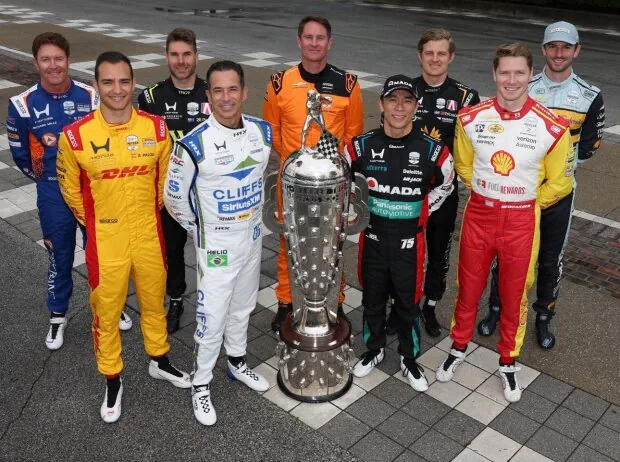
By the way: At the Indy 500, cars are qualified in principle. Regardless of the number of entries, it is not a driver who qualifies for the race, but the driver qualifies his car. If a driver unexpectedly becomes unavailable between qualifying and the race, the car would be taken over by a substitute driver to ensure that 33 cars actually participate in the race.
#2 – Josef Newgarden – Team Penske – Chevrolet
#3 – Scott McLaughlin – Team Penske – Chevrolet
#4 – Caio Collet – A.J. Foyt Enterprises – Chevrolet (Rookie)
#5 – Patricio “Pato” O’Ward – Arrow McLaren – Chevrolet
#06 – Helio Castroneves – Meyer Shank Racing – Honda *
#6 – Nolan Siegel – Arrow McLaren – Chevrolet
#7 – Christian Lundgaard – Arrow McLaren – Chevrolet
#8 – Kyffin Simpson – Chip Ganassi Racing – Honda
#9 – Scott Dixon – Chip Ganassi Racing – Honda
#10 – Alex Palou – Chip Ganassi Racing – Honda
#11 – Katherine Legge – HMD Motorsports – Chevrolet *
#12 – David Malukas – Team Penske – Chevrolet
#14 – Santino Ferrucci – A.J. Foyt Enterprises – Chevrolet
#15 – Graham Rahal – Rahal Letterman Lanigan Racing – Honda
#18 – Romain Grosjean – Dale Coyne Racing – Honda
#19 – Dennis Hauger – Dale Coyne Racing – Honda (Rookie)
#20 – Alexander Rossi – Ed Carpenter Racing – Chevrolet
#21 – Christian Rasmussen – Ed Carpenter Racing – Chevrolet
#23 – Conor Daly – Dreyer & Reinbold Racing – Chevrolet *
#24 – Jack Harvey – Dreyer & Reinbold Racing – Chevrolet *
#26 – Will Power – Andretti Global – Honda
#27 – Kyle Kirkwood – Andretti Global – Honda
#28 – Marcus Ericsson – Andretti Global – Honda
#31 – Ryan Hunter-Reay – Arrow McLaren – Chevrolet *
#33 – Ed Carpenter – Ed Carpenter Racing – Chevrolet *
#45 – Louis Foster – Rahal Letterman Lanigan Racing – Honda
#47 – Mick Schumacher – Rahal Letterman Lanigan Racing – Honda (Rookie)
#51 – Jacob Abel – Abel Motorsports – Chevrolet *
#60 – Felix Rosenqvist – Meyer Shank Racing – Honda
#66 – Marcus Armstrong – Meyer Shank Racing – Honda
#75 – Takuma Sato – Rahal Letterman Lanigan Racing – Honda *
#76 – Rinus “VeeKay” van Kalmthout – Juncos Hollinger Racing – Chevrolet
#77 – Sting Ray Robb – Juncos Hollinger Racing – Chevrolet
* Part-time program (only Indy 500)
Data on the Indianapolis Motor Speedway
Type: Superspeedway
Length: 2.500 miles (4.023 kilometers)
Banking: 9 degrees, 12 minutes (Turns 1-4)
Turns: 4
Race title: 110th Running of the Indianapolis 500
First edition: 1911
Lap record: 37.616 seconds – 239.260 mph (384.969 km/h)
– set by Arie Luyendyk (1996 on Fast Friday)
Pole record (four laps): 2:33.701 minutes – 234.220 mph (376.860 km/h)
– set by Scott McLaughlin (2024)
Most poles: Rick Mears (6)
Most wins: A.J. Foyt, Al Unser, Rick Mears, Helio Castroneves (4)
All Indy 500 Winners
2025 (IndyCar): Alex Palou
2024 (IndyCar): Josef Newgarden
2023 (IndyCar): Josef Newgarden
2022 (IndyCar): Marcus Ericsson
2021 (IndyCar): Helio Castroneves
2020 (IndyCar): Takuma Sato
2019 (IndyCar): Simon Pagenaud
2018 (IndyCar): Will Power
2017 (IndyCar): Takuma Sato
2016 (IndyCar): Alexander Rossi
2015 (IndyCar): Juan Pablo Montoya
2014 (IndyCar): Ryan Hunter-Reay
2013 (IndyCar): Tony Kanaan
2012 (IndyCar): Dario Franchitti
2011 (IndyCar): Dan Wheldon
2010 (IndyCar): Dario Franchitti
2009 (IndyCar): Helio Castroneves
2008 (IndyCar): Scott Dixon
2007 (IRL): Dario Franchitti
2006 (IRL): Sam Hornish Jr.
2005 (IRL): Dan Wheldon
2004 (IRL): Buddy Rice
2003 (IRL): Gil de Ferran
2002 (IRL): Helio Castroneves
2001 (IRL): Helio Castroneves
2000 (IRL): Juan Pablo Montoya
1999 (IRL): Kenny Bräck
1998 (IRL): Eddie Cheever
1997 (IRL): Arie Luyendyk
1996 (IRL): Buddy Lazier
1995 (CART): Jacques Villeneuve
1994 (CART): Al Unser Jr.
1993 (CART): Emerson Fittipaldi
1992 (CART): Al Unser Jr.
1991 (CART): Rick Mears
1990 (CART): Arie Luyendyk
1989 (CART): Emerson Fittipaldi
1988 (CART): Rick Mears
1987 (CART): Al Unser
1986 (CART): Bobby Rahal
1985 (CART): Danny Sullivan
1984 (CART): Rick Mears
1983 (CART): Tom Sneva
1982 (USAC): Gordon Johncock
1981 (USAC): Bobby Unser
1980 (CART): Johnny Rutherford
1979 (CART): Rick Mears
1978 (USAC): Al Unser
1977 (USAC): A.J. Foyt
1976 (USAC): Johnny Rutherford
1975 (USAC): Bobby Unser
1974 (USAC): Johnny Rutherford
1973 (USAC): Gordon Johncock
1972 (USAC): Mark Donohue
1971 (USAC): Al Unser
1970 (USAC): Al Unser
1969 (USAC): Mario Andretti
1968 (USAC): Bobby Unser
1967 (USAC): A.J. Foyt
1966 (USAC): Graham Hill
1965 (USAC): Jim Clark
1964 (USAC): A.J. Foyt
1963 (USAC): Parnelli Jones
1962 (USAC): Rodger Ward
1961 (USAC): A.J. Foyt
1960 (F1): Jim Rathman
1959 (F1): Rodger Ward
1958 (F1): Jimmy Bryan
1957 (F1): Sam Hanks
1956 (F1): Pat Flaherty
1955 (F1): Bob Sweikert
1954 (F1): Bill Vukovich
1953 (F1): Bill Vukovich
1952 (F1): Troy Ruttman
1951 (F1): Lee Wallard
1950 (F1): Johnnie Parsons
1949 (AAA): Bill Holland
1948 (AAA): Mauri Rose
1947 (AAA): Mauri Rose
1946 (AAA): George Robson
1942 to 1945 no Indy 500 (Second World War)
1941 (AAA): Floyd Davis & Mauri Rose
1940 (AAA): Wilbur Shaw
1939 (AAA): Wilbur Shaw
1938 (AAA): Floyd Roberts
1937 (AAA): Wilbur Shaw
1936 (AAA): Louis Meyer
1935 (AAA): Kelly Petillo
1934 (AAA): Bill Cummings
1933 (AAA): Louis Meyer
1932 (AAA): Fred Frame
1931 (AAA): Louis Schneider
1930 (AAA): Billy Arnold
1929 (AAA): Ray Keech
1928 (AAA): Louis Meyer
1927 (AAA): George Souders
1926 (AAA): Frank Lockhart
1925 (AAA): Peter DePaolo
1924 (AAA): Lora Corum & Joe Boyer
1923 (AAA): Tommy Milton
1922 (AAA): Jimmy Murphy
1921 (AAA): Tommy Milton
1920 (AAA): Gaston Chevrolet
1919 (AAA): Howdy Wilcox
1917 and 1918 no Indy 500 (First World War)
1916 (AAA): Dario Resta
1915 (AAA): Ralph DePalma
1914 (AAA): Rene Thomas
1913 (AAA): Jules Goux
1912 (AAA): Joe Dawson
1911 (AAA): Ray Harroun
Read more Red Bull: Not yet on the same level as McLaren and Co.