





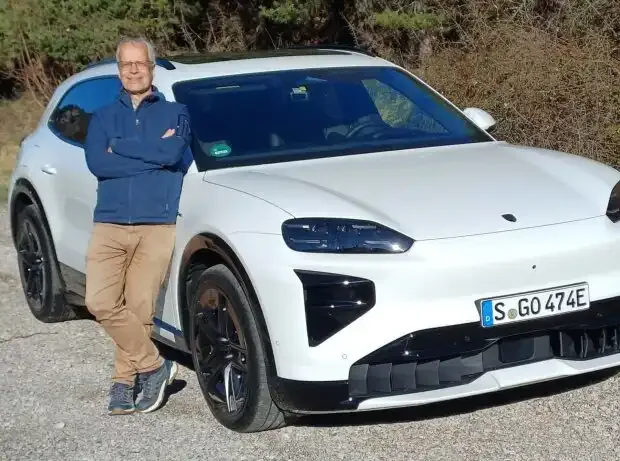
(Motorsport-Total.com/Motor1) – A catapult launch on an aircraft carrier must feel something like this: After pressing the push-to-pass button, I feel a full 730 kW of drive power. Quickly on the brakes, because I’ve long since been in the illegal speed range, then the button again, brake and gas again, and again and again. Until Marina, the Ukrainian colleague riding along, starts to feel queasy. That was my first impression when testing the new Porsche Cayenne Turbo Electric.
Read more Lewis Hamilton: Why he is so much stronger in 2026 than in 2025
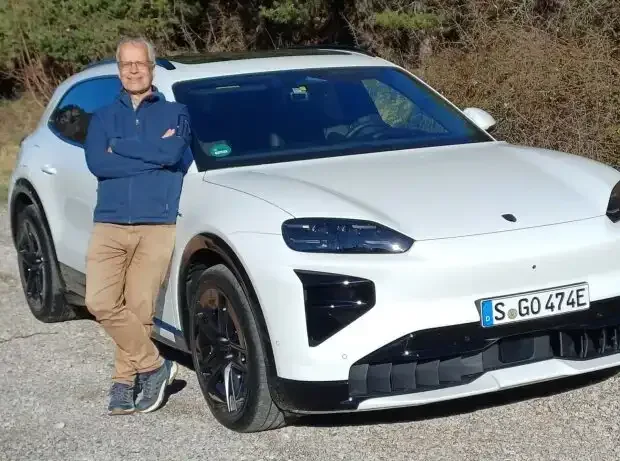
The technical basis for the electric Cayenne is the Premium Platform Electric (PPE), which also carries the Macan Electric. However, the technology is significantly different; for example, the battery consists of different cells and is cooled differently. In addition, the Cayenne also features overrun recuperation, while the Macan only recovers energy when braking. And the Turbo’s rear motor has particularly effective cooling. The Porsche Cayenne Electric has been available to order since November; it is available in the Cayenne, Cayenne S, and Cayenne Turbo versions. As mentioned, I tested the top version with a whopping 850 kW or 1,156 hp. Here are the most important data:
Porsche Cayenne Turbo Electric:
Drive: AWD 630-850 kW, 1,500 Nm
0-100 km/h / Top speed: 2.5 sec. with Launch Control / 260 km/h
WLTP consumption: 20.4-22.4 kWh
Battery net / gross: 109 / 113 kWh
WLTP range: 564-624 km
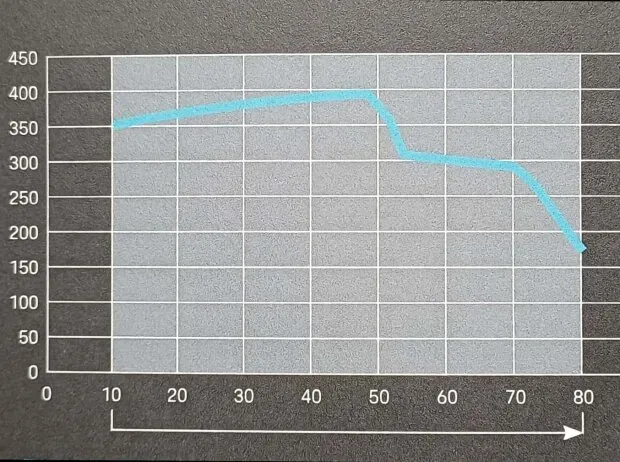
Max. charging power AC / DC: 11 kW (optional 22 kW) / 390 kW (200 kW with 400 volts)
DC charging time 10-80%: 16 min with 800 volts, 26 min with 400 volts
Length / Height: 4.99 m / 1.67 m (normal level)
Towing capacity braked, 12%: 3.0 tons (with off-road package 3.5 tons)
Price: 165,500 euros
Driving impressions
I have already described the first encounter with the electric Turbo. On the second day, we take a scenic route through the Pyrenees. I drive much more calmly than before, but this time too, the stomach of my passenger, Dirk from Germany, rebels.
When we get out, I also feel a slight malaise. Is it because of the vehement forward urge? Or because the 2.7-tonner lies so beautifully still on the asphalt, even when the landscape flies by outside – a discrepancy that puts our brain under stress? I don’t know.
My third key experience is an indirect one. I had actually forgotten to try out the Launch Control. This time Erik is at the wheel, and the colleague from Gothenburg demonstrates it right away: In Sport Plus mode, you step on the gas and brake simultaneously while stationary and then release the brake.
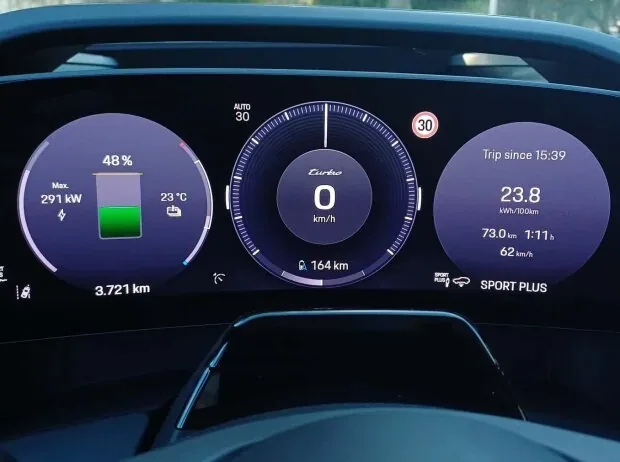
“It’s like being kicked by a horse,” Erik states after we are able to speak again. I can’t judge that, as it hasn’t happened to me yet, but if the push-to-pass button was already a catapult launch, then this is a rocket launch. 850 kW or an incredible 1,156 hp bring us to 100 km/h in 2.5 seconds. For that, the recorded trip computer consumption of around 25 kWh/100 km was still moderate.
Later, I ask drive expert Timo Henn about the power distribution of the all-wheel-drive vehicle. The permanent magnet motor at the front from the PPE modular system delivers 270 kW, while the rear motor with innovative direct cooling contributes 600 kW. “But that doesn’t add up to the full 850 kW,” I complain. Correct, that only applies at 650 volts of voltage at the motors, Henn specifies. When maximum power is demanded, as in our “rocket launch” with Launch Control, the voltage is increased to 800 volts, and then 750 kW are available at the rear.
You can’t just add up the 270 and 750 kW, but electric car fans should be aware of that. In any case, the drive is designed to be strongly rear-biased. Daring drivers can use this for drifts, but you should really know what you’re doing, especially on public roads. The Turbo is also equipped as standard with Porsche Torque Vectoring Plus, an electronically controlled differential lock on the rear axle, which makes turning in easier.
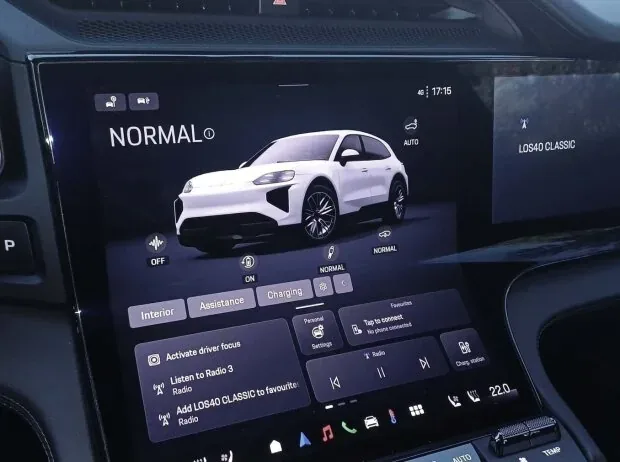
If you want, you can have the work of the motors accompanied by an artificial V8 sound. Several colleagues found it too artificial, but I liked it quite well, especially since it’s not too loud. By default, the sound only plays in Sport and Sport Plus driving modes, including outside. Those who prefer it more discreet can switch to Normal or Comfort in town. Unfortunately, simulated gear changes like in the magnificent Hyundai Ioniq 5 N are not yet available, and at the test event, the manufacturer refused to say anything on the subject. But since a prototype with shift paddles already exists, it should only be a matter of time.
The focus of the Cayenne Turbo Electric was clearly on performance. From the perspective of battery experts, driving is nothing more than discharging, even if that sounds a bit bleak. Since charging and discharging power are usually similar, the Cayenne battery can also be filled very quickly. Up to 390 kW, sometimes even 400 kW are possible, and this value is probably limited by the charging port, because it only supports 500 amperes, and 800 volts times 500 amperes is simply no more than 400 kW.
This means the standard charging process from 10 to 80 percent takes only 16 minutes. This results in a phenomenal charging speed of 108 kWh x 0.7 / 16 min = 4.8 kWh/min – currently the second-best value ever.
It’s fastest if you start at a battery temperature of 15 degrees and a state of charge of 9 percent. At that temperature, the battery doesn’t feel quite comfortable yet, but it gets hotter during charging, even if it is intensively cooled from above and below.
By the way, you can also charge at Tesla Superchargers with 400 volts; then so-called bank charging comes into action: The front three and the rear three battery modules are then connected in parallel (96s2p instead of 192s1p). This way, you still charge with 200 kW, the maximum at 400 volts, and the standard charging stroke takes 26 minutes. Alternatively, you can charge with 11 kW alternating current or for an extra charge of 1,666 euros with 22 kW.
The charging ports are located at the rear; on the right there is an AC port, on the left the usual double port for AC and DC. The charging flap opens when you touch the rear area with your hand. It closes automatically when you pull out the charging plug or otherwise after two minutes. In the future, a cable will no longer be absolutely necessary: Inductive charging is expected to arrive at the end of the year; anyone who wants to have the necessary charging plate installed should think about the corresponding pre-fitting when ordering the vehicle now.
Trailer operation
To our knowledge, the Cayenne Turbo Electric is currently the electric car with the highest towing capacity: You are allowed to pull braked trailers weighing up to 3.5 tons. However, this only applies with the optional off-road package (2,492 euros), because certain minimum values for the approach and departure angles at the front and rear are prescribed for such heavy trailers. But even the normal version can pull more with 3.0 tons than, for example, the BMW iX (2.5 tons).
Of course, the range decreases significantly with such a load, but Cayenne customers usually don’t tow their trailers far: Anyone who pays well over 150,000 euros for the Turbo Electric typically doesn’t go on vacation with a caravan. More likely, two large horses are driven to the vet or the motorboat to the nearest lake.
Chassis
But the Cayenne has even more tricks up its sleeve, and a good part of them is made possible by the sophisticated chassis. The electronically controlled shock absorbers of the PASM system can be adjusted along with the driving mode. The spread is wide. For example, you feel speed bumps (sleeping policemen) significantly less in Comfort mode than in Sport modes. However, a disadvantage that I know from all air suspensions is a slightly spongy feeling when steering back and forth a bit at 60 to 80 km/h.
Read more Mir “without regret” after Austin crashes despite missed podium chance
With the standard air suspension, the ground clearance can be changed by 85 mm. In off-road mode it is 245 mm, the normal level is 190 mm, and the lowest possible level is 170 mm. The chassis position is changed either automatically or via the operating system in the cockpit. In addition, there are buttons in the trunk with which you can lower the car for loading and unloading.
Interior and operation
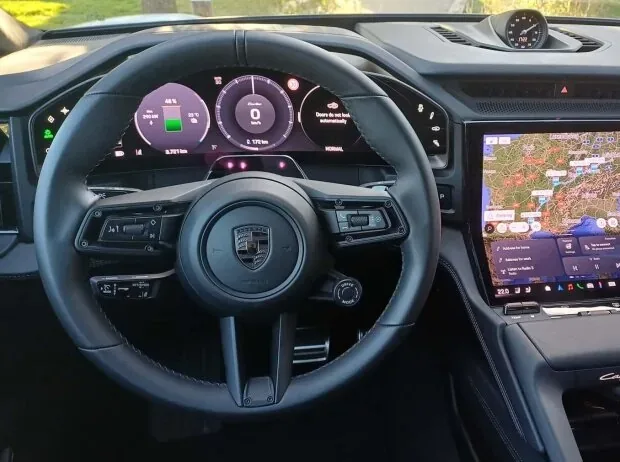
The highlight in the interior is clearly the Flow Display: The touchscreen is installed vertically here and has a “round” bend, which shows the map in the upper two-thirds and control surfaces at the bottom. But you can also use the entire screen as one if you want to scroll through the many settings. In front of it is a padded storage area for the wrist. In addition, there is a curved instrument display on which you can, for example, display the five Porsche-typical round instruments. Alternatively, there is a three-way configuration.
The battery display is particularly informative for electric nerds like me. It reveals not only what power you could currently charge with, but also the current battery temperature and whether it is too high, too low, or just right for fast charging. The head-up display installed in the test car costs an extra 2,392 euros.
There is a start button in the Cayenne Electric (Porsche-typical to the left of the steering wheel), but usually you don’t need it. As soon as you approach the vehicle with the key in your pocket, it is unlocked and the system is booted up. To start driving, you push the joystick to the right of the steering wheel down, and you’re ready to go.

The voice control left a somewhat ambivalent impression. It could tell me the name of the jagged mountains I was passing, perform calculations, and say something in Ukrainian. But the windows cannot be opened with it; infotainment expert Dirk Assfalg explained to me that they fear a loud-calling stranger could open the windows from the outside and steal something. The transparency of the glass roof can only be changed from the driver’s seat, and the car could not display the recuperation settings either. However, those who know their way around can display the general settings; the driving modes and recuperation modes appear at the very top.
Speaking of recuperation: The Cayenne only offers the modes On, Off, and Auto. Porsche fundamentally rejects one-pedal driving; we already learned that at the technical workshop for the electric Cayenne in Leipzig. And the “On” setting only causes weak recuperation. Colleague Marina, who privately drives a Model 3, was irritated because Porsche writes that the recuperation is particularly strong, up to 600 kW are possible. However, this refers to brake recuperation, not overrun recuperation – a difference that I found difficult to explain to Marina, as her trust in my expertise was as limited as her English.
The standard “adaptive” sports seats of the Turbo can be electrically adjusted in many ways. This also applies to the seat cushion depth and the width of the seats. The latter is a very nice feature, as the seat bolsters grip more firmly, holding you better on serpentine routes. Also pleasant are the optional surface heating for the armrests in the doors and between the front seats, as well as the glass sunroof, which is also available at an extra charge.
In the rear, the space is generous. In the trunk of the test car, we discovered the super-soft pillows that can be slipped over the headrests in the rear, and where the back of the head is bedded as softly as in an ICE train. The rear seats can be folded down electrically from the trunk in a 40:20:40 ratio. The luggage compartment holds 747 to 1,658 liters; in addition, there is a 90-liter frunk at the front.
The navigation maps impress with their Google Earth map display. The charging route planning is particularly praiseworthy, especially in comparison to the models recently driven from MG or Toyota. In “my” Porsche, the very long route from Lisbon to Munich could be set up in no time via voice control, and the recommended charging stops were drawn in from the start. There are also setting options for the minimum state of charge with which you want to arrive at the charging parks or at the destination.
Exterior
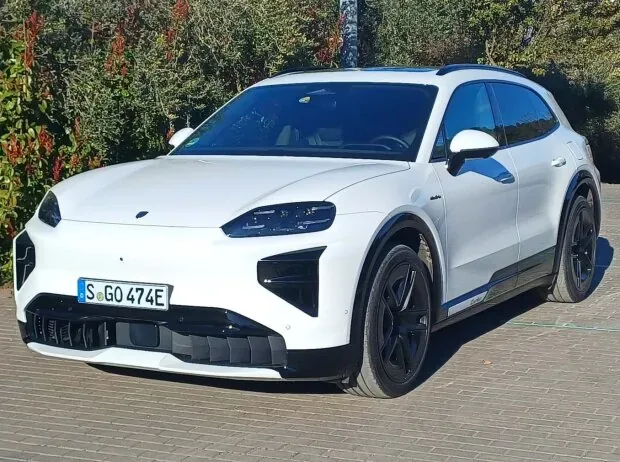
The Porsche Cayenne Electric is a decent chunk at almost five meters long and 1.67 meters high (normal level), but the look is rather discreet. No comparison with the conspicuous Mercedes G-Class; the rounded design is more similar to that of the Mercedes EQS SUV or Lucid Gravity. The characteristics of the Turbo include various elements in matte gray Turbonite, Turbo lettering on the sills and at the rear, and a special apron:
With the optional off-road package, a slightly shorter apron results in a larger approach angle; here, the otherwise glossy black part is matte. In the images above, the air intakes in the apron are open; this is what it looks like when the car is parked with an increased cooling requirement. If the car has not been driven so hard, they close and remain closed even when parked.
Like the Macan Electric, the Cayenne Electric has traditional pull handles. A special feature of the Turbo are the automatically extending aeroblades at the rear, which extend the streamlines and thus reduce wind resistance.
As far as colors are concerned, there are White, Silver, Gray, Black, the Mystic Green Metallic in our pictures, and two shades of blue, as well as a conspicuous Madeira Gold Metallic at no extra charge. Four other shades cost 3,510 euros each. The rim color can also be configured; in addition to the respective exterior color, there are also Red, Blue, and even Gold. An additional splash of color is provided by the bright yellow calipers of the PCCB ceramic brakes.
Prices and equipment
The Porsche Cayenne Turbo Electric costs 165,500 euros even without options. With the numerous extras available, this can be increased significantly. Standard equipment includes 21-inch alloy wheels, Matrix LED headlights, electrically adjustable and heated leather steering wheel with mode selection wheel and push-to-pass button, 18-way electrically adjustable sports seats at the front with memory function, electrically adjustable seats at the rear, seat heating front and rear, a surround sound system from Bose, air suspension with adjustable dampers (PASM), Porsche Torque Vectoring Plus, fixed caliper brakes front and rear with red calipers, sensor-controlled tailgate, two-zone automatic climate control, and much more.
Competitors include the Lucid Gravity Grand Touring, the upcoming Range Rover Electric, and the electric Mercedes G-Class, while the Mercedes EQS 580 4Matic SUV and the BMW iX only offer 400-volt technology.
More on the electric Porsche Cayenne:
New Porsche Cayenne S Electric with 490 kW and 653 km range
Porsche Cayenne Electric: First ride and new technical details
Conclusion
In terms of drive and charging performance, the Porsche Cayenne Turbo is hard to beat. Thus, the 850 kW car also offers endless driving fun. Simulated gear changes would be the icing on the cake.
Thanks to the air suspension with various additional systems, the large battery, and fast charging, the electric Cayenne is of course also capable of long highway stretches. But it is not a range specialist; here the significantly smaller BMW iX3 is ahead. In the Cayenne, the battery, drive, tires, and much more were designed for performance, as Porsche sees itself as a sports car manufacturer. Nevertheless, the car also offers enough space for the family and last but not least, it is the electric car with the highest towing capacity …
Read more Genesis GMR-001 officially presented: Andre Lotterer’s new weapon
- MotoGPFrom victory candidate to loser: The Bagnaia mystery of Austin
- 24h Le MansGenesis GMR-001: This is how the new LMDh enters the race
- Formula 1Fernando Alonso: No Aston Martin progress in the coming months
- MotoGPMarc Marquez admits: “Can’t make a difference”
Source: Press information, configurator