








(Motorsport-Total.com/Motor1) – The year is 1991. At the IAA in Frankfurt, visitors rub their eyes. Amongst the staid notchback sedans and the usual suspects of the compact class, a vehicle is parked that looks as if it came straight out of a Luc Besson science fiction film. Rounded, friendly, almost a bit like a polished pebble. It is the Renault Scénic concept.
Read more Erotic dancers target Formula 1 race in Canada with strike
The word stands for “Safety Concept Embodied in a New Innovative Car,” but for most visitors it simply means: the future. Patrick Le Quément, the then design chief with a penchant for bold shapes, sketched something here that would sustainably change the automotive world.
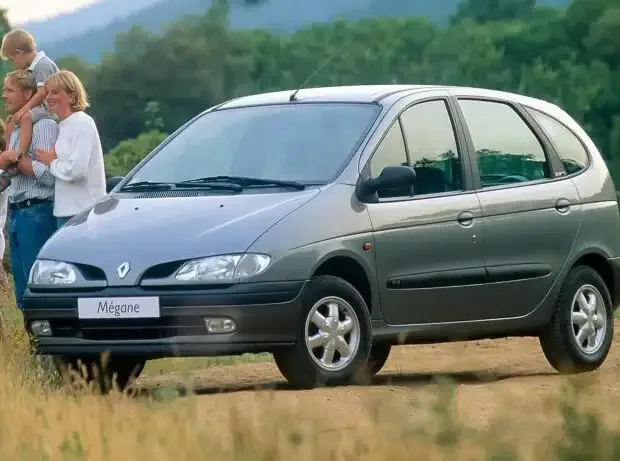
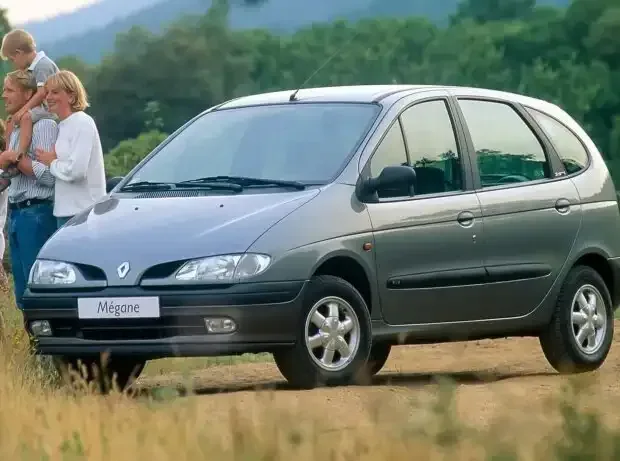
But we know the game: concepts shine in the spotlight of trade fairs and often end up in the dustbin of history. Not so with Renault. The French, then in an absolute innovation frenzy (think of the first Twingo), mean business. We jump five years ahead. It is March 1996, Geneva Motor Show. The covers come off and there it stands – almost unchanged in its philosophy: the Renault Mégane Scénic.
Today, a proud 30 years after its debut, we look back at this car and realize: Renault invented nothing less than a completely new segment back then – the compact van. While the big brother Espace has been making large families happy since 1984, the Scénic now brings the “spaceship” principle to the handy format of the Golf class.
Space miracle on 4.13 meters
Anyone standing in front of a modern SUV today is almost shocked at how compact the original Scénic actually is. With a length of just 4.13 meters, it is shorter than a current VW Polo. But the trick lies in the height. A full 1.67 meters it rises into the sky – 18 centimeters more than the classic Mégane sedan that provides its technical base. This egg-shaped “Monospace” silhouette creates a sense of space that was previously thought impossible in this class.
Photo series: Renault Megane Scenic (1996-2003)
You don’t climb into the car, you step in. The seating position is elevated, the glass surfaces are huge. As later with BMW, the rear window can be opened separately. But the real magic happens in the back. Instead of a simple rear bench, Renault installs three individual seats. This is the moment when fathers and mothers across Europe get teary-eyed. The seats can not only be moved longitudinally by 17 centimeters but also folded individually or completely removed.
Suddenly, the weekly shopping at the hardware store or the move of the first student flat becomes child’s play. Those who leave the middle seat at home can even move the outer seats inward to create more shoulder room. And if the kids whine: the backrest of the middle seat can be folded down into a table. With complete removal of the rear seats, the loading volume grows to a gigantic 1,800 liters. These are figures that made some station wagons pale with envy back then.
Read more Goosebumps and Fear: This is How the MotoGP Riders Experienced the Barcelona Crashes
Brave engines for the “Car of the Year”
But Renault does not settle for mere size. It is the attention to detail that makes the Scénic so special. Storage and compartments can be found everywhere in the interior. There are drawers under the seats and – the absolute highlight for every child of the 90s – secret compartments in the floor. Whoever hid their Gameboy games here was the king of the schoolyard. Even a cooling compartment for beverage cans in the center console is part of the repertoire.
Under the hood, things are solid. At launch, four petrol and two diesel engines provide propulsion, with power ranging from reasonable 47 kW (64 hp) to fairly confident 84 kW (114 hp). The driving behavior? Typically French: more comfortable than sporty, but always safe. The specialist press promptly acknowledges that the concept works: in 1997, the Scénic is crowned European “Car of the Year.”
Facelift, all-wheel-drive adventure, and million-seller
The success is so huge that Renault has to ramp up production every six months. In 1999, the visual refresh follows. The headlights become larger, the look more alert. Much more important, however: the car emancipates itself. It is no longer called Mégane Scénic but simply Renault Scénic. It is now a brand within the brand. Under the hood, there is now optionally a 2.0 16V with 139 hp.
Images by: Renault
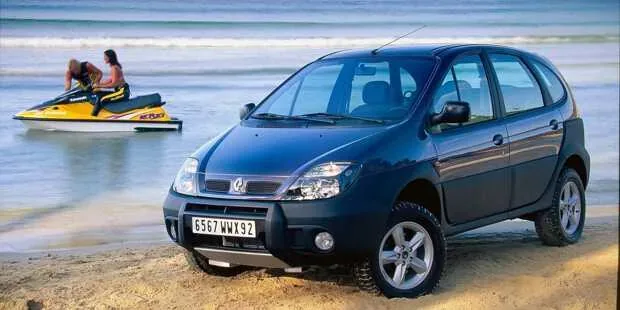
Renault continues to experiment and shows courage for niche products. In summer 2000, the Scénic RX4 appears. With a spare wheel on the rear, significantly more ground clearance, and permanent all-wheel drive, it anticipates today’s crossover trend. It is the rustic outdoorsman in a family of practical city dwellers. Technically, they keep up as well: at the end of 2000, the first common-rail diesel, the 1.9 dCi (102 hp), enters the lineup and ensures contemporary efficiency.
When the first Scénic hands over the baton to the second generation in 2003 after more than two million units built, it has changed the automotive landscape. Almost every major manufacturer now has a compact van in their program. But they have all disappeared today, including the Scénic. Despite an additional seven-seater, the Grand Scénic, the hammer falls in 2023. The name lives on in the purely electric Scénic E-Tech. The SUV faction has won. Unfortunately.
Read more “The gas no longer responded”: Acosta on the accident with Alex Marquez
More from Renault history:
Renault 5 GTL (1983): On the road with grandma’s charming couch
Renault Sport Spider: The radical abnormality in the test report