

– After a break of about a month, Formula 1 returns to the track in early May for a special weekend in Miami. It will be the first Grand Prix where the latest changes to the technical regulations for 2026 will take effect.
Read more «Uccio»-Interview: «Valentino has asked us for at least one victory»
These adjustments, based on insights from the first three Grands Prix, pursue two clear goals: to enable drivers to push to the limit again in qualifying and to reduce speed differences in direct duels without compromising overtaking opportunities.
The changes will have significant effects on qualifying set-ups and race dynamics, forcing teams to rethink their approach to overtaking maneuvers.
McLaren has already analyzed the adjustments in detail and published graphics showing how a race weekend will change.
Less Lift-and-Coast and Super-Clipping in Qualifying
Compared to 2025, the 2026 cars will complete a lap in a completely different way. With the 350 kW of the electric motor, they not only achieve significantly higher top speeds on the straights but also faster, thanks to the immediate torque of the MGU-K.
However, the battery remains the limiting factor. Due to its limited capacity, the available energy is quickly consumed. As a result, the electric motor’s power progressively decreases before the system inevitably switches to recuperation mode.
This dynamic, as seen in the first sector at Suzuka, occasionally forced drivers (and their electronics) to sacrifice cornering speeds and use corners more as charging zones than as a driving challenge. Many drivers therefore criticized that qualifying had lost its appeal due to the strong focus on energy management.
Formula 1 before restart: Is better racing coming now?
The FIA has worked to put the driver back at the center. The fastest solution was to reduce the amount of energy recoverable per lap, which makes techniques like lift-and-coast and super-clipping less impactful.
The less energy that can be recovered, the lower the incentive for extreme recuperation strategies.
An important clarification: The limit for super-clipping, where the MGU-K works against the internal combustion engine at full throttle on the straights to charge the battery, will be increased from 250 to 350 kW, making it more effective.
Nevertheless, the reduced total energy amount means that the need for super-clipping decreases. According to the FIA, its use will be reduced to about two to four seconds per lap.
How Qualifying Changes
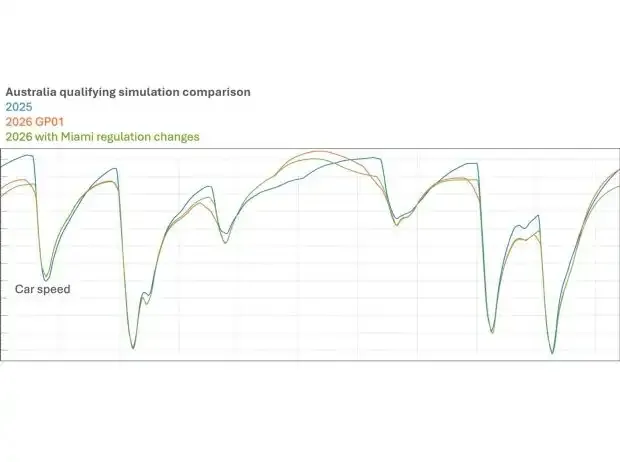
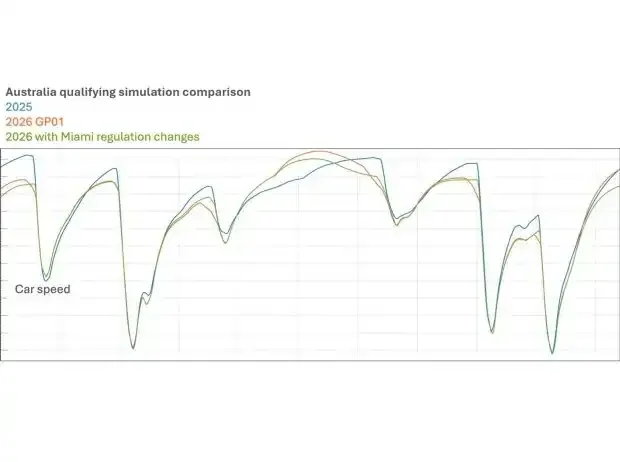
But how exactly will qualifying evolve with these changes? McLaren has published comparison graphics that overlay real telemetry data from the 2026 Australian Grand Prix (orange in the graphic above) with a simulation of the new rules (green).
The data shows that cars achieve lower top speeds due to the reduced energy budget. This has two effects: Less recoverable energy leads to less aggressive charging phases, which reduces the previously strong speed drop at the end of straights due to lift-and-coast or super-clipping.
The energy is distributed more evenly across the entire straight. Although the top speed is lower, cars reach the braking zones at a higher speed than in the first three races. The reason: The internal combustion engine increasingly resumes its actual role instead of being used for battery charging.
Overall, the speed loss on straights will be less than before, even if it still costs time. According to McLaren, the average time loss is about two to three tenths of a second, depending on the track.
Read more Mick Schumacher in the Indy oval: «I have to trust my butt»
In addition, how and when the electronics reduce the power of the MGU-K will be adjusted so that small driving errors do not have an excessive impact on energy consumption.
How On-Track Duels Change
These changes do not only affect qualifying. Following the incident between Oliver Bearman and Franco Colapinto in Suzuka, the FIA and teams have developed measures to reduce speed differences between attacking and defending cars.
The goal is more safety without compromising overtaking duels. Two concrete measures have been introduced: In track sections with restricted active aerodynamics, electrical power in the race will be limited to 250 kW, even in overtake mode.
On straights with open wings in Straight Mode, it remains at 350 kW. Furthermore, the effectiveness of the boost function has been adjusted to ensure that speed differences between drivers remain within a safer, more controllable range.
McLaren shows in a graphic how race progression and overtaking maneuvers in Miami will change as a result. Due to the lower total energy amount, the strategic use of the MGU-K gains further importance.
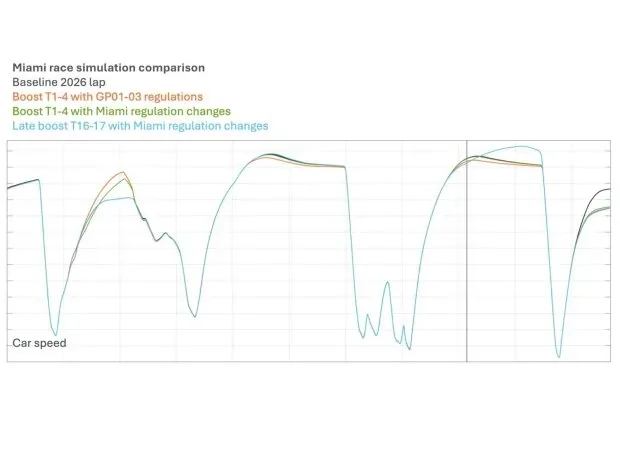
“Let’s take turns 1 to 4. If you use the boost in this section, you would achieve a very high speed advantage on the straight according to the previous rules, as you can see from the orange curve,” explains McLaren’s Head of Performance Engineering, Mark Temple.
“With the power reduction from 350 to 250 kilowatts, the green curve then results. This makes overtaking more difficult in such areas – and that is exactly the intention, because if there is no Straight Mode there, then the spot is less suitable for overtaking.”
“Another change applies everywhere: If you use the boost later, i.e., after the power on the straight has already decreased, you used to get the full 350 kW again. Now that is reduced. You either maintain the current power level or, if it is below 150 kW, it rises back to 150 kW.”
The accident between Bearman and Colapinto occurred in a section with restricted active aerodynamics. Under the new rules, the boost there would no longer deliver the full 350 kW but would be limited to a lower level, thereby reducing the approach speed.
Overtaking maneuvers are therefore likely to shift back more towards classic zones where maximum energy may be used.
“I think we will see fewer opportunistic overtaking attempts in unusual places, but that is a sensible compromise for safety. On the main straights, however, little will change,” says Temple.
“I believe the possibility still exists if you think of two consecutive long straights – that long straight up to turn 17 and then down to turn 1. It could still happen that a car does a bad job overtaking, uses too much energy, and then gets overtaken again on the next straight.”
“Personally, I even think that’s a pretty good thing because it adds a slightly stronger strategic element to overtaking. The driver has to think more, and it will reward those drivers who think about their actions, learn from them, and optimize them.”
Read more Indy 500 Test (Day 1): Schumacher in the pack — Best time for Daly