






(Motorsport-Total.com/Motor1) – You have to explain it to young people: There was once a time when not every second car was an SUV. A time when new body styles and space concepts were still bold. Just like the Skoda Roomster, which is now turning 20 years old.
Read more Will Monaco be better with the new cars? «Will not be enough»
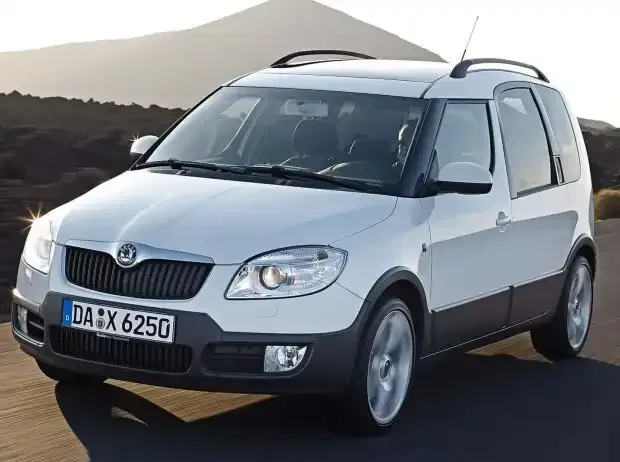
The story of the Skoda Roomster begins in 2003 with a much-noticed vision at the International Motor Show (IAA) in Frankfurt. There, the Czech Volkswagen subsidiary presented the study of a compact family car. The concept breaks with traditional design conventions and attracts attention through an exceptionally generous amount of space while maintaining compact dimensions.
The design team led by Thomas Ingenlath was responsible for the lead in the design. Due to the extremely positive reactions from automotive journalists and numerous potential customers, Skoda quickly decided to turn the design study into a production vehicle. However, it took nearly three years until the market launch, during which the vehicle was made fit for series production and everyday use.
On February 28, 2006, the Skoda Roomster celebrated its official world premiere at the Geneva Motor Show, thereby establishing a completely new market segment for the brand as its fourth model series. The official sales launch in the core European markets was scheduled for late summer of the same year.
Immediately popular
Even before the actual market launch, the first vehicles were available for preview in dealers’ showrooms to satisfy customer curiosity. Demand significantly exceeded the manufacturer’s expectations: in Germany alone, the company recorded more than 8,000 new orders before the sales start on September 2, 2006.
To meet the enormous demand, Skoda announced on August 31, 2006, the introduction of a third shift at the Kvasiny production plant starting November 22. The goal was to produce more than 20,000 units by the end of the year.
Technically, the Roomster is based on a clever mix of existing concepts: while the front end essentially corresponds to the platform of the Skoda Fabia, the rear axle comes from the first-generation Skoda Octavia. This allows for an extremely long wheelbase of 2,617 millimeters, which forms the basis for the unconventional space concept. With an overall length of 4,205 millimeters, the Roomster offers above-average space for passengers and luggage.
Clever layout
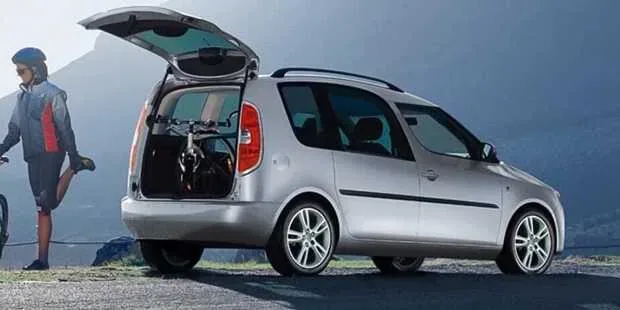
Visually, the vehicle is divided into two zones: the dynamically designed “Driving Room” cockpit with flat front windows and the spacious “Living Room” in the rear with significantly lowered side windows, which offer an excellent view especially for children.
A key purchasing argument is the so-called “Varioflex” seating system. The three rear individual seats can be moved independently, folded down, or completely removed. If the middle seat is removed, the two outer seats can be moved inward for more shoulder room.
The trunk volume is therefore highly variable and ranges from 450 to 530 liters in the standard configuration, which is among the top values in this vehicle class. With the rear seats fully removed, the cargo space grows to up to 1,780 liters, turning the Roomster into a small transporter in no time.
Affordable prices, manageable performance
At the market launch in autumn 2006, three trim levels were available: Roomster, Style, and Comfort. The pricing underlines the brand promise of excellent value for money. The base model starts at 12,990 euros, while the Style and Comfort lines are available from 14,490 euros and 16,690 euros respectively.
Read more Clear words from Davide Tardozzi: «Aprilia is currently superior»
Photo series: Skoda Roomster (2006-2015): The space miracle turns 20
The engine range includes six engines, all of which meet the EU4 emission standard. Among the gasoline engines, an in Mlada Boleslav developed 1.2-liter three-cylinder with 47 kW (64 hp) forms the entry level. Above that are a 1.4-liter four-cylinder with 63 kW (86 hp) and as the top engine a 1.6-liter four-cylinder with 77 kW (105 hp), for which an automatic transmission is optionally available.
The diesel portfolio consists of two 1.4-liter three-cylinder engines with 51 kW (70 hp) and 59 kW (80 hp) as well as the most powerful diesel, a 1.9-liter four-cylinder with 77 kW (105 hp). The two stronger diesel engines are equipped with a diesel particulate filter as standard. Depending on the engine, the vehicles reach top speeds between 155 and 184 km/h.
A touch of off-road
The model range was supplemented in 2007 by the Roomster Scout. This off-road look variant differs from the series version mainly by robust design elements such as plastic cladding on the sills and wheel arches as well as a visual underride protection. These modifications increase the Scout’s dimensions to 4,219 mm length, 1,695 mm width, and 1,650 mm height.
Thus, with the same wheelbase, it is 14 mm longer, 11 mm wider, and 43 mm higher than the civilian base version. Despite the off-road appearance, the Scout is also delivered exclusively with front-wheel drive. In addition, the “Praktik” commercial vehicle variant appears with sheeted rear side windows and a robust cargo area partition for commercial users.
A fuel saver from Austria
That the space vehicle can also convince in terms of efficiency is proven by the Austrian fuel-saving expert Gerhard Plattner on an extensive European tour with a Skoda Roomster 1.4 TDI. On the 446-kilometer section from Tallinn to St. Petersburg, Plattner sets a new record by reducing consumption to only 3.98 liters. This record drive was favored by a flat route profile and low traffic, allowing for smooth rolling.
Upon his subsequent arrival in Helsinki, Plattner had covered a total of 13,864 kilometers and consumed 624.11 liters of fuel. This corresponds to an impressive overall average consumption of 4.5 liters per 100 kilometers. On the last 437-kilometer section from St. Petersburg to the Finnish capital, the Roomster recorded a consumption of 4.21 liters.
Facelift in 2010
In spring 2010, the model series underwent a thorough facelift. At the Geneva Motor Show from March 4 to 14, Skoda presented the “new face” of the Roomster as well as the technically related Fabia. A completely newly developed front end with a changed design language makes the space miracle appear visually lower and wider at the same vehicle height, giving the vehicle a much more dynamic appearance.
The Scout variant also received a visual and technical update as part of this facelift. Inside, more modern infotainment systems were introduced, and the engine range was switched to efficient TSI gasoline and common-rail TDI diesel engines, which now meet the stricter Euro 5 standard.
The Skoda Roomster remained a fixed part of the model program until 2015, before production was discontinued after around 370,000 units without a direct successor. Plans for a second generation based on the Volkswagen Caddy were abandoned shortly before series maturity.
Read more Formula 1 Commission: No Breakthrough on Changes to Engine Rules
Latest from Skoda:
Skoda Epiq (2026): This is the cost of the crossover at the start of orders (update)
Skoda Fabia 130 (2026) in test: A bit of GTI?