






(Motorsport-Total.com/Motor1) – There are cars that retell an era – and others that seem far ahead of their time. The Volkswagen Scirocco Bi-Motor 360/4 clearly belongs to the second category. As an extreme prototype vehicle from the early 1980s, it combines two engines with a somewhat “handcrafted” all-wheel drive and achieves performance that was at supercar level at the time.
Read more Unexpected success: Verstappen reveals details about his maiden victory
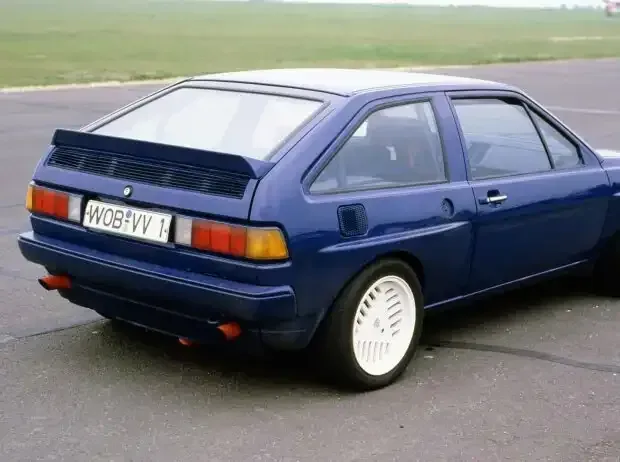
It is a visionary project from Volkswagen Motorsport, developed at a time when powerful all-wheel drive concepts were just beginning their evolution. It all started with an extraordinary challenge. Klaus Peter Rosorius, then head of Volkswagen Motorsport, commissioned the Viennese designer Kurt Bergmann with a radical project.
A Jetta as camouflage
The goal was to develop an all-wheel drive without the then usual heavy driveshaft. A nondescript VW Jetta served as the first test vehicle. Bergmann implanted two GTI engines into this vehicle – one in the front, one in the rear – each driving its own axle. The first test drives were so promising that the decision was made to bring the concept to the big stage of motorsport.
The next chapter took the team to the USA, to the legendary hill climb at Pikes Peak in Colorado. Based on the VW Golf, a new prototype was created for the “Race to the Clouds.” The 19.9-kilometer natural road, which leads up to 4,700 meters altitude, served as the ultimate test laboratory. At this point, the project was not yet fully developed, but the experiences gained in the Eifel mountains and the Rocky Mountains were essential for further development.
1983: The Scirocco 360/4 experiment
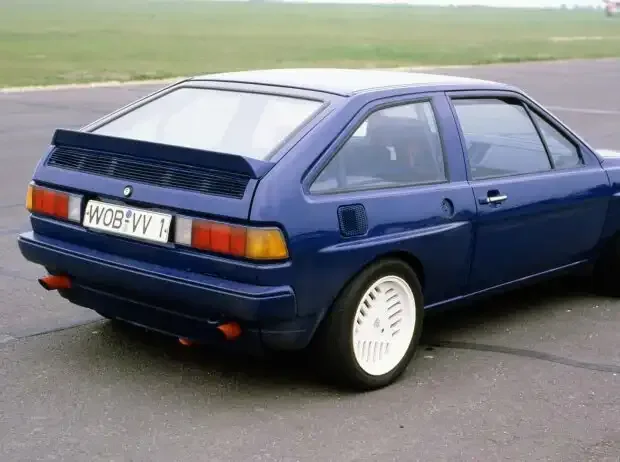
Parallel to the hill climb efforts, further prototypes were developed in Germany to test the technology for a possible small series or technological carriers. Under the leadership of Dr. Ulrich Seiffert, the spectacular 360/4 was created in 1983 based on the Scirocco II. The designation was programmatic: 360 hp total output and drive of all four wheels.
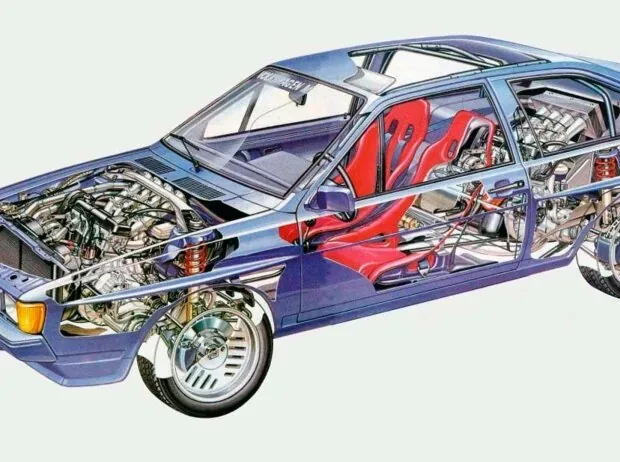
Technically, the car resembled a “Frankenstein project” with two hearts. Two 1.8-liter four-cylinder naturally aspirated engines from tuner Eckart Berg powered the car. This experimental character was also reflected visually: the body was significantly widened to accommodate 15-inch light alloy wheels of the Centra Type 6 type. Distinctive wheel arches and side air intakes served the necessary heat management of the rear engine, while two tailpipes at the rear hinted at the mechanical complexity.
Read more Vinales evaluates MotoGP comeback: Is he fit enough again now?
Controlling this double power source posed great challenges for the engineers. The first prototype used two synchronized five-speed manual transmissions, which required a high degree of precision from the driver. In a later, second prototype (the 280/4 with Oettinger engines), a setup with two three-speed automatic transmissions was even tested to simplify synchronization.
Inside, the technical approach was consistently continued. An instrument cluster developed by VDO integrated two separate tachometers as well as double temperature gauges, flanked by a central digital speedometer. Despite these extraordinary qualities and the impressive engineering effort, the project remained in the experimental stage. The enormous technical complexity, lack of everyday usability, and high costs prevented any industrial development. Thus, only two units were built.
1987: Almost victory at Pikes Peak
The radical peak of the Bi-Motor era was reached in 1987. Kurt Bergmann designed the ultimate Golf for Jochi Kleint. This car had an aluminum monocoque and a plastic body that was 20 centimeters wider than the production model. Two longitudinally installed 1.8-liter turbo engines mobilized around 650 hp together, transmitted via Hewland Formula 2 gearboxes.
The victory at the prestigious hill climb was within reach, but fate struck cruelly: just one mile before the finish, a joint of the front suspension broke. Jochi Kleint had to give up, and Walter Röhrl secured the triumph in the Audi Sport Quattro.
In total, only five of these extraordinary vehicles were produced: the original Jetta test vehicle, two Pikes Peak Golfs from Kurt Bergmann’s workshop, as well as a Scirocco and another Golf in Germany. Despite the impressive performance, the enormous complexity and high costs prevented any industrial development. Today, these fascinating witnesses of a bold era stand in the AutoMuseum Volkswagen and remind us of a time when engineering spirit knew no bounds.
Read more Formula 1 Upgrade: With this plan, Cadillac wants to chase Aston Martin in Canada
Other VW models that no one knows:
Beetle successor: Why the EA 266 did not become the Golf
The rarest Beetles in the world: 9 treasures from truck to luxury