




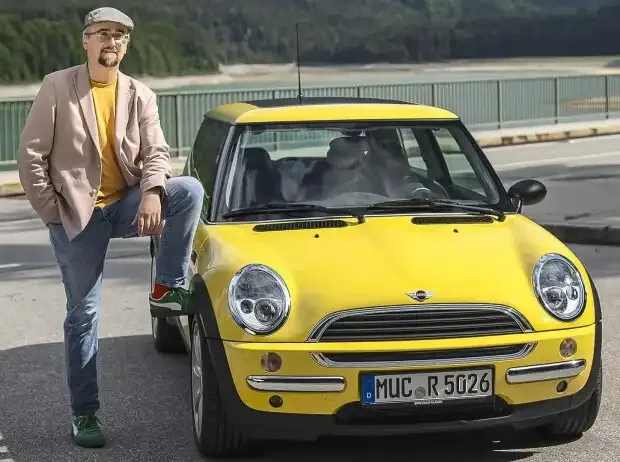
(Motorsport-Total.com/Motor1) – In October 2000, the time of farewell strikes for fans of the classic original Mini. After an impressive 41 years of production and more than 5.3 million units built, the last classic Mini rolls off the production line. Around 600,000 of these were produced alone at the traditional Oxford plant between 1959 and 1968.
Read more Mercedes: This is why we are beyond the development phase of the competition
However, anyone who believes that the iconic vehicle concept by Sir Alec Issigonis would finally disappear into automobile museums is greatly mistaken. After a production break of almost one year, the brand opens a completely new chapter.
The groundwork for the relaunch was already laid at the beginning of 1994 when the BMW Group took over the Rover Group. Although the marriage with Rover failed, the Munich-based company saw potential in the British traditional name Mini for something completely new: the first premium vehicle in the small car segment fits well into the group portfolio.
A first promising preview was provided in 1997 by the Mini Cooper study shown at the International Motor Show in Frankfurt. The design, drawn by Frank Stephenson and later brought to production maturity under Gert Volker Hildebrand, successfully translates the genes of the classic into the modern era.
Restart 25 years ago
Short body overhangs, round headlights, the hexagonal grille, and the visually floating roof remain, but grow to contemporary small car dimensions. At the end of September 2000, the production version celebrated its world premiere at the Paris Motor Show. In Germany, the new Mini Cooper was first admired in November 2000 at the Berlin Motor Show. The official sales launch in the home market of Great Britain took place on July 7, 2001, while German customers could buy it from September 8, 2001.
Photo series: Time travel in the R50: The first Mini under BMW management
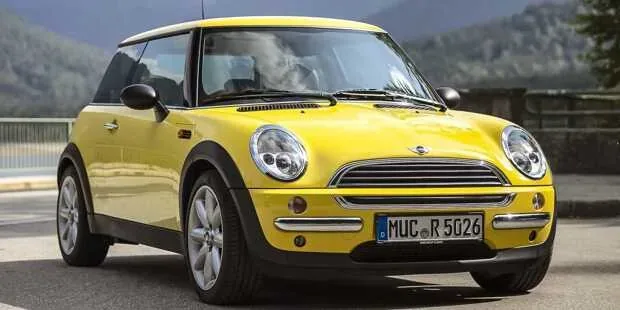
Initially, the Mini One with 90 hp and the significantly more dynamic Mini Cooper with 115 hp are available. Under the hoods, transversely mounted 1.6-liter four-cylinder naturally aspirated engines from the Tritec joint venture with Chrysler, manufactured in Curitiba, Brazil, work. The result exceeds even the boldest expectations. Demand is so enormous that at the Oxford plant, weekend shifts have to be added just two months after the sales launch to increase the planned production volume for 2001 from 30,000 to 42,000 units.
BMW previously invested heavily in converting the Oxford site. Within just 13 months, the responsible parties relocated the production of the Rover 75 to Birmingham and invested around 230 million British pounds (then about 700 million DM) in the Oxford plant.
The neo-Mini was also small at first
On April 26, 2001, the first production vehicle rolled off the line there: a Mini Cooper in fiery Chili Red with a white contrasting roof. And now I, as Hildebrandt, am practically sitting in Hildebrand. Without T and without coffee. Joking aside, one involuntarily asks: Is the first BMW Mini really already 25 years old? Well, the lack of LED gimmicks on the body reveals it a bit. Here, everything is still genuine tinsel to bridge to the old Mini.
Looking at the dimensions of the 2002 Mini One makes the generational change particularly clear. While the original Mini, with its modest three meters in length, was designed as a tiny economy car, the new version appears significantly more mature. However, the R50, the development code of the neo-Mini, still seems modest by today’s standards.
The three-door Mini One measures exactly 3,626 millimeters in length, 1,688 millimeters in width, and 1,408 millimeters in height. With a wheelbase of 2,467 millimeters, the little car now offers space for four occupants along with modern safety and driving comfort. Theoretically at least; in reality, only children should sit in the back. Or you fold the backrests down right away, because the trunk is very modest at 150 liters in normal condition. Up to 670 liters can be expanded.
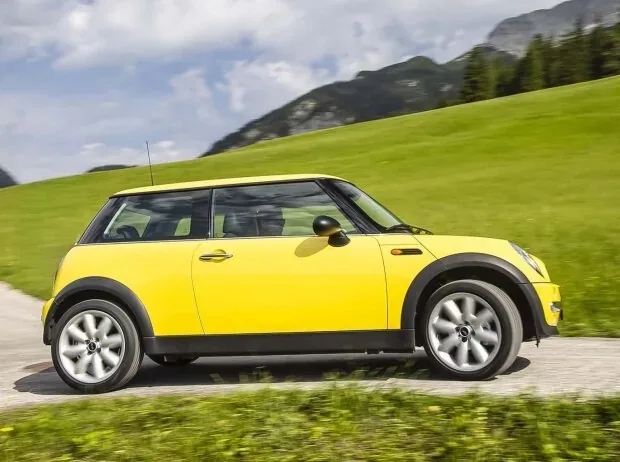
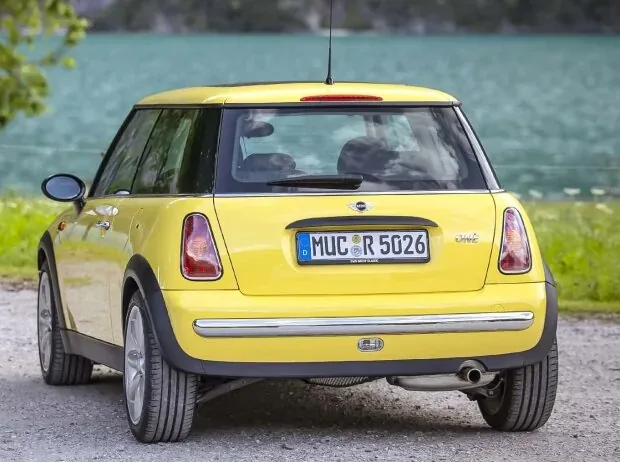
The visual differentiation of the individual model variants is cleverly solved. The entry-level Mini One always carries its roof in body color, while the slats of the grille and the exterior mirror housings are made of black plastic. Special colors like Liquid Yellow additionally make the little one an exotic: In the first year of sales, only about every fifteenth vehicle in Germany is delivered in this sunny paint.
A Mini One cost 15,250 of the then new euros in 2002. That sounds cheaper today than it was back then, as many small cars were still available for under 10,000 euros. The lack of the massive shine of higher trims actually suits the One quite well, as I find in reality. A quite charming look, but not exaggeratedly jazzed up.
Read more Mansory Vincero and Vivere: Striking Bugatti Conversions
By the way, the three-door is 1.69 meters wide and 1.42 meters high. Especially drivers over 1.80 meters feel the intimacy in the neo-Mini; my passenger sits almost frog-like next to me as a seat giant. The not at all mini-like bloating in the form of a Countryman and Co. would only come much later.
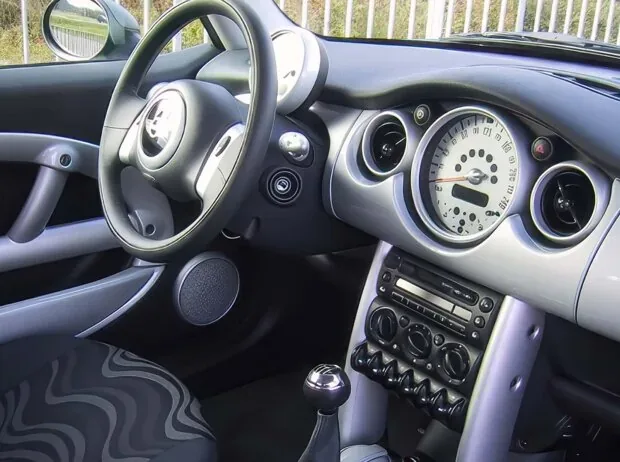
The keyword “modest” does not apply to the cockpit of the Mini One. The central speedometer is intended as a retro element but is overloaded with scales and thus difficult to read. Only a weak consolation is the tachometer behind the steering wheel. And the switches for the power windows and mirror adjustment first have to be found. But is it better today when everything is hidden in huge touchscreens and distracts even more?
In the 24-year-old Mini, at least, no camera stares at you permanently, which goes crazy at the slightest yawn. Here, the driver is still the focus and not annoying filler material in the car. Very special is the narrow windshield; neck training comes naturally for tall people. A reminiscence to the early Mini’s turn signal lever is found in the same component in 2002, but the red tip no longer has a signaling function here.
And how does the first BMW Mini drive? My co-driver soon wonders where progress has actually gone since then. There’s something to that. Just put in a smartphone holder for navigation, done. Our car, maintained by BMW Classic, already has air conditioning, cup holders too. The manual transmission from Midland Gear in the UK is unfortunately more Midland than Gear. Short throws, but somewhat clunky and above all looong geared.
Real sprightliness is also thwarted by the 1.6-liter naturally aspirated petrol engine, whose 140 Newton meters of torque are available at 3,000 rpm. 10.9 seconds is okay, but no more. Especially in the city, the engine must be kept happy; below 2,000 rpm, not much happens. But the Mini One suggests a sportiness it actually does not have. Included with every one of the then retro Brits is the nowadays already overused “go-kart feeling.” Here it has not yet become hollow marketing speak but is really present. This photo hints at it:
Technically, the R50 takes modern paths. In addition to electronic throttle control and ABS, BMW’s Cornering Brake Control is also part of the standard equipment. Thanks to an elaborate multi-link rear axle, the front-wheel drive offers the agile, go-kart-like handling that fans have always associated with the brand.
The model range was supplemented from March 2002 by the sporty Cooper S with the internal designation R53. A Roots supercharger helps the 1.6-liter engine here to a solid 163 hp. Because the intercooler takes up space under the characteristic air scoop, the battery is moved to the rear, which is why the Cooper S rolls on run-flat tires from the factory.
The fleet of the Bavarian police also upgrades and takes a self-wrapped Mini One into service on a trial basis in July 2002. In the following years, the brand sends further derivatives into the race. In 2003, a fuel-efficient diesel made its debut in the R50, whose 75 hp 1.4-liter engine comes from Toyota.
Another highlight followed in July 2004 with the four-seat convertible of the R52 series. At the same time, BMW gave the model family a facelift. A smooth-shifting Getrag five-speed transmission replaced the previous five-speed manual from Midlands. The first generation of the New Mini developed into a worldwide bestseller until it was replaced by the R56 in November 2006.
Today, the first BMW Minis are inexpensive, unfortunately for reasons: engines and transmissions are considered not very durable, and rust can also nibble at the body. Among insiders, the three-door R56 from 2006, which remained small at 3.70 meters and whose derivatives are considered significantly better in quality, is regarded as better. Here, the engines now came from the PSA Group.
- MotoGP400 km/h in MotoGP? Why Ezpeleta is now setting a limit
- MotoGPAprilia: Raul Fernandez names the reason for MotoGP dominance
- DTMDisqualification and appeal! Huge fuss about DTM winner Bortolotti
- DTMDTM-BoP Nürburgring: Will Porsche be “eaten” again on the straights?
Mini yesterday and today:
Roaring cube: On the road in the old rally Mini of the 1960s
Mini Cooper C three-door (2026) in test: A real baby BMW?
Read more How a procedural error led to Quartararo’s penalty in Silverstone