






(Motorsport-Total.com/Motor1) – Our valued readers have probably already studied the section “Do you still know this one?” There we present cars from the past that have now almost been forgotten. But what about the models that are still quite numerous on the roads? Those types that everyone knows, which are clearly over 20 years old, but sometimes much less.
Read more Exclusive: How Frederic Vasseur Got Ferrari to Take More Risks
Will they ever become classics? That sparks controversial discussions. We want to present some of these models in our series “Classics of the Future?”
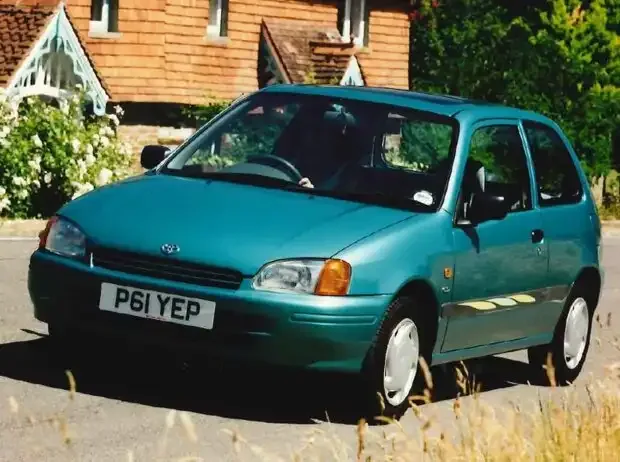
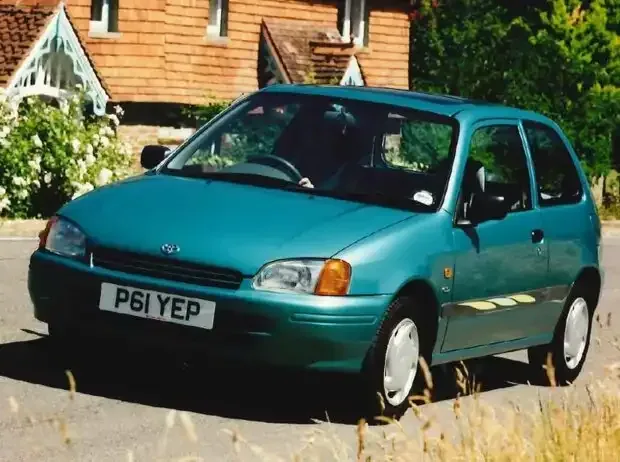
Small cars generally have a hard time as old- and youngtimers. They were rarely preserved because they were already cheap when new. While a Mercedes or BMW represented a value in itself that was cared for and driven for a long time, the short-lived goods were mostly maintained by their owners with a tight budget. As a result, some small cars are now rare despite a robust base. This also applies to the last generation of the Toyota Starlet in Europe, which is now turning 30 years old.
The last Starlet
The Starlet P9 model series (series 90), introduced in 1996, continued the proven concept of the compact three- or five-door hatchback. A distinctive and unmistakable design feature of the P9 generation was the slightly forward-sloping beltline on the front side doors.
On the Japanese domestic market, Toyota divided the range into three versions: the down-to-earth Reflet, the sporty Glanza, and the more luxuriously equipped Carat. The trim levels Reflet (as Base, F, and X), Carat, and Glanza S relied on the proven 1.3-liter four-cylinder naturally aspirated engine of type 4E-FE. In Japan, this naturally aspirated engine produced around 85 hp depending on the variant, while the spectacular Glanza V mobilized a hefty 135 hp thanks to turbocharging.
Photo series: Toyota Starlet (1996-1999)
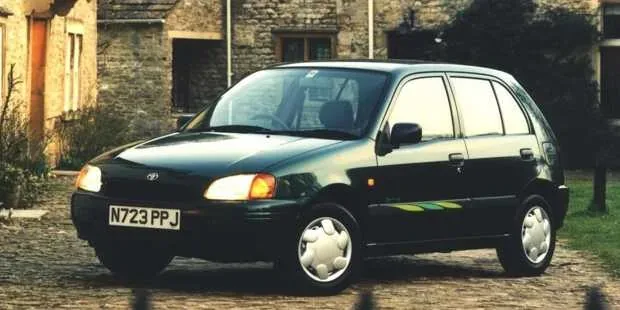
For the Reflet base version, the economical 1N diesel engine was also available as an alternative. Based on the five-door Reflet, Toyota also brought the Starlet Remix to the market – a crossover pioneer in a rustic off-road look with fender flares, robust cladding, roof rails, and a spare wheel mounted externally on the rear.
Parallels to the Paseo
Under the sheet metal, the P9 series shared the technical platform, chassis, and numerous components with the Toyota Paseo sports coupe. There were interesting differences in the interior: while the right-hand drive versions of the Starlet received their own dashboard with higher-placed central air vents, the left-hand drive variant adopted the dashboard directly from the Tercel and Paseo.
In the second quarter of 1996, the Starlet EP91 finally rolled out to European dealers. All vehicles intended for Europe were uniformly powered by the 4E-FE naturally aspirated engine, which produced a robustly tuned 75 hp (55 kW) in the European specifications.
Read more Who slept the worst last night: Fabio Quartararo
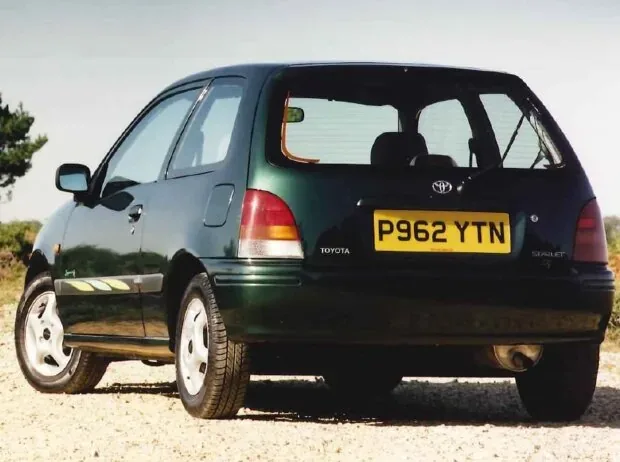
Sufficient to bring the Starlet, weighing just over a ton, to 100 km/h in 11.2 seconds. A top speed of 170 km/h was possible. The ADAC at the time considered the interior equipment “relatively Spartan,” and twelve-year-olds would feel claustrophobic in the back. At least the engine was high-revving.
However, marketing and trim levels varied significantly from country to country: In Germany, the simply named “J” base model of the Starlet started at 17,980 marks. A VW Polo with 75 hp (but rear doors) was almost 5,000 DM more expensive. Toyota charged 19,980 marks for the three-door standard Starlet, and the five-door cost an additional 900 marks.
The Starlet worldwide
In the UK, the model range initially started with the base version 1.3 Sportif and the higher-end 1.3 CD (which came standard with a CD radio and a sunroof). For the 1998 facelift, the British range was revised and then included the base model 1.3 S, the sportily inclined 1.3 SR (with lowered suspension, rear spoiler, and sports exhaust), as well as the fully equipped 1.3 GLS. In Switzerland, the top model corresponded to the 1.3 Crystal trim level.
Higher trim variants were reserved for features such as a driver airbag, a tachometer, front electric windows, rear headrests, and body-colored bumpers; an anti-lock braking system (ABS) and a sunroof mostly remained optional extras.
For the 1998 model year, Toyota gave the Japanese version a subtle facelift with newly designed front bumpers, a revised grille, new taillights, and refreshed seat covers. Production of the P9 generation finally ended worldwide in July 1999.
The Starlet made way for its direct successor, the Toyota Yaris. Today, the P9 is considered a prime example of the proverbial Toyota reliability of the 1990s in the youngtimer scene thanks to its extremely durable technology and indestructible mechanics.
More Toyota classics:
Time travel: On the road in the Toyota Corolla GT (AE86) from 1986
Toyota Supra (A80, 1993-2002): A Japan legend turns 30
Read more Ex-engineer believes: Sainz-Albon crash could become a problem for Williams