





(Motorsport-Total.com/Motor1) – From the ID.2 All prototype to the name release, first camouflaged images and interior shots … three years of miserable salami tactics have finally come to an end. With over 20 million units sold in 50 years, the Wolfsburg model is one of the most successful small cars. Now it is going electric and stands before us in full glory.
Read more MotoGP: No more wildcards for all manufacturers from 2027 onwards
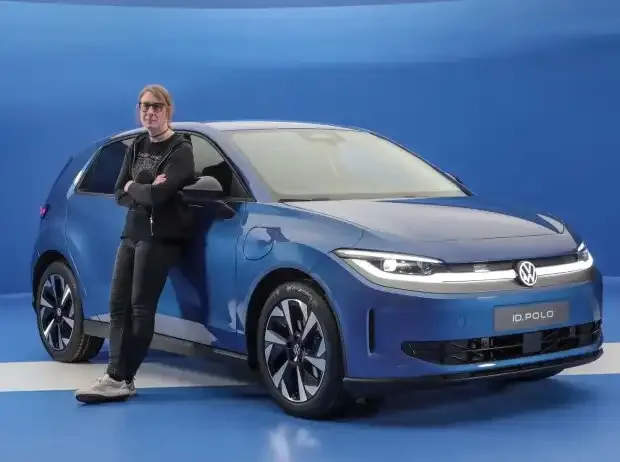
To currently distinguish it from its combustion engine counterpart, it goes by the name VW ID. Polo. Even the camouflaged versions suggested a down-to-earth, clear connection to the origin. The production version confirms it: the small electric brother of the Golf wants to convey real Volkswagen values again and therefore consciously presents itself as the seventh generation of the small car classic.
Body and Design
For the first time, the “Pure-Positive” design is used on the ID. Polo. Clear proportions, iconic design features, a friendly-looking front end, and a solid rear are meant to capture the timeless and charismatic style of days gone by. And it works! The seventh generation is immediately recognizable as a friendly everyday companion from Wolfsburg.
That is exactly what the previous rather soulless ID models lacked: the quote in consistent evolution. The E-Polo also sports a nice grin at the front. VWs are allowed to show friendliness among the mass of narrow-headed, overly aggressive grumps. And honestly, that does something to you. At the sight of the smiling design elements with the small pupils in the strongly contrasted LED headlights and the air intakes, I immediately smile back.
The light strip and the illuminated VW logo no longer disrupt the flow as noticeably as with the combustion engine counterparts. Side flow-through openings promote a strong drag coefficient of 0.264 and the “dimple effect.” The proportions are also right in the side view. Effective lines emphasize dynamism and straightness; I last saw the curved C-pillar so strongly emphasized on the Golf 4. VW still draws parallels here to the original Golf. There is also play with the color offset of the sills and the lower bumper elements. Together with the small wheel arch clearance, the Polo appears as close to the ground as its fossil brother.
Photo Gallery: VW ID. Polo (2026)
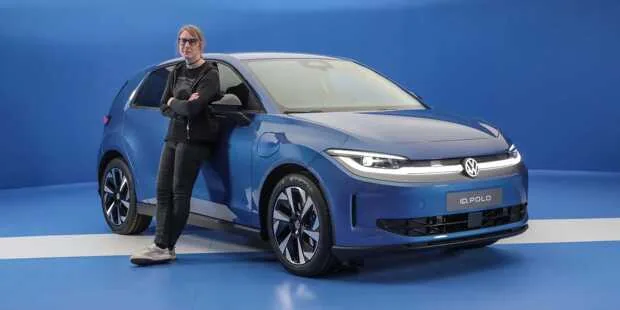
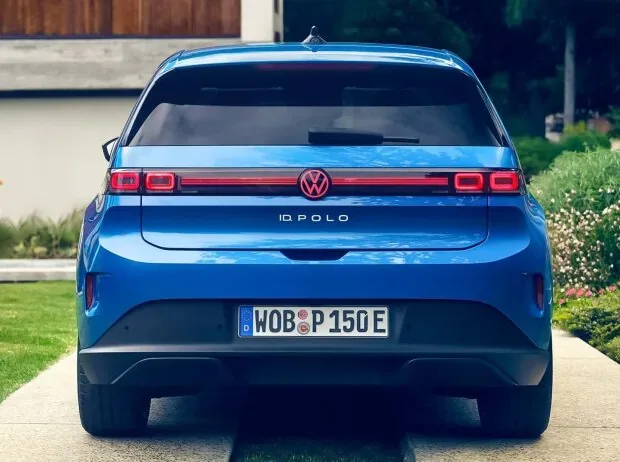
The dimensions in detail make it clear: 4.05 meters in length, 1.82 meters in width, 1.53 meters in height. The MQB+ Polo is close to the Polo 6 (4.07 x 1.75 x 1.45 meters). And the wheelbase is only just five centimeters longer than the MQB model: 2.60 meters (combustion engine: 2,552 mm). At the rear, a new design with a continuous light strip in the middle dominates, which is intended as the “golden ratio” for “clear surface division.”
VW is finally showing courage again with color, alongside the classics in black, white, gray, silver, and blue, the Polo is also available in red and yellow. The latter in particular makes the little charming guy appear even sunnier – top!
Interior
The ID. Polo also benefits from its new platform (MEB+) in the interior, which creates a lot of space with compact packaging. The trunk holds a maximum of 441 liters. This is even well above the VW brothers Golf (381 liters) and ID.3 Neo (385 liters). Responsible for this is a box in the rear that extends deep into the floor of the Wolfsburg model. An individually usable floor provides clear separation. With the rear seat folded down, the new ID family member reaches 1,243 liters.
Overall, the interior focuses on an “ergonomic interplay of digital and physical controls.” The horizontal orientation of the dashboard provides important information on one line of sight. A 10-inch display is used as the instrument cluster, which can also be customized with the previously shown retro elements. In the center, a 13-inch touchscreen offers clear structure and smooth operation.
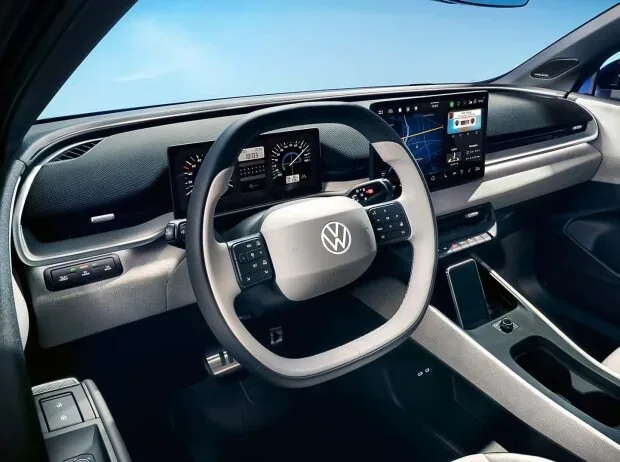
Physical controls with very good pressure point and haptic feedback are available, as with the ID.3 Neo, on the completely redesigned multifunction steering wheel, in the door panels, and below the centrally placed screen (climate control). For example, the volume can be adjusted via a small sound control on the center console. The steering column levers can also be well seen through the slim two-spoke design of the steering wheel.
The center console offers a smartphone tray with an inductive charging option depending on the equipment, two cup holders, and a center armrest with integrated storage compartment. Padded fabric strips have been applied to the dashboard, door panels, and center console in the visible area.
All textiles of the seats, doors, headliner, and carpets consist of 100 percent so-called rPET materials (recycled polyethylene terephthalate), mostly obtained from PET bottles. Overall, all this feels comfortable and high-quality in the first seating test. And on the rear seat, headroom and legroom are quite above the usual class average.
A vehicle-to-load function is standard, as well as a variety of assistance systems. Optionally, for example, a “Connected Travel Assist” is available, which uses online data for assisted lateral and longitudinal control and now also reacts to traffic lights. This is a novelty in the small car class.
Read more David Coulthard responds to manipulation allegations against FIA
Drive and Battery
The drive system of the ID. Polo is also a complete new design. The already announced new electric motor APP290 (Axial Parallel Position) is used. The 290 here stands for the maximum torque in Newton meters. Attached to the motor housing is the
1-speed transmission including housing and the also newly developed pulse inverter. The climate compressor was elaborately decoupled from the body and, according to VW, should not transmit vibrations into the interior.
The compact in-house development saves not only space but also weight. It also contributes to further cost reduction and energy savings. At launch, the unit is available in three power levels: 85 kW (116 hp), 99 kW (135 hp), and 155 kW (211 hp). During the coming year, the already announced ID. Polo GTI with 166 kW (226 hp) will be added.
For the first time, the “corporate standard cell” is also used. The new battery system is integrated directly into the body using cell-to-pack technology. Three of these battery packs form the energy storage in the battery system. In addition, certain elements were reinforced in the core to prevent further vibrations and achieve more direct driving behavior. The construction also favors a weight of under 1,600 kilograms (37 kWh: 1,568 kg, 52 kWh: 1,576 kg).
Two battery variants are available: a 37-kWh battery as a lithium iron phosphate version (LFP) and a 52-kWh version as a nickel manganese cobalt variant (NMC) with an even higher energy density. The smaller battery reaches a maximum fast charging power of 90 kW, the larger can handle up to 105 kW.
Charging from 10 to 80 percent should take about 27 minutes, or 24 minutes for the larger pack. According to Wolfsburg, a particularly flat charging curve favors stable charging times. Overall, ranges between 329 kilometers (37 kWh) and 455 kilometers (52 kWh) are promised with the new technology. The top speed is limited to 160 km/h.
Chassis and Features
VW also relies on proven technology for the chassis. Although a newly developed and tuned chassis for the front-wheel drive of the ID. Polo is used here, the structure is typical Volkswagen. The goal was also to design an optimal solution under high cost, space, and weight efficiency.
Thus, a combination of a MacPherson front axle and a particularly compact multi-link rear axle works. The interplay is intended to offer precise linearity and provide the driver with maximum feedback. The driving comfort should still be significantly above that of the predecessor. Compared to the MQB Polo, vibration comfort should have been improved again, as the natural frequencies of the front and rear axles could each be reduced by 5 percent.
A new one-box brake system with disc brakes on the front and rear axles ensures better brake modulation. This typical electric “mushy” feeling in the transition between recuperation and physical brake or a too soft or aggressive pedal feel when the brake pads engage should be prevented, the VW engineers assured me in a personal conversation. In addition, the VW ID. Polo comes with genuine one-pedal driving. Surface rust on the rear brake discs should be avoided by preventive regular application of the brake pads.
More about VW:
VW ID. Cross (2026): Everything about dimensions and technology
VW Golf 9 (2028): First teaser image of the electric ID. Golf
At low speeds, VW has also come up with a new brand sound, which will be used for the first time in the ID. Polo. “Various parameters were incorporated to make the sound experience as pleasant and fascinating as possible.” In the “Sport” driving profile, a “particularly charismatic sports sound” is also generated up to 50 km/h. We are curious what the little electric car will hum to us.
- MotoGPRed Bull and Monster: MotoGP sponsorship is being reshuffled
- Formula 1Lightning threats: Why Formula 1 cannot/must not race in thunderstorms
- DTM“Like a married couple”: “Grello” ace Preining loses master engineer
- Formula 1Newey on Imola 1994: “The biggest memory is the sirens”
The VW ID. Polo starts as Trend at 24,995 euros. Here, the EU-mandated assistants and helpers are on board, as well as automatic climate control and the digital units that brands like Fiat or Citroen forgo in the entry-level models, for example. The ID. Polo Life (focused on comfort) and the ID. Polo Style complete the range. The latter then also comes, for example, with IQ.Light, the illuminated light strip, and 3D LED taillights. Unfortunately, no prices have been communicated for these versions yet.
Read more «Like a married couple»: «Grello» Ass Preining loses master engineer