







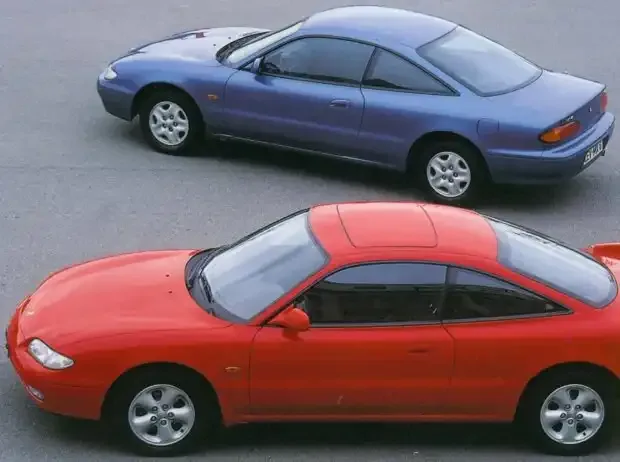
(Motorsport-Total.com/Motor1) – The 1990s were an experimental time for Japanese car manufacturers. In spring 1984, Kenichi Yamamoto, as the new Mazda president, decided on the “Off-Line Go-Go” program – projects needed a 55 percent chance of realization to be continued. On this basis, cars like the legendary MX-5 were created, but also two coupes that came onto the market in 1991 and are now almost forgotten.
Read more Maverick Vinales is also missing in Aragon: Pol Espargaro steps in again
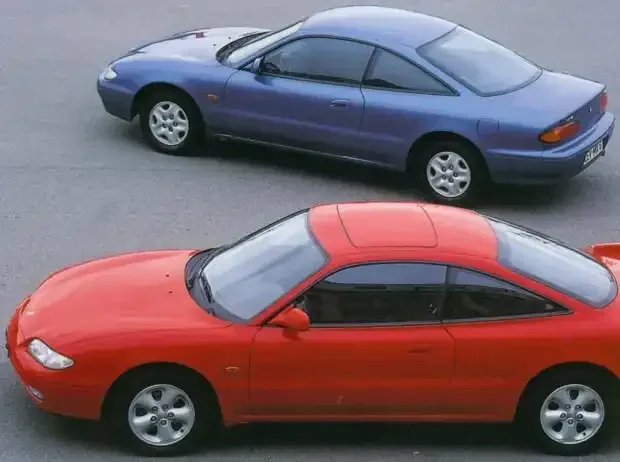
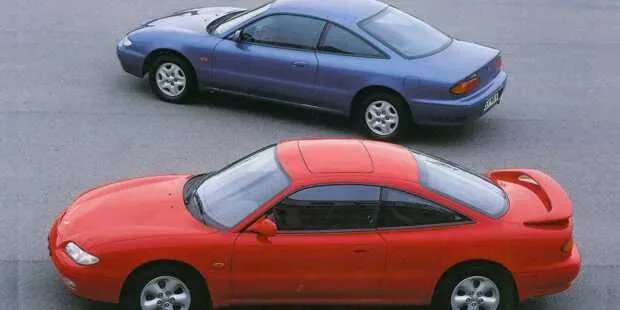
While the Mazda RX-7, RX-8, and MX-5 are celebrated by enthusiasts and in the scene, the MX-3 and MX-6 seem to live in the shadows. They simply have neither a Wankel engine nor a roof that opens. Both used mass-production technology but packaged it in independent bodies and brought technical refinements that were anything but standard at the time. And both turn 35 years old this year.
The MX-3 made its world debut in March 1991 at the Geneva Motor Show – a deliberate decision to position the car as an alternative to European compact sports cars.
With a length of only 4.22 meters and rounded, organic shapes, the 2+2 seater fully rode the wave of the then-trendy biodesign. At the rear was a distinctive glass hatch, strongly reminiscent of the Porsche 924, under which there was space for 289 liters of luggage.
Mini V6 in a lightweight
Under the sheet metal was the front-wheel-drive platform of the Mazda 323. The real highlight, however, was found in the engine bay: alongside a 1.6-liter four-cylinder with 65 kW (88 hp), Mazda fitted the coupe with a six-cylinder. This 1.8-liter V6 produced exactly 1,845 cubic centimeters of displacement, 98 kW (133 hp), and 157 Nm of torque and was considered the smallest series-produced V6 in the world at the time.
The engine with an aluminum block and two overhead camshafts per cylinder bank was not designed for brute power but for absolute smoothness. The sprint to 100 km/h was achieved in a respectable 8.5 seconds.
Photo gallery: 35 years of Mazda MX-3 and MX-6 (1991)
At the same time, the engine was quite economical for its time: at a constant 90 km/h, the V6 consumed only 7.1 liters per 100 kilometers according to the manufacturer. This was also due to the low curb weight, which ranged from a slim 1,030 to 1,115 kilograms depending on the equipment.
After a facelift in 1994, which included a renewed dashboard and a reduction of the V6 power to 129 hp, production ended in 1998. Around 20,000 MX-3s found buyers in Germany.
Read more Carlos Sainz: The team must take failures personally!
Mid-size class with all-wheel steering
Those who needed something a bit larger and more elegant could reach for the Mazda MX-6 from autumn 1991. At 4.62 meters long, the two-door positioned itself as a classic grand tourer in the upper mid-size class. The technical basis here was the front-wheel-drive layout of the Mazda 626.
In Germany, a 2.0-liter four-cylinder with 85 kW (115 hp) and a 2.5-liter V6 with 121 kW (165 hp) were available. The latter, just like its smaller sibling in the MX-3, stood out for a particularly smooth and quiet engine operation.
The technical unique selling point of the MX-6 was only available as an option. For the V6, an electronically controlled all-wheel steering (4WS) was available optionally. The system not only reduced the turning circle but also ensured lower load change reactions and a smoother cornering behavior.
However, the mid-size coupe was not a bestseller in Germany: until production ended in 1997, only around 2,700 buyers in this country chose the MX-6. Those satisfied with teleporting back to the era of affordable sports coupes and taking a look at the two Japanese models should travel to Augsburg. In the Mazda Classic exhibition at the Automobil Museum Frey, the 35-year history of the two models can be traced.
Those who want to experience the two Mazda insider tips on the road must be patient. The market in Germany is manageable. Roadworthy MX-3s with TÜV start at about 2,500 euros. It is unfortunately even more difficult with the MX-6. If you find one, expect to pay between 5,000 and 12,000 euros depending on condition. In this size, it is easier in this country to get along with an Opel Calibra, Peugeot 406 Coupe, or Ford Cougar.
More Mazda classic metal:
Mazda MX-3 (1991-1998): Do you still know it?
Mazda MX-5 Skyactiv-G 132 (2026) meets its ancestor: Old hits hard
Read more Isack Hadjar missed a race weekend for the first time: «It’s strange»