



(Motorsport-Total.com/Motor1) – If you are looking for a compact and sporty convertible in the USA in the 1960s, you have little luck with the domestic brands. European manufacturers like Fiat or Alfa Romeo, but also the British roadsters or the VW Karmann-Ghia, fill this gap. Not only in the families of Italian immigrants do the Fiat 500, Fiat 1100, and Fiat 1300 enjoy a certain popularity.
Read more F1 on TV: The interim review 2026 from ORF, RTL, ServusTV and Sky
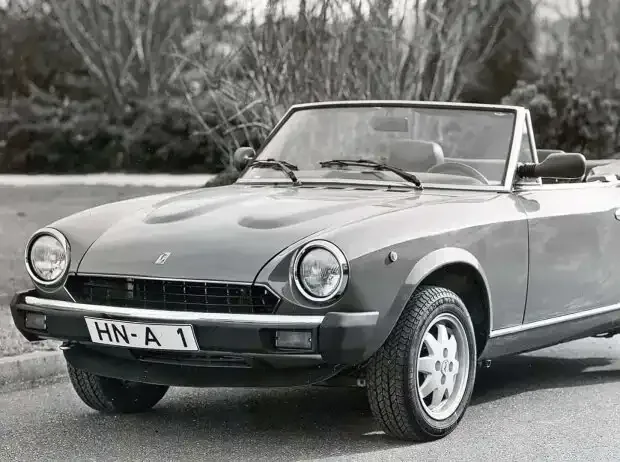
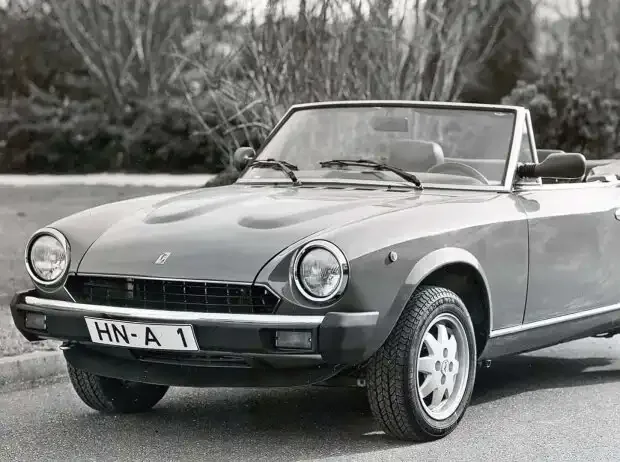
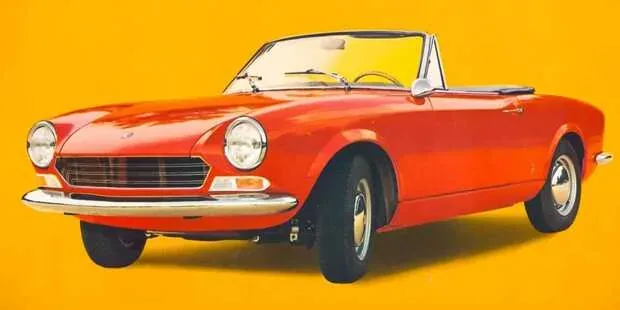
The Fiat 124 Sport Spider, presented in 1966 at the Turin Motor Show, also targets the taste of American customers from the start. In contrast to the 124 sedan, also introduced in 1966, the appearance is significantly more exciting. The body design was created at Pininfarina under the direction of Tom Tjaarda. The American with Dutch roots gave the 2+2 seater a distinctive front with a flat-sloping hood, framed by pronounced fenders with round headlights.
The elegant hip curve of the rear fenders and the crease to the trunk edge are also unmistakable. Pininfarina also took over the production of the bodies, which were completed at Fiat’s Turin-Mirafiori plant. The chassis, including independent front suspension and rear solid axle, comes from the Fiat 124 sedan but is shortened by 14 centimeters and also reinforced. A torque tube transmits power between the gearbox and differential.
The engine is a design by former Ferrari technician Aurelio Lampredi. The four-cylinder has an aluminum cylinder head. The two overhead camshafts are driven in a revolutionary way for the time, namely by a plastic toothed belt. 90 hp from just over 1.4 liters of displacement was impressive at the end of the 1960s. Also, a standard five-speed gearbox and disc brakes on all four wheels were anything but a given at that time.
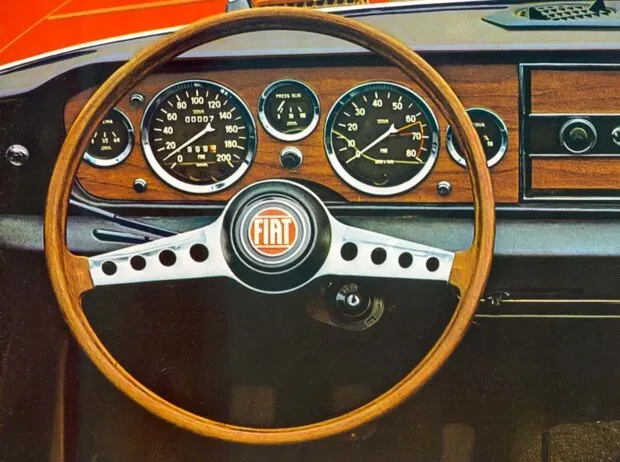
With up to 170 km/h, the approximately 930-kilogram Fiat 124 Sport Spider is one of the sportiest vehicles in its segment. The simple handling also delights both the public and the specialist press. The fabric roof can be opened within seconds with just a few moves. Behind the steering wheel with two sportily perforated metal spokes, five round instruments provide information about the most important operating data. The strategy pays off. Already from the first model generation AS (1966 to 1970), about two-thirds were sold in the USA.
Gradually more power and more modern technology
While the second series BS (1969 to 1970) was still being built, the visually slightly revised BS1 series (1970 to 1972) was already rolling off the production line. Features include the analog clock, the center console, changed taillights with reversing lights, side chrome trim strips, and the honeycomb radiator grille with a centrally placed brand emblem instead of the previously installed version with three chrome bars.
Photo series: 60 years of Fiat 124 Sport Spider
The brake system changed to a dual-circuit system increases safety as do headrests on the front seats and the revised rear axle, which is now guided by four longitudinal arms and a Panhard rod.
In 1971, the engine of the Fiat 124 Sport Spider received more displacement. The 1.6-liter four-cylinder now produces an impressive 110 hp with two double downdraft carburetors (Weber or Solex). The slightly larger engine requires a modification of the hood. Actually, a hood scoop is only needed on the left side, where the larger, almost rectangular air filter is placed. For symmetry reasons, however, the hood receives two distinctive bulges. About three-quarters of the BS1 series were even sold in the USA, here with a restricted engine due to stricter emission laws.
Just one year later, the engine was changed again. With slightly smaller displacement and only one double carburetor, the 1.6-liter four-cylinder produces only 108 hp in combination with the five-speed gearbox or 104 hp if the vehicle is equipped with the four-speed gearbox. The series code is now CS.
After less than a year of production, the Fiat 124 Sport Spider received a new engine again with the CS1 series, the 1.8-liter four-cylinder from the then-new Fiat 132. The power increases, as with the European version, to 118 hp with a five-speed gearbox. Also in 1972, Fiat presented an Abarth version of the Spider, designed as a homologation model for rally sport (code CSA).
The 1.8-liter engine produces 128 hp, and an independent suspension replaces the rear solid axle. The fabric roof is replaced by a plastic hardtop. The engine and trunk hoods are made of fiberglass, and the doors are made of aluminum. About 1,000 units were produced within three years.
Read more Tech3 boss Steiner: Liberty can take MotoGP to the next level
End in Europe, boom in the USA
But despite the now stronger engine, the Spider sold only sluggishly in Europe. From autumn 1974, the convertible was officially offered only in the USA. External features of the Fiat 124 Spider America are mainly the oversized bumpers, also due to US regulations. A three-speed automatic was offered as an option.
The 1.8-liter engine had to be adapted to local emission standards and unleaded gasoline. As a result, power initially dropped to 93 hp. From 1976, a complex emission control system was necessary, which cost another six hp. From July 1978, a two-liter engine with 83 hp in carburetor version (CS2) or 102 hp with injection (CS0) powered the Spider. A turbocharged variant produced 120 hp but was sold only about 700 times.
After a few units were initially sold in Europe in 1981 as Fiat 124 Spider 2000 i.e. with fuel injection and catalytic converter, the convertible officially returned to the old continent in 1982. The new name Pininfarina Spidereuropa (DS0) reveals that Pininfarina now takes over complete production. Without a catalytic converter, the two-liter engine produces 105 hp; with emission control (for example in Germany), 103 hp remain.
In April 1982, the Pininfarina Spidereuropa Volumex complemented the range. A mechanical Roots supercharger increased power to 135 hp. Due to the now achievable top speed of 190 km/h, Pininfarina equipped it with a sports chassis and wide tires on special alloy wheels. Other visual features of the Volumex model are fender flares, leather-covered interior, Abarth leather steering wheel, and boost pressure gauge in the center console. Price in Italy: 14 million lire.
About 500 units were produced by Pininfarina exclusively in red or black. Most of them went to Germany at a base price of 29,600 Deutsche Mark. Production of the Spider ended definitively in 1985. Within 19 years, about 198,000 units were produced (including the CSA series). More than 80 percent went to the USA. Between 2016 and 2020, there was again a Fiat 124 Spider, now based on the Mazda MX-5.
The Fiat 124 Sport Spider in motorsport
With the introduction of the BS1 series, the Fiat 124 Sport Spider also became interesting for rally drivers. With strong support from Fiat’s customer racing department “Squadra Clienti,” the Spider soon established itself alongside the sedan version of the 124 as a serious contender for victories. In addition to the power increase to up to 155 hp at 7,500 rpm, a closely spaced Colotti racing gearbox, limited-slip differential, and lightweight parts form an irresistible combination. Where allowed, doors and hoods made of plastic also reduce the weight to less than 900 kilograms.
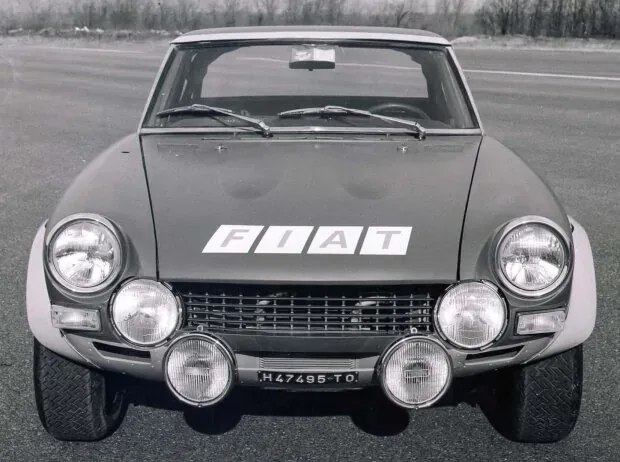
The competition respectfully calls the Fiat 124 Sport Spider, which always competes with the roof closed, the “ragtop bomber.” Only from 1971 was there a plastic hardtop. Already in 1970, Alcide Paganelli and co-driver Ninni Russo won the title in the Italian Rally Championship with the Fiat 124 Sport Spider. In January 1971, Håkan Lindberg and co-driver Sölve Andreasson caused a stir with seventh place at the famous Monte Carlo Rally.
One year later, Lindberg (now with co-pilot Helmut Eisendle) even won the Acropolis Rally and the Austrian Alpine Rally. At the end of the year, Fiat took second place in the manufacturers’ championship behind the in-house competition from Lancia. Also in 1972, Fiat driver Raffaele Pinto became European Rally Champion. At the start of the 1973 season, the Fiat Abarth 124 Rally in Group 4 version, initially with 165 hp and later up to 210 hp, replaced the 1600 Spider on the world’s rally stages.
The Fiat 124 Sport Spider today
European versions of the Fiat 124 Sport Spider from the first series are now rare classics. Much more common are examples reimported from the USA. In Germany, the heritage of the charismatic convertible is preserved mainly by the Fiat 124 Spider Club Deutschland e.V. (www.fiat-spider.de) and the Fiat 124 Spider Club e.V. (www.fiatspider.de).
These legends also turn 60 now:
BMW 02 (1966-1977): The predecessor of the 3 Series turns 60
60 years of Alfa Romeo Spider: At the beginning was the Duetto
Read more IndyCar Portland 2026 FT1: Mick Schumacher in Top 20 without testing