







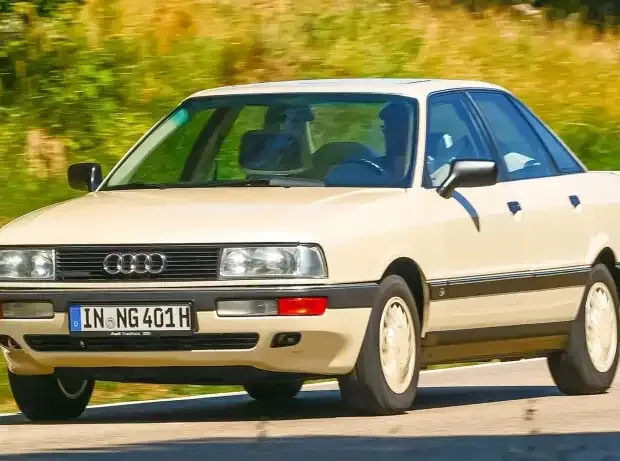
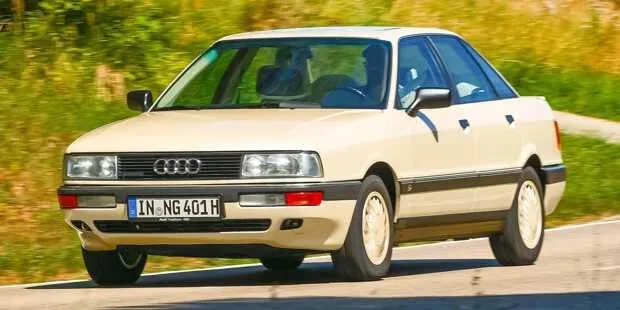
(Motorsport-Total.com/Motor1) – We live in an era where classic cars no longer look like such. Proof: The vehicle in the picture above. In 1986, Audi launched the then-new 80 of the B3 series. So, 40 years ago. By now, all B3s receive the coveted H license plate. But the survivors are far from being old junk.
Read more Sainz expects chaos in Madrid: «We will see safety cars and red flags»
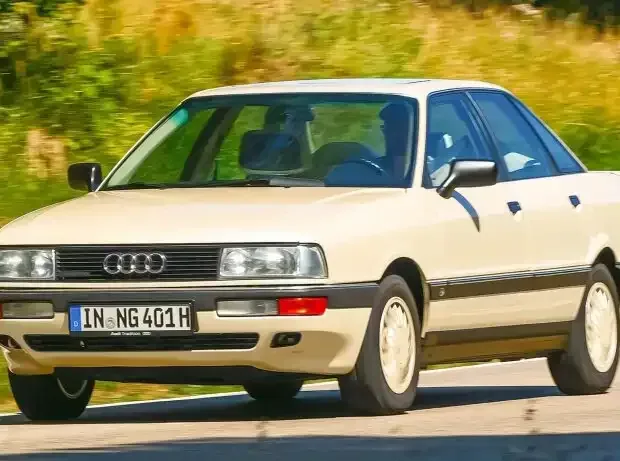
“Wait a minute!” brand experts will shout by now. That’s not an 80, but a 90! Correct. Audi Tradition, the brand’s classic department, gave us an upgrade. Which we of course do not say no to, because in 2026 the five-cylinder at Audi also celebrates a milestone birthday. It turns 50 there, celebrated by a special exhibition in Ingolstadt.
And me behind the wheel of the 90 quattro B3. A car from the Piëch era at Audi, when Ferdinand Karl wanted to blow the mustiness out of the model range. No more boring conservative cars, but modern cars for modern people. Garnished with motorsport involvement. The over 700 hp Audi 90 quattro IMSA GTO swept the USA in 1989 and is today a cult object in every video game.
Premium 80 as an answer to BMW and Mercedes
“My” 90 is somewhat tamer then. In May 1987, the new Audi 90 was launched after Ingolstadt had first put five-cylinder engines under the hood of the 80 three years earlier. Reasons for this were provided by the German competition: BMW had already installed six-cylinder engines in the 3 Series at the end of the 1970s, which mutated into the E30 in 1982. At the same time, Mercedes pushed the 190 into the 4.40-meter mid-size class.
That was not enough: Since 1981, parent company VW also offered the Santana as a five-cylinder. Although only with moderate success, Audi felt compelled to act. In 1982, Audi first introduced the five-cylinder in the 80 quattro and 80 CD, before the 90 marked the luxury variant in 1984. Around 110,000 units of the first 90 generation (a Super 90 already existed from 1966 to 1971) were sold in four years. A sufficient reason to launch a successor.
Audi describes it in the 1987 brochure as follows: “With the new Audi 90, the latest state of the art in the German compact class is presented.” Yes, you read that right: compact class. And further: “Independently aesthetic in design with exceptionally good aerodynamics […] And that with generous space.”
More looks, higher price
Independent? Of course, every observer sees the Audi 80 base. Spruced up with some chrome, the continuous rear panel, and a bumper with indicators and fog lights in the style of the Porsche 928. Both the panel and bumper were later often retrofitted as accessories by Audi 80 owners.
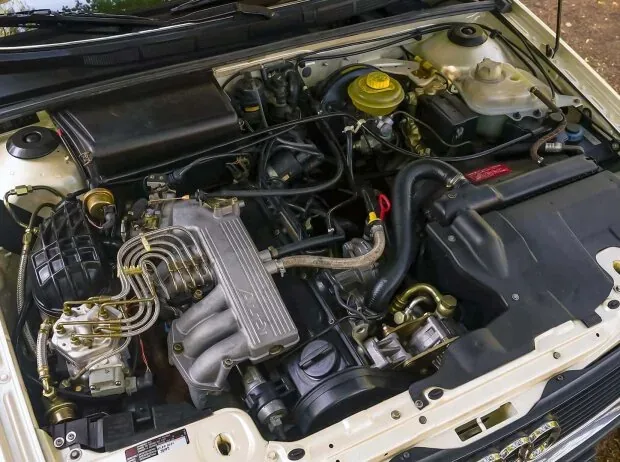
In any case, this is enough for Audi to charge almost 4,500 marks more for the cheapest 90 B3 compared to an 80. Not mass-produced, rather a prestige object for the brand and customers. The 90 accounts for only eleven percent of the B3, as Kevin Thiel writes in his standard work on the Audi 80.
The model range of the second Audi 90 generation is as follows: 2.0 E with 115 hp, 2.3 E with 136 hp and optional all-wheel drive, as well as the top five-cylinder quattro 20V or 20V with 170 hp. Very rare remains the only four-cylinder in the 90, the 1.6-liter turbo diesel with 80 hp.
Read more Driver ratings Monza: Several 1s, but also a 6
Everything used to be smaller
I am driving the 2.3-liter five-cylinder. Built in 1987 in “Pearl White” (L0A9), 4.39 meters long plus 90 sport package with rear spoiler. Base price in February 1988: 46,200 DM with all-wheel drive. Without it, it would be almost 10,000 marks less. My first impression: How small the mid-size class of that time looks today. The Audi is only 1.69 meters wide and 1.37 meters high. A true blessing in the age of aircraft carrier SUVs.
However, the B3 is not as spacious as the brochure of the time proclaimed. I still remember well how my mother looked astonished into the small trunk of an Audi 80 workshop car. She was used to a VW Passat Variant. Folding rear seats are not available in the B3 due to the vertically arranged fuel tank directly behind the bench, 453 liters of luggage fit into the rugged rear compartment with the massive trunk lid.
A case for two
And even inside, you don’t feel spaciousness. Four adults in this sedan? Rather not. Also due to the only hinted rear headrests. My spontaneous thought: A 2+2 with four doors. No wonder the B3 series was almost never seen as a taxi during its lifetime. Audi had indeed planned a station wagon, but only realized it later with the B4. A true eye-catcher, however, is the white leather interior, which was really expensive at the time. My ears like the solid closing sound of the doors.
Photo series: Time travel in the Audi 90: The B3 classic with all-wheel drive and luxury in detail
The specialist press at the time criticized the strong heating of the galvanized body due to the rounded glass surfaces. They were right, as I quickly notice at just under 30 degrees outside temperature. My 90 even has air conditioning on board, unfortunately it is empty. So windows down, anyway ideal to listen to the five-cylinder. Inside, the 136 hp remain discreetly in the background, the 90 is not supposed to be a wild sports car. Only in the fresh air does the engine spin up into Röhrl-like sound worlds.
Noticeable besides the slightly right-shifted steering wheel towards the driver is one fact: This car does not feel 40 years old. The five-cylinder spins smoothly from 1,500 rpm even in fifth gear, although the gearbox does not reach BMW precision. For that, the 1,220-kilogram Audi calmly cuts through corners thanks to all-wheel drive. Meanwhile, my photographer is bringing another vehicle back to Ingolstadt. And I think to myself: Take your time. Lots of time!
Exactly 141,809 vehicles will Audi build by 1991, of which 26,300 with all-wheel drive. Then it’s over with the 90, the massively revised 80 B4 gets five- and six-cylinder engines without a separate number on the rear. A rare digit, the 90. Audi builds almost ten times as many of the bourgeois 80 B3, namely 1.3 million units.
More Audi classics in the test report:
Audi 100 CS quattro (1987) in the test report: The Schanzer
Audi 50 (1977) in the test report: Solo for Polo