








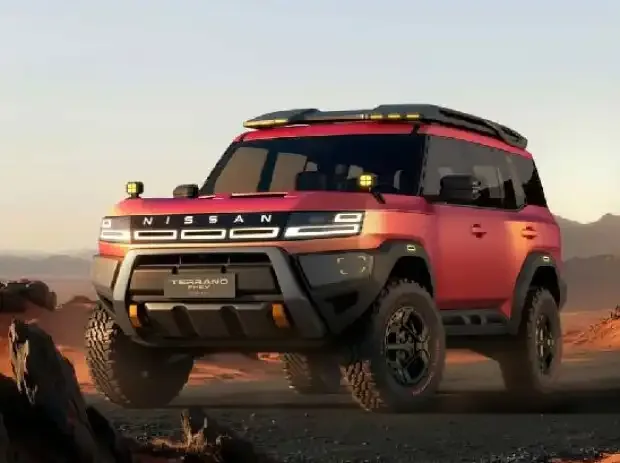
(Motorsport-Total.com/Motor1) – A famous model name from the 1990s and 2000s returns from retirement. While the Terrano doesn’t have the same charisma, millennials will remember the name – a reminiscence of times when ladder-frame SUVs were more the rule than the exception.
Read more Coulthard: Miami will hardly show the effects of the changes
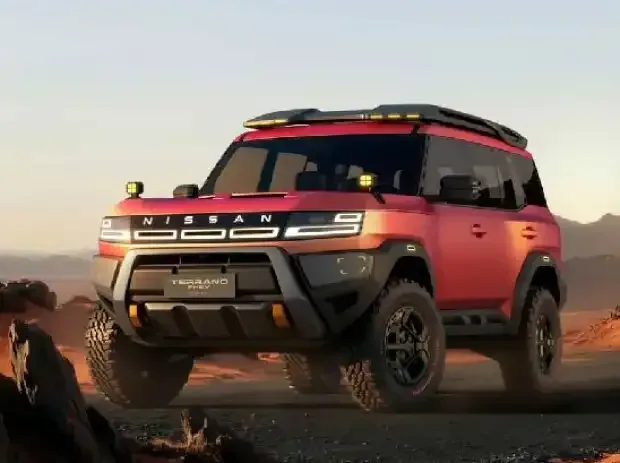
While technical data remains largely in the dark, the impression clearly points to a classic ladder-frame construction. Incidentally, “retirement” is not entirely correct for the Terrano: in some markets, such as Russia, Nissan offered a revised Dacia Duster under this name.
Nissan at least confirms a plug-in hybrid powertrain, suggesting a technical kinship with the Frontier Pro PHEV introduced last year. The electrified pick-up is the brand’s first true plug-in hybrid model – because the e-Power models are, strictly speaking, electric cars with an internal combustion engine as a range extender. If the SUV is based on the same platform as the pick-up, a 1.5-liter turbo petrol engine will be used, combined with an electric motor integrated into the transmission.
In the Frontier Pro PHEV, this system delivers 402 hp (296 kW) system output and 800 Nm of torque. Thanks to a 33 kWh battery pack, the pick-up drives 135 km purely electrically – however, according to the comparatively generous CLTC test cycle. Corresponding WLTP and EPA values would be significantly lower.
Although referred to as a concept, the car already appears so close to production that it could be sold to customers with few changes. In fact, the production version of the Terrano is expected to follow soon. Nissan plans to launch the raised SUV in China within a year. In addition, “selected global markets” are also expected to receive the all-terrain vehicle – however, an introduction in North America or Europe is considered very unlikely.
Photo gallery: Nissan Terrano Concept (2026)
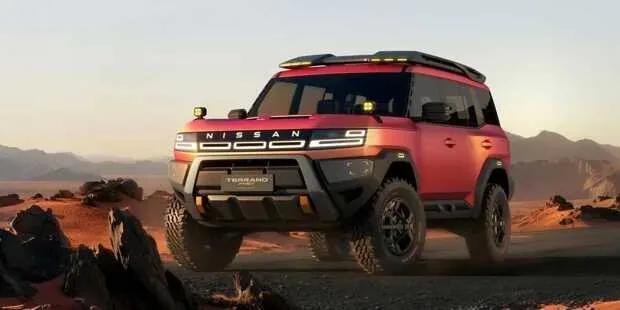
Nissan does not comment on the size, but visually the Terrano appears smaller than the Armada/Patrol and at the same time significantly larger than the original Terrano, which was a compact SUV. An introduction to the USA would make little sense because it could interfere with the revived Xterra there.
Read more MotoGP Test Jerez: Ogura Fastest — Innovations at Ducati and Aprilia
The Terrano is to be manufactured in China with the support of local joint venture partner Dongfeng. Visually, it has everything that characterizes a “go-anywhere” SUV: angular wheel arches, chunky tires, robust underbody protection elements, and auxiliary lights. For better approach and departure angles, Nissan has shortened the bumper corners, and there is also a side ladder to access the roof rack.
The largely exposed spare wheel at the rear suggests a side-hinged access to the cargo area – whether this will remain in the production version is open. Nissan has not yet shown an interior photo. However, if the Terrano is indeed based on the Frontier Pro PHEV, the pick-up’s cabin should not fundamentally change for the SUV sibling model.
Nissan’s restructuring plan is visibly gaining momentum – and bringing new products to market is exactly what the company needs now. With Dongfeng, Nissan can accelerate development and reduce costs to become more competitive again after some difficult years. The angular SUV has clear recognizable potential – which makes it a shame that it will probably only be offered in a few regions, with a focus on the Chinese market.
The return of Terrano and Xterra means new entries in a shrinking portfolio: globally, Nissan is cutting 11 underperforming models from its lineup. We are excited about this new wave of products – including an electric Juke, the Rogue E-Power, a Skyline sedan (in the USA with an Infiniti emblem), and of course, the next GT-R.
More from Nissan:
Nissan Z (2026): European dream gets a facelift in the USA
Nissan Micra Review: Electric small car with 416 km range