






(Motorsport-Total.com/Motor1) – Late you come – but you come! When Friedrich Schiller wrote these words in 1799, he certainly did not think of an automobile that would motorize half of Germany about 180 years later. But anyone moving around in a Mercedes 240 D of the 123 series plans carefully. Traveling instead of racing is the motto here. For the 50th birthday of the 123 series, we got behind the wheel.
Read more Bernd Mayländer: This is how the modern safety car system was created
This automobile inspires great confidence from the very first moment: After the press premiere of the new Mercedes sedans of the 123 series in January 1976 in Bandol, southern France, and even before the official market launch of this upper mid-range series, the first annual production is already sold out. Delivery times sometimes amount to up to three years.
By January 1986, an incredible number of 2.7 million W 123 rolled off the production line. At times, the W 123 topped the German registration statistics. Practically every German comes into contact with the Mercedes mid-range class. The diligent middle-class citizen saves up for his 200er and forgoes extras. Those who are wealthy but prefer to wear the mink inside buy a 280 E or 280 CE with full equipment; affluent family fathers reach for the station wagon called T-model from 1977 onwards.
Taxi and bestseller
Or you get driven in a 123 diesel: 50 years ago, 75 percent of all taxis in the Federal Republic were Mercedes, as the company proudly presents in its taxi brochure for the W 123.
“Generation Golf” is the name of a bestseller; it could just as well be called “Generation W 123.” This Mercedes is still present in the streets well into the 1990s. Afterwards, it migrates to Africa or the Balkans. The author of these lines was chauffeured through Albania in 2002 in a no longer really fresh 220 D. Mercedes on every corner and the feeling: This diesel will get you anywhere. No wonder the 123 is now one of the most popular classic cars.
Role model S-Class
But back to 1976: The W 123 reflects many concept and style elements of the then S-Class (W 116). According to Mercedes, it was also supposed to have “certain similarities” with the predecessor Strich-Acht. A high-quality finish is part of it, as well as the excellent chassis tuning, the generous sense of space inside, a newly developed safety steering column, and seatbelt locks mounted directly on the seat fittings. From 1980, Mercedes already offered the anti-lock braking system ABS in the 123 series and from 1982 the driver airbag. Both, of course, at enormous extra costs.
Mercedes distributed an 89-page press kit to journalists in Bandol. And it was eagerly read:
“Evolution to measure” is the headline over the first test report by the colleagues from “auto motor und sport” in issue 3/1976. The verdict is clear: Mercedes succeeded with the new W 123 “above average well.” The article names “well-dosed progress, targeted further development, and uncompromising commitment to quality” as decisive factors.
Correctly recognized. The Mercedes customer is often named like a Mercedes board member: Heinz Schmidt. And the Heinz Schmidts of this world have little interest in experiments. Their 123 may not be cheap (starting at 18,400 DM in January 1976), but it is valuable and durable. Almost like the rustic wall unit in the living room. Not a design highlight, but can be inherited if needed.
A wide variety
After the premiere of the W 123, about a year later in spring 1977, the coupe (C 123) followed. In September 1977, the Mercedes-Benz T-model (S 123) was introduced for the first time in this series. Other body versions include long sedans (V 123) and partially bodied chassis (F 123).
By far the most popular is the sedan with 2,375,440 units. The most frequently produced 123 is the sedan type 240 D with 448,986 vehicles. The rarest is the coupe 280 C with 3,704 vehicles.
The engine program of the 123 series ranges from the 200 D, which is very popular as a taxi, to the innovative and agile 300 D turbo diesel, up to the 280 E with its 185 hp inline six-cylinder.
In 1982, Mercedes-Benz offered a bivalent engine from the factory that could use LPG and gasoline. And in experiments, vehicles ran on hydrogen as well as battery-electric drive. Thus, the 123 series pointed to the future of drive technology already about half a century ago.
Read more Type 01: The new Jaguar officially appears less camouflaged
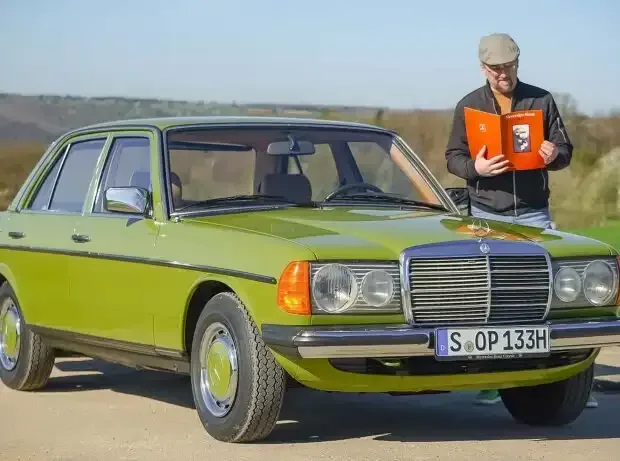
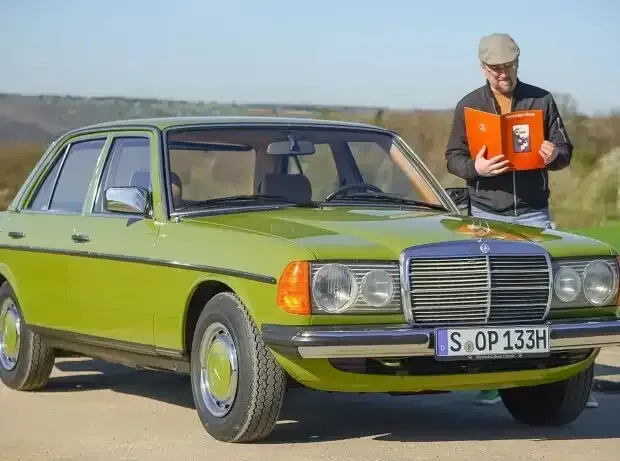
But the vehicle I am sitting in for my drive has an old acquaintance under its star-studded hood: OM 616 aka 240 D with the 72 hp that the “oil engine” (hence OM) was given from August 1978. Typical for that time is the farmer green paint and the double headlights called “ox eyes,” which only disappeared with the model update in 1982. The sedan is 4.72 meters long, 1.79 meters wide, with a 500-liter trunk.
Photo series: Mercedes 240 D (W 123) in the test report: Power for the farmer
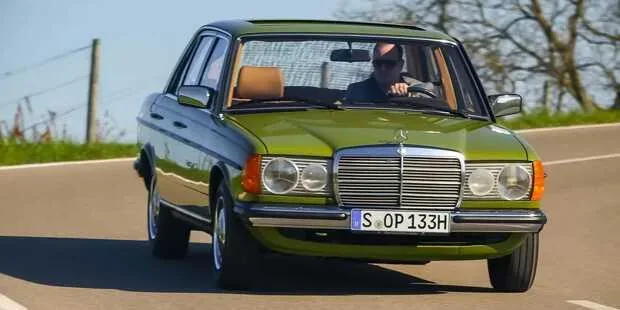
No wonder the station wagon was still rare in the taxi scene back then. There is more than enough space in the sedan. My photographer lounges on the sofa back seat, I sit behind the huge steering wheel (power steering was only standard from 1982) on a generous armchair. The doors close with a solid “wupp.” Instruction on operation? Not necessary, after all, there is not much to operate.
Turn the ignition key and off we go, the engine is still warm and spares me the obligatory pre-glow. (For everyone under 30: No, not the one with alcohol on Friday night!) There it is, the omnipresent and yet so relaxing knocking of the four-cylinder.
A hint of tractor or Unimog always lingers. But also the promise to always arrive. Under the premise of car hiking. I release the foot-operated handbrake by pulling the lever. OM 616 soon makes it clear: Don’t rush me! Especially since in my case a four-speed automatic transmission is also involved. It takes 24.7 seconds to reach 100 km/h with it. Experienced diesel Daimler drivers know: Always stay in flow. This is not a 100-meter sprint, but a marathon.
Strength lies in calmness
How aptly the Mercedes taxi brochure from December 1976 describes it: “In your Mercedes-Benz taxi, passengers are surrounded by an atmosphere of solidity and calm. All the hustle and bustle of road traffic stays outside …” You can almost hear the clicking of the mechanical taximeters from back then. Under “solidity” is a photo of the W 123 in the encyclopedia.
Calm, however, is relative; at the latest on the highway, conversation is only possible with difficulty. Overtaking too, although at least a hint of acceleration is noticeable. But one should drive with foresight. Owners of a 200 D (31 seconds to 100!) have the ultimate subscription for the right lane. Also because the Swabian steel 240 D weighs around 1.4 tons, it’s game over at 138 km/h.
Sportiness only comes involuntarily. “The seats support the bodies of the occupants better during cornering,” noted Mercedes board member Scherenberg at the 123 presentation. He seems to have been an optimist. The curve-240 D equation definitely does not work. It is not a corner thief. But a solid Swabian who steals nothing.
Although: The W 123 could even do sport. In 1977, the series moved into the spotlight of international motorsport: At the London-Sydney long-distance rally, a grueling race over six and a half weeks and 30,000 kilometers across Europe, Asia, and Australia, two 280 E prevailed against strong competition. The winning car is now in the Mercedes Museum.
But back to the 240 D. Its automatic acts according to the motto of former Federal President Roman Herzog: A jolt must go through Germany. Noise. RPM, more RPM, noise, clonk. Accompanied by a distinctive diesel flag from the exhaust. “My” car has just 169,000 kilometers on the clock. For the 123 diesel, that is considered just broken in. Three times that is not the exception but usually the rule. A 240 D still reaches its destination even if three screwdrivers are sunk in the sills by TÜV inspectors.
Maybe buying a Mercedes 240 D is not a bad idea. Spare parts are plentiful, although not for every detail anymore; the diesels, which are slow from today’s TDI perspective, have a manageable fan base. Also for this reason, good 200 D or 240 D are not too expensive. And an oasis of deceleration in times of hectic news flow. 100 to zero. That should definitely have been in the press kit in 1976.
Read more Skoda Epiq (2026): This is what the 26,000-euro crossover looks like
Mercedes classics in the test report:
Mercedes 280 TE (1977-1985) in the test report: King station wagon the first
Mercedes Simplex 28/32 hp (1904) in the test report: Modern Methuselah